

n
Maintaining good oral health is essential for overall well-being, but many people worry about unexpected dental bills. Understanding how the dental cost nhs uk system operates ensures you receive necessary dental care without surprise expenses.
nn
The National Health Service operates a banded payment structure across England that caps what dentists can charge for clinically necessary treatments. In this detailed 2026 guide, you will learn the exact prices for each treatment band, who qualifies for 100% free NHS dental care, how the Low Income Scheme works, and how to find an NHS practice currently accepting patients.
nnnn
 n
nnn
1. Dental Cost NHS UK: Current Band Charges for 2026
nn
In England, NHS dental care is divided into three clear price tiers, known as bands. The standard dental cost nhs uk structure guarantees that you pay a single fixed fee for a complete course of treatment within a specific band, regardless of how many individual visits or dental x-rays you need.
nn
According to official NHS dental treatment charge standards, the current fixed charges across England are:
n
- n
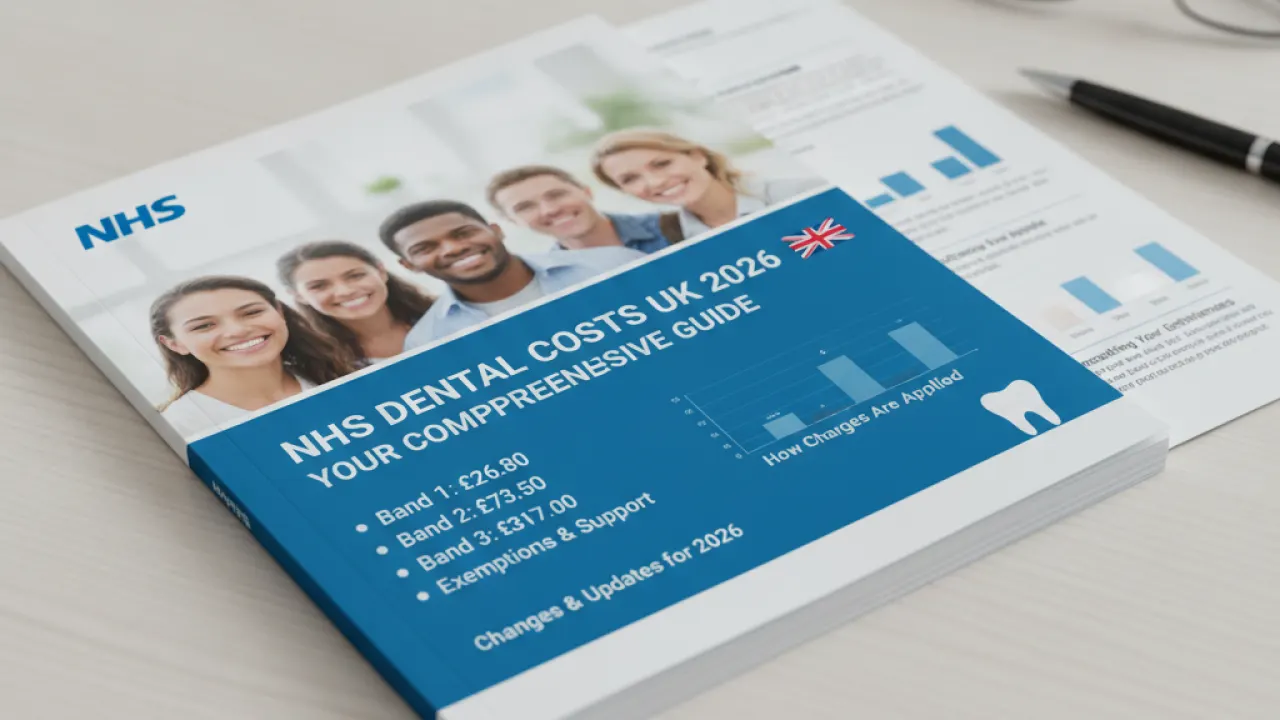
- Band 1: £26.80. Covers basic examinations, diagnosis, x-rays, scaling and polishing if clinically required, and prevention advice.
- Band 2: £73.50. Covers everything in Band 1, plus restorative work such as fillings, root canal treatments, and tooth extractions.
- Band 3: £319.10. Covers everything in Bands 1 and 2, plus complex laboratory-made prosthetics including crowns, dentures, and bridges.
- Urgent Care: £26.80. Covers emergency consultations, temporary fillings, pain relief, or emergency extractions to stabilize acute dental trauma.
n
n
n
n
nn
| NHS Treatment Band | Current Fixed Cost | Key Treatments Included |
|---|---|---|
| Band 1 | £26.80 | Full examination, digital x-rays, clinical scale & polish, oral cancer check |
| Band 2 | £73.50 | Amalgam or composite fillings, root canal therapy, tooth extractions |
| Band 3 | £319.10 | Crowns, partial or full acrylic dentures, bridges, custom inlays |
| Urgent Treatment | £26.80 | Immediate emergency pain relief, temporary fillings, drain abscess |
nn
 n
nnn
2. Band 1: Examinations, Diagnosis, and Basic Care
nn
Band 1 represents the standard entry point for regular dental checkups. When you visit your NHS dentist for a routine consultation, the £26.80 fee covers everything needed to assess your oral health.
nn
During a Band 1 appointment, your dentist examines your teeth, gums, tongue, and soft mouth tissues for signs of decay, gum disease, or oral cancer. If your dentist suspects hidden decay between teeth or under older restorations, they will take bitewing x-rays, which are fully included in the £26.80 price.
nn
A common question regarding dental cost nhs uk is whether cleaning is included. Under NHS regulations, a scale and polish is included in Band 1 only if the dentist decides it is clinically necessary to treat active gum disease. If you simply desire cosmetic cleaning to polish away tea or coffee stains without clinical necessity, your dentist may offer a private hygienist appointment instead.
nn
3. Band 2: Fillings, Root Canals, and Extractions
nn
If your initial checkup reveals tooth decay, infections, or teeth that cannot be saved, your treatment moves into Band 2. The total charge for Band 2 is £73.50.
nn
Band 2 replaces the Band 1 charge rather than adding to it. For example, if you attend a checkup (£26.80) and your dentist finds two cavities requiring fillings, you pay a total of £73.50 for the entire course of treatment, not £26.80 plus £73.50.
nn
Furthermore, the £73.50 fee covers all necessary Band 2 treatments identified in that treatment plan. If you require three separate fillings and one extraction, the entire package costs £73.50. Standard filling materials on the NHS include silver amalgam for back molar teeth and tooth-colored composite resin for front biting teeth where appearance is clinically important.
nn
 n
nnn
4. Band 3: Crowns, Dentures, and Complex Bridges
nn
Band 3 represents the highest payment tier in the NHS dental pricing system, carrying a fixed charge of £319.10. This band applies whenever your treatment requires custom laboratory fabrications.
nn
Common procedures falling under Band 3 include:
n
- n
- Dental crowns: Metal, porcelain-bonded, or ceramic crowns designed to protect heavily damaged or root-treated teeth.
- Dentures: Full or partial acrylic dentures designed to replace multiple missing teeth and restore chewing ability.
- Dental bridges: Fixed artificial teeth anchored to neighboring healthy teeth.
- Custom mouthguards: Occlusal splints prescribed to prevent severe tooth wear caused by night-time teeth grinding (bruxism).
- Orthodontic appliances: Medically necessary braces approved for children or young adults with severe developmental malocclusion.
n
n
n
n
n
nn
Before beginning any Band 3 work, your NHS dentist is legally required to provide a written treatment plan (Form FP17DC) detailing all planned procedures and confirming the £319.10 cost. Having an emergency savings fund ensures unexpected Band 3 dental bills do not disrupt your monthly household budget.
nn
5. Urgent Treatment Band and Emergency Out-of-Hours Care
nn
Severe toothaches, facial swelling, or broken teeth from accidents require immediate attention. The NHS provides an Urgent Treatment band priced at £26.80.
nn
This fee covers emergency consultations, diagnostic x-rays, pain-relieving medications, temporary dressings, draining of dental abscesses, or emergency tooth extractions. The primary goal of urgent treatment is to relieve acute pain and stabilize your condition.
nn
If you require emergency care outside normal clinic hours, call NHS 111. The triage team can connect you with an out-of-hours emergency dental hub in your area. If your emergency visit reveals that you need permanent complex treatment (such as a full root canal or permanent crown), that follow-up work will be scheduled as a new standard course of treatment under Band 2 or Band 3.
nn
 n
nnn
6. Who Qualifies for 100% Free NHS Dental Treatment?
nn
Millions of UK residents are entirely exempt from paying any dental cost nhs uk charges. You are entitled to completely free NHS dental care if, at the time your treatment begins, you meet any of the following statutory criteria:
n
- n
- Age criteria: You are under 18 years of age, or under 19 years old and enrolled in full-time qualifying education.
- Pregnancy and maternity: You are pregnant or have had a baby in the last 12 months (you must show a valid Maternity Exemption Certificate or Mat B1 form).
- Hospital inpatient: You are currently staying in an NHS hospital and receiving dental care provided by the hospital dental service.
- NHS trust clinics: You receive treatment from an NHS hospital dental service (although you may still pay standard charges for custom dentures or crowns).
n
n
n
n
nn
You must sign a declaration on the official NHS PR form confirming your exemption before treatment starts. NHS Business Services Authority (NHSBSA) cross-checks declarations against digital tax and benefit databases. Falsely claiming free dental care triggers an automatic £100 penalty charge notice plus the original dental fee.
nn
7. Qualifying Benefits: Universal Credit and Pension Credit Rules
nn
Receiving certain state benefits provides free NHS dental treatment for you and your partner. However, benefit exemption rules contain strict conditions that applicants must understand to avoid penalty fines.
nn
Universal Credit Dental Exemption
n
You qualify for free NHS dental care under Universal Credit only if your net earnings during your most recent assessment period meet government thresholds. You qualify if your take-home pay was £435 or less (if your Universal Credit claim does not include a child or disability element), or £935 or less (if your claim includes children or limited capability for work). Learn how monthly earnings are calculated in our complete guide on how to apply for Universal Credit.
nn
Pension Credit and Other Benefits
n
You automatically qualify for 100% free dental treatment if you receive the Guarantee Credit element of Pension Credit. For details on how Pension Credit supports retirement living, see our guide to State Pension payment rates and qualifying rules. Other qualifying benefits include income-based Jobseeker’s Allowance, income-related Employment and Support Allowance, and Income Support.
nn
 n
nnn
8. The NHS Low Income Scheme: HC2 and HC3 Certificates
nn
If you are on a modest income but do not receive a passported qualifying benefit, you can still obtain support through the NHS Low Income Scheme (LIS). This scheme helps students, part-time workers, and unpaid carers manage healthcare costs.
nn
To apply, complete form HC1 (available online or by post from Jobcentre Plus offices). The NHS calculates your requirements against your household earnings and capital. If your savings sit below £16,000 (or £23,250 if you live permanently in a care home), you may be awarded one of two certificates:
n
- n
- HC2 Certificate: Grants 100% free NHS dental treatment, free NHS prescriptions, free eye tests, and help with optical vouchers and hospital travel costs.
- HC3 Certificate: Grants partial assistance toward your dental cost nhs uk bill, setting a reduced contribution limit on your treatment band.
n
n
nn
Unpaid family carers juggling part-time work often use the Low Income Scheme to protect their oral health. Read our complete guide to Carer Allowance rules and qualifying support to see how low-income benefits work together.
nn
9. Dental Charges Across the UK: England, Scotland, Wales, and NI
nn
Healthcare policy is devolved across the UK nations, meaning dental charges differ significantly depending on where you reside:
n
- n
- Scotland: Routine dental checkups are 100% free for all registered NHS patients regardless of age or income. Restorative treatments are charged at 80% of the NHS fee structure, with costs capped at a maximum of £384 per course of treatment.
- Wales: The Welsh government streamlined dental charges into a revised band system. Routine Band 1 checkups cost £20.00, Band 2 treatments cost £60.00, and Band 3 prosthetics cost £260.00. Urgent dental appointments in Wales cost £30.00.
- Northern Ireland: Patients pay 80% of the government dental fee scale for standard clinical care, up to a maximum cap of £384 per treatment plan. Routine checkups carry a modest subsidized charge.
n
n
n
nn
| Region | Checkup (Band 1) | Fillings (Band 2) | Crowns / Dentures (Band 3) |
|---|---|---|---|
| England | £26.80 | £73.50 | £319.10 |
| Wales | £20.00 | £60.00 | £260.00 |
| Scotland | Free for all | 80% of cost (capped) | 80% of cost (capped at £384) |
| Northern Ireland | Subsidized checkup | 80% of cost (capped) | 80% of cost (capped at £384) |
nn
 n
nnn
10. NHS vs Private Dental Care: Cosmetic Restrictions and FP17DC Forms
nn
Many patients feel confused when a dentist offers a mix of NHS and private treatment options in the same chair. Understanding the distinction protects you from unnecessary expenditure.
nn
The NHS dental service only provides clinically necessary treatment to secure and maintain oral health. It does not fund purely cosmetic treatments. For example:
n
- n
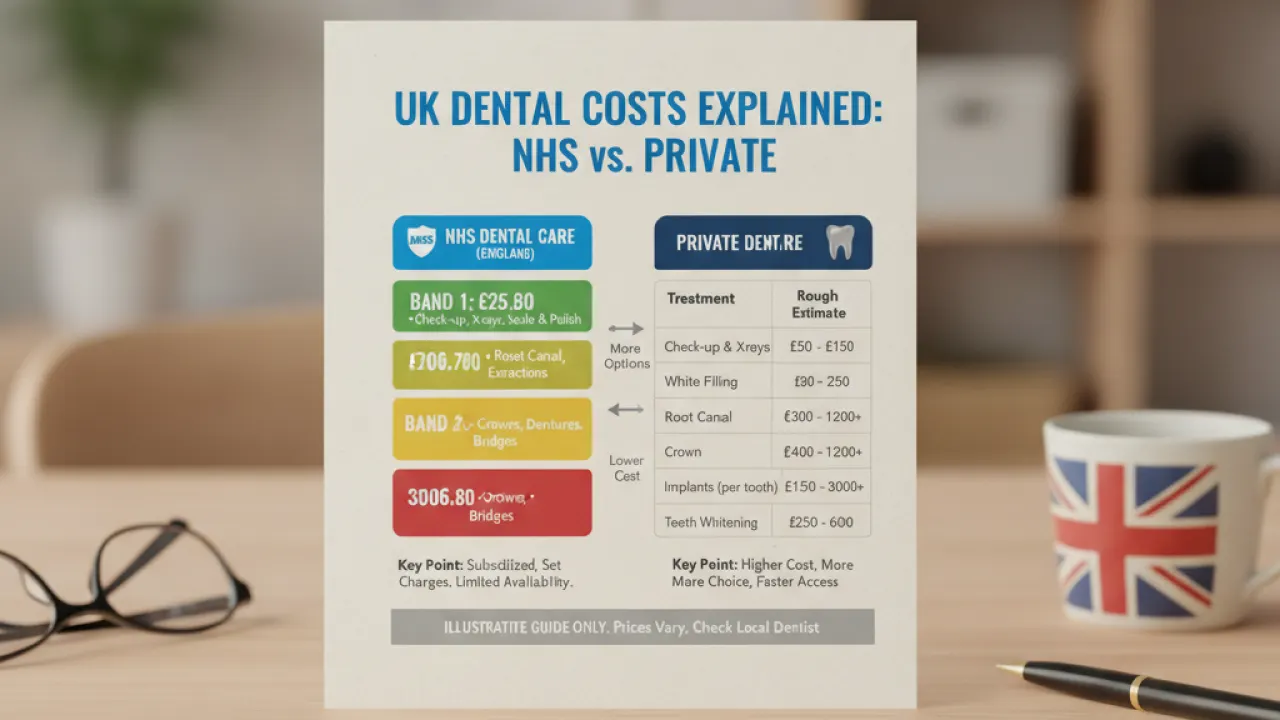
- White fillings on molars: The NHS provides tooth-colored composite fillings on front teeth, but uses durable silver amalgam for back chewing teeth. If you want white composite on a back molar for aesthetic reasons, the dentist can charge privately for that specific tooth.
- Teeth whitening: Bleaching and whitening treatments are considered purely cosmetic and are never funded on the NHS.
- Dental implants: Implants are rarely available on the NHS, except in extreme trauma or mouth cancer cases. Standard NHS care replaces missing teeth with acrylic dentures or bridges under Band 3 (£319.10).
n
n
n
nn
Your dentist can provide private treatments alongside NHS care, but they must never force you to accept private options if a clinically effective NHS alternative exists. Always insist on receiving form FP17DC before treatment begins, which outlines the exact breakdown between NHS and private elements.
nn
Every NHS dental claim is registered on the central NHS Compass portal. You have the right to request an itemized receipt showing the date of service, treatments delivered, and the exact NHS band fee billed. If you believe you were wrongly charged private rates for standard treatments like fillings or checkups, you can dispute the charge with the clinic practice manager or report the practice to your regional Integrated Care Board.
nn
11. How to Find an NHS Dentist Accepting New Patients
nn
Securing an appointment with an NHS dentist is one of the most common challenges facing UK households. Unlike registering with a GP surgery, you do not need to live in a clinic’s strict catchment area to receive NHS dental care.
nn
To locate an open NHS practice:
n
- n
- Use the NHS ‘Find a Dentist’ online tool: Enter your postcode on the NHS website to see local clinics and their current acceptance status.
- Call practices directly: Many clinics update their online status infrequently. Calling local clinics directly often reveals openings or cancellations that are not listed online.
- Join waiting lists: Ask to be placed on clinic cancellation or waiting lists. When a patient misses an appointment, clinics frequently offer same-week slots to waitlisted individuals.
- Contact your local Integrated Care Board (ICB): If you cannot find any dental clinic accepting NHS patients within a reasonable distance, contact your local ICB dental commissioner. They hold statutory duties to ensure adequate dental service access in your area.
- Community Dental Services (CDS): If you or a family member have complex physical disabilities, severe dementia, or extreme dental phobias requiring specialized clinical facilities or conscious sedation, ask your GP or high street dentist for a referral to your local Community Dental Service.
n
n
n
n
n
nn
12. Frequently Asked Questions
nn
Do I have to pay for a checkup if I need follow-up fillings?
n
No. When you require fillings following an examination, your treatment moves from Band 1 to Band 2. You pay a single flat fee of £73.50 for the entire course of treatment, which covers both the initial examination and all necessary fillings.
nn
What happens if a filling or crown breaks within a year?
n
Under the NHS 12-month guarantee rule, your dentist must repair or replace a failed filling, root canal restoration, crown, or inlay free of charge within 12 months of placement, provided you attended recommended follow-ups and the failure was not caused by trauma.
nn
Can an NHS dentist refuse to treat me if I miss an appointment?
n
Yes. Dental practices operate as independent businesses under NHS contracts. If you miss two appointments without giving at least 24 hours of advance notice, the practice has the legal right to deregister you and decline future NHS treatment.
nn
Is dental care free for pensioners in the UK?
n
No. Reaching State Pension age does not automatically grant free NHS dental care. Pensioners must pay standard NHS dental charges unless they receive Guarantee Pension Credit or hold a valid HC2 certificate through the NHS Low Income Scheme.
nn
Can a dentist charge me private rates if I booked an NHS slot?
n
No. A dentist cannot switch you to private fees without your prior written consent. If you booked an NHS appointment, the clinic must provide all clinically necessary care under the standard NHS price bands and provide a written treatment estimate.
nn
Can an NHS dentist charge extra fees for PPE or cleaning?
n
No. Under standard NHS contracts, dentists are strictly prohibited from adding infection control or PPE surcharges to your bill. The banded fees (£26.80, £73.50, and £319.10) represent the total maximum fee for all clinically required care.
nn
How often should I visit the dentist on the NHS?
n
Under National Institute for Health and Care Excellence (NICE) clinical guidelines, dental recall intervals are tailored to your personal oral risk. Patients with excellent oral health may only need an examination every 12 to 24 months, while patients with active gum disease or recurrent cavities should attend every 3 to 6 months.
nn
Managing your dental cost nhs uk bills is simple once you understand the banded payment structure. By verifying your exemption status, scheduling regular Band 1 checkups, and taking advantage of the Low Income Scheme when eligible, you can maintain a healthy smile without straining your finances.
nn
Have you registered with an NHS dentist recently, or do you have questions about the band charges? Share your experiences in the comments below to help other readers find affordable dental care.
n