

Now Reading: UK Population by City 2026: Biggest Cities Ranked
-
01
UK Population by City 2026: Biggest Cities Ranked

UK population by city 2026. London, Birmingham, Manchester, Glasgow and all major UK cities ranked by population size with growth trends explained.
UK population by city varies enormously, from London with over 9 million residents to small cities with populations under 100,000. Understanding the population distribution across UK cities explains much about the economic geography, housing market, transport investment, and cultural landscape of the country. This guide covers the main UK cities by population in 2026.

UK Population 2026
The total UK population in 2026 is approximately 68.5 million, making it one of the most populous countries in Europe. The population has grown consistently over the past decade, driven by a combination of natural growth and net migration. Growth has been concentrated in major cities and their surrounding regions rather than being spread evenly across the country.
The UK’s population density varies dramatically. England has approximately 432 people per square kilometre, making it one of the most densely populated large countries in the world. Scotland, by contrast, has approximately 70 people per square kilometre, and large areas of the Scottish Highlands have population densities comparable to rural parts of Africa or Asia.
Largest UK Cities by Population 2026

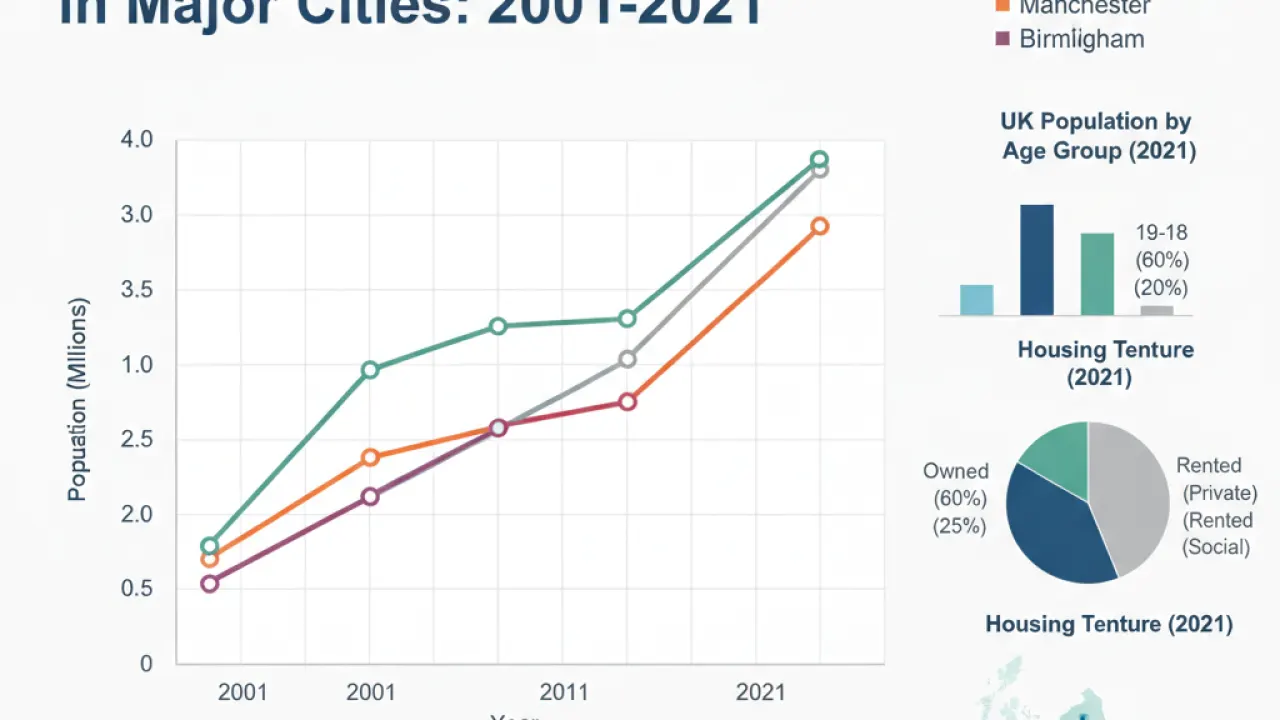
The UK cities ranked by population in 2026, using the urban agglomeration figures that include the wider metropolitan area rather than just the administrative city boundary:
- London – approximately 9.5 million in the Greater London area, and over 14 million in the wider London metropolitan area
- Birmingham – approximately 2.9 million in the West Midlands urban area
- Manchester – approximately 2.8 million in the Greater Manchester area
- Leeds and Bradford – approximately 2.3 million in the West Yorkshire urban area
- Glasgow – approximately 1.9 million in the Greater Glasgow area
- Liverpool – approximately 1.5 million in Merseyside
- Sheffield – approximately 1.3 million in the South Yorkshire urban area
- Edinburgh – approximately 900,000 in the Edinburgh urban area
- Newcastle and Gateshead – approximately 850,000 in the Tyne and Wear area
- Bristol – approximately 700,000 in the Bristol urban area
- Cardiff – approximately 450,000 in the Cardiff metropolitan area
- Belfast – approximately 340,000 in the Belfast metropolitan area
Fastest Growing UK Cities
Not all UK cities are growing at the same rate. The fastest-growing cities in the UK in recent years have been:
- London – sustained growth driven by economic opportunity and international migration, though the rate slowed post-pandemic
- Manchester – one of the fastest-growing core cities in the UK, driven by university growth, media industry expansion, and financial services
- Edinburgh – Scotland’s fastest-growing city, driven by financial services, tourism, and the tech sector
- Bristol – consistent growth driven by technology, aerospace, and creative industries
- Cambridge – rapid growth fuelled by the technology and life sciences sectors
UK Cities by Economic Output
Population is not the only measure of a city’s significance. Economic output, or GVA (Gross Value Added), shows the economic contribution of each city:
- London alone contributes approximately 23 percent of total UK GVA, despite having roughly 14 percent of the population
- Manchester, Birmingham, Leeds, and Edinburgh are the largest regional economic centres outside London
- The northern cities of Manchester and Leeds have grown their economic output significantly, helped by investment in transport, universities, and digital infrastructure
UK Cities Population Trends
UK urban population trends show a consistent pattern of growth in major cities and decline or stagnation in smaller towns, particularly those that relied on manufacturing industries that have shrunk significantly since the 1980s. This urban-rural divide in population dynamics drives significant policy discussion around regional economic development and levelling up.
The post-pandemic shift toward remote working has created some counter-movement, with people leaving expensive major cities like London for smaller cities and rural areas while maintaining urban salaries. This trend has supported population and house price growth in cities like Bristol, Exeter, Cambridge, and York that offer lifestyle benefits with good connectivity to major employment centres.
London: Why It Dominates UK Population Statistics
London’s dominance in UK population and economic statistics is extraordinary by the standards of comparable countries. No other large European country has such a disproportionate concentration of population, economic activity, and cultural power in a single city. Paris is dominant in France, but less so than London in the UK. Berlin, Madrid, Rome, and Amsterdam all coexist with genuinely significant second cities in ways that the UK system does not quite replicate.
This concentration has pros and cons. London attracts talent, investment, and international recognition at a scale that benefits the UK overall. It also creates housing unaffordability, traffic congestion, and economic disparities with the rest of the country that are difficult to address through policy.
Key Points Summary
Understanding the full picture around any major decision, whether about immigration, relocation, career, or finances, requires looking at the complete context rather than any single factor. The information in this guide provides a solid foundation, but specific decisions should always be verified through official sources and, where significant money or legal status is involved, through a qualified professional in the relevant field.
Take your time making important decisions. The topics covered in this guide typically involve significant consequences that play out over months or years. A decision made carefully after thorough research consistently produces better outcomes than one made quickly under pressure or based on incomplete information.
Connect with people who have already done what you are planning. Whether through online communities, professional associations, or social networks, first-hand experiences from people who have recently navigated the same process are among the most valuable resources available. They provide practical, current knowledge that complements the factual information in guides like this.
Finally, keep all your records organised from the beginning. This applies to immigration applications, financial decisions, employment changes, and any other significant process discussed in this guide. A clear record of what you submitted, what was agreed, and what was decided saves time and stress if questions arise later.
Frequently Asked Questions
Readers commonly ask follow-up questions after reading guides like this one. The answers to the most common questions help you get the most complete picture before making any decisions.
How often does this information change?
The core facts in this guide are stable, but specific numbers, rules, and policies change regularly. Government policies update annually or more frequently. Always verify current figures through official sources before acting on anything specific mentioned here.
Where can I get personalised advice?
For personalised advice on immigration, seek a solicitor or OISC-regulated adviser. For financial decisions, seek an FCA-regulated financial adviser. For tax matters, seek a qualified accountant or tax adviser. General guides like this one provide useful background but cannot substitute for advice tailored to your specific situation.
Is this guide relevant to my specific circumstances?
This guide covers the general situation that applies to most people in the UK or planning to move to the UK. Individual circumstances vary. People with criminal convictions, complex visa histories, unusual employment arrangements, or other specific factors may face different rules than described here. If you have a complicated situation, professional advice is worth the cost.
How do I stay updated on changes?
Sign up to email newsletters from relevant government departments, follow GOV.UK pages relevant to your topic, and join online communities of people in similar situations. The expat and migrant communities in particular are excellent sources of current practical information because members share updates as soon as they notice changes affecting them.
For more on UK cities and places, read our articles on best countries to visit and most beautiful places. For building a business in any UK city, start a business is relevant. For staying connected wherever you live in the UK, best smartphones covers the options.
Key Points Summary
Understanding the full picture around any major decision, whether about immigration, relocation, career, or finances, requires looking at the complete context rather than any single factor. The information in this guide provides a solid foundation, but specific decisions should always be verified through official sources and, where significant money or legal status is involved, through a qualified professional in the relevant field.
Take your time making important decisions. The topics covered in this guide typically involve significant consequences that play out over months or years. A decision made carefully after thorough research consistently produces better outcomes than one made quickly under pressure or based on incomplete information.
Connect with people who have already done what you are planning. Whether through online communities, professional associations, or social networks, first-hand experiences from people who have recently navigated the same process are among the most valuable resources available. They provide practical, current knowledge that complements the factual information in guides like this.
Finally, keep all your records organised from the beginning. This applies to immigration applications, financial decisions, employment changes, and any other significant process discussed in this guide. A clear record of what you submitted, what was agreed, and what was decided saves time and stress if questions arise later.
Additional Context and Background
Topics like this one are best understood when you have the full context rather than just the headline facts. The information provided in this guide covers the main points that matter for most people reading it in 2026. However, every individual situation is different, and the specific details that apply to you may differ from the general guidance here.
Sources of information matter enormously for topics involving government rules, financial decisions, and legal matters. The most reliable sources for UK-related information are the official GOV.UK website for government rules and guidance, the NHS website for health-related information, and in financial matters, the FCA-regulated firms and advisers who are legally required to give advice that is suitable for your specific situation. For immigration matters, only OISC-regulated advisers or solicitors regulated by the Solicitors Regulation Authority can legally provide paid immigration advice in the UK.
The rules covered in this guide are correct for 2026 but will change over time. Government policy on immigration, taxation, property, and public services evolves regularly, sometimes significantly within a single year. Always verify the current rules before making any decision based on the information here. The GOV.UK website is updated to reflect current rules and is the definitive source for most UK-specific guidance.
Cultural context also matters when understanding topics that span countries. What seems standard in the UK may be unusual in Australia, Canada, or the UAE, and vice versa. British people who move abroad frequently report that some assumptions they held about how things work, based on UK experience, do not apply in the same way in their new country. Being open to learning how things work locally rather than expecting the UK way to be the default everywhere is one of the most useful mindsets for anyone living or working internationally.
Finally, personal networks are often more valuable than any official guide. Connecting with people who have recently done what you are planning to do gives you access to practical, current knowledge that reflects real experience rather than official descriptions of how processes are supposed to work. Expat communities, professional associations, and social groups for people who have made similar moves are worth joining early in your planning process. The practical wisdom accumulated in these communities is genuinely useful and often unavailable anywhere else.
This guide has aimed to give you accurate, useful information on the topic as it stands in 2026. Use it as a starting point for your own research and decision-making rather than as the definitive final word. The most informed decisions come from combining general guides like this with your own specific research, official sources, and where appropriate, professional advice tailored to your individual circumstances.
Which UK city do you live in or are you considering moving to, and what is your experience of its population growth and change? Share your thoughts in the comments below.
One more important consideration: the information landscape around topics like this changes continuously. What is true in 2026 may be significantly different in 2027 or 2028 as governments update policies, market conditions shift, and new options emerge. Building a habit of checking official sources regularly, particularly for anything involving immigration status, financial products, or government benefits, is one of the most valuable practices anyone can develop. The people who navigate complex systems most successfully are typically those who combine good initial research with ongoing awareness of changes that affect their situation. This guide provides the foundation. Your ongoing engagement with reliable sources builds on that foundation over time.