



Living with a long-term illness, physical disability, or mental health condition often brings unexpected extra living expenses. Securing the right disability benefit uk support provides essential financial relief to cover personal care, specialized transport, and household adaptations.
The British social security system provides multiple distinct disability schemes depending on your age, work history, and daily care requirements. Because different rules apply to working-age adults, children, and state pensioners, understanding which benefit matches your personal situation is key. In this 2026 guide, we explain all major UK disability payments, updated weekly rates, medical evidence rules, secondary grants, and how to submit a successful claim.

1. Disability Benefit UK: Overview of the Social Security System
The United Kingdom organizes disability financial support into two main categories: non-means-tested extra cost benefits and means-tested income replacement benefits.
Extra cost benefits, such as Personal Independence Payment (PIP), Attendance Allowance, and Child Disability Living Allowance (DLA), are designed specifically to help you manage the costs of daily care and mobility. These payments are completely tax-free. They do not depend on how much income you earn or how much money you hold in savings accounts, and you can claim them whether you are in employment, self-employed, or out of work. You can review full official eligibility guidelines directly on the GOV.UK financial help for disabled people portal.
Income replacement benefits, such as the Universal Credit health elements and New Style Employment and Support Allowance (ESA), support people whose illnesses limit their ability to work. Understanding how these programs interact ensures you receive all the help you are entitled to without accidentally losing related entitlements.
2. Master Comparison: Weekly Rates and Eligibility Rules
The table below summarizes the core disability benefit uk schemes available across Britain for 2026, showing payment ranges, target age groups, and taxation rules.
| Benefit Scheme | Target Age Group | Weekly Rates (2026) | Means-Tested? | Taxable? |
|---|---|---|---|---|
| Personal Independence Payment (PIP) | Ages 16 to State Pension Age | £28.70 to £184.30 | No | No |
| Adult Disability Payment (ADP Scotland) | Ages 16 to State Pension Age (Scotland) | £28.70 to £184.30 | No | No |
| Disability Living Allowance (Child DLA) | Children under 16 | £28.70 to £184.30 | No | No |
| Attendance Allowance | State Pension Age and older (66+) | £72.65 or £108.55 | No | No |
| Universal Credit (LCWRA Element) | Working-age adults unable to work | £416.19 per month | Yes | No |
| New Style ESA (Support Group) | Working-age adults who paid NI | Up to £138.20 | No (NI-based) | Yes |
| Carer’s Allowance | Carers providing 35+ hours of care | £81.90 | Earnings cap (£151/wk) | Yes |

3. Personal Independence Payment (PIP) for Working-Age Adults
Personal Independence Payment (PIP) is the primary disability benefit uk payment for adults aged between 16 and State Pension age living in England, Wales, and Northern Ireland. PIP helps with the extra costs arising from a physical illness, mental health condition, sensory impairment, or learning difficulty.
PIP is composed of two components, each paid at either a standard or enhanced weekly rate:
Daily Living Component
The Daily Living component assesses your ability to complete ten everyday activities, including preparing food, eating and drinking, managing therapies, washing and bathing, managing toilet needs, dressing and undressing, communicating verbally, reading, mixing with other people, and making budgeting decisions.
- Standard Rate: £72.65 per week (paid if you score 8 to 11 points on daily living descriptors).
- Enhanced Rate: £108.55 per week (paid if you score 12 or more points).
Mobility Component
The Mobility component assesses your physical ability to walk outdoors without pain, breathlessness, or distress, as well as your capacity to plan and follow journeys without getting lost or experiencing overwhelming psychological distress.
- Standard Rate: £28.70 per week (paid if you score 8 to 11 points on mobility descriptors).
- Enhanced Rate: £75.75 per week (paid if you score 12 or more points).
If you qualify for the top tier of both components, your total PIP award reaches £184.30 per week (£737.20 every four weeks). PIP is paid every four weeks directly into your bank account. Because it is non-means-tested, you can receive PIP whether you earn a high professional salary or rely on other government support.
4. Adult Disability Payment (ADP) in Scotland
If you live in Scotland, the Department for Work and Pensions (DWP) no longer manages new disability claims. Social Security Scotland delivers Adult Disability Payment (ADP), which has completely replaced PIP as the core working-age disability benefit uk option for Scottish residents.
ADP pays the exact same weekly monetary rates as PIP and uses identical point descriptors for daily living and mobility. However, Social Security Scotland operates under a distinct, human-centered philosophy designed to reduce assessment anxiety:
- No private for-profit contractors: Assessments are carried out by in-house NHS practitioners employed directly by Social Security Scotland.
- Fewer face-to-face consultations: Social Security Scotland gathers supporting medical evidence directly from your GP, social workers, and consultants on your behalf whenever possible.
- Indefinite awards: People with lifelong or degenerative conditions are awarded indefinite awards, eliminating stressful repeat reassessments.
- Short-term assistance: If you appeal an ADP reduction, you can receive short-term financial assistance to maintain your previous benefit income while your appeal is reviewed.

5. Universal Credit Health Elements: LCW and LCWRA Explained
While PIP assists with extra living expenses, Universal Credit provides means-tested income replacement if your health condition limits your capacity to work. To access this help, you must obtain a Statement of Fitness for Work (fit note) from your GP and log it in your Universal Credit online account.
After three months of continuous fit notes, you undergo a Work Capability Assessment (WCA). The assessment places you into one of three outcome groups:
1. Fit for Work
You do not receive extra financial elements and must search for employment according to your standard claimant commitment.
2. Limited Capability for Work (LCW)
HMRC and DWP acknowledge that your health prevents you from working right now, but you are expected to prepare for work in the future (such as updating CVs or attending training). Unless you were awarded LCW before April 2017, this status does not award extra money, but it protects you from mandatory job applications and grants you a work allowance.
3. Limited Capability for Work and Work-Related Activity (LCWRA)
If your health severely restricts your ability to work and complete work preparation activities, you receive the LCWRA element. This awards an extra £416.19 per month on top of your standard Universal Credit allowance. You have zero work search requirements, and you receive an automatic monthly earnings work allowance, letting you keep more income if you choose to work part-time.
If you are exploring the overall claiming process, read our complete guide on how to apply for Universal Credit in the UK.
6. New Style Employment and Support Allowance (ESA)
When exploring which disability benefit uk options provide income replacement, New Style Employment and Support Allowance (ESA) offers non-means-tested support if you have paid sufficient Class 1 or Class 2 National Insurance contributions over the previous two tax years.
Unlike Universal Credit, New Style ESA is not means-tested. Your partner’s income and your personal savings will not reduce your award. However, if you receive a private occupational pension over £85 per week, your ESA payment is reduced by 50% of the excess.
During the initial 13-week assessment phase, claimants receive up to £90.50 per week (or £71.70 if aged under 25). Once the Work Capability Assessment confirms you belong in the Support Group, your weekly payment rises to up to £138.20 per week. You can claim New Style ESA and PIP simultaneously, receiving both payments without any deductions.
7. Disability Living Allowance (DLA) for Children
Disability Living Allowance (DLA) for Children serves as the primary disability benefit uk scheme for families raising a child under the age of 16 who experiences physical, sensory, developmental, or mental health impairments.
To qualify, the child must require substantially more care, attention, or supervision than a child of the same age without a disability. Child DLA features two elements:
Care Component
- Lowest Rate (£28.70/wk): If your child needs help for at least an hour during the day.
- Middle Rate (£72.65/wk): If your child needs frequent help or constant supervision throughout the day, OR supervision during the night.
- Highest Rate (£108.55/wk): If your child requires care or supervision throughout both day and night, or has a terminal illness.
Mobility Component
- Lower Rate (£28.70/wk): Available from age 5 for children who can walk physically but need guidance or supervision on unfamiliar routes outdoors.
- Higher Rate (£75.75/wk): Available from age 3 for children who cannot walk, have severe walking difficulties, or have severe mental impairments with extreme behavioral difficulties.
Securing Child DLA at the middle or highest care rate also exempts your household from the statutory Benefit Cap and enables you to claim extra disability child elements within Universal Credit.
8. Attendance Allowance for Pensioners Over State Pension Age
If you have reached State Pension age (currently 66) and need help with daily personal care because of a physical illness, frailty, or memory loss, you can claim Attendance Allowance as your dedicated disability benefit uk support.
Attendance Allowance is designed specifically for older adults. Unlike PIP, it does not include a mobility component. However, the cash payments can be spent on anything that makes your life safer and more comfortable, such as paying for private home carers, gardener assistance, taxis, or heating.
There are two weekly payment tiers:
- Lower Rate (£72.65 per week): You require frequent help or constant supervision throughout either the day OR the night (for example, help getting out of bed, bathing, dressing, or taking medication).
- Higher Rate (£108.55 per week): You require help or supervision during both the day AND the night, or you have a terminal diagnosis.
Receiving Attendance Allowance often increases your entitlement to other support. For instance, it can trigger severe disability premiums within Pension Credit and council tax support. If you are approaching retirement age or reviewing state entitlements, check our detailed breakdown of State Pension rates and qualifying rules.

9. Carer’s Allowance and Support for Unpaid Family Carers
Caring for a disabled loved one is physically and emotionally demanding, and frequently requires family members to reduce their work hours or leave employment entirely. Carer’s Allowance provides financial support for unpaid carers.
To qualify for Carer’s Allowance, you must fulfill three core conditions:
- You spend at least 35 hours every week caring for someone who receives a qualifying disability benefit (such as PIP Daily Living component, Attendance Allowance, or Child DLA Middle or Highest Care rate).
- You are aged 16 or over and not enrolled in full-time education (21 hours or more per week).
- Your net weekly earnings do not exceed the statutory earnings limit of £151 per week after allowable deductions for income tax, National Insurance, and 50% of personal pension contributions.
Carer’s Allowance pays £81.90 per week. For a detailed guide on earnings caps, overlapping benefit rules, and Scotland’s Carer Support Payment, read our in-depth resource on Carer Allowance rates and claiming rules.
10. Motability Scheme, Blue Badges, and Travel Passes
Award letters for disability benefit uk payments do more than provide direct cash. They act as a gateway passport to extensive travel and transport support.
The Motability Scheme
If you receive the Enhanced Rate Mobility component of PIP or ADP, Higher Rate Mobility Child DLA, or Armed Forces Independence Payment, you can exchange part or all of your mobility allowance to lease a brand-new car, wheelchair-accessible vehicle (WAV), scooter, or powered wheelchair. The lease includes full insurance cover for up to three named drivers, breakdown assistance from the RAC, replacement tyres, and annual servicing.
The Blue Badge Parking Scheme
A Blue Badge allows drivers and passengers with severe mobility limitations to park closer to their destinations. In England and Wales, you qualify automatically if you receive 8 points or more under the PIP “moving around” descriptor, or 10 points under the “planning and following journeys” descriptor for severe psychological distress. Badges allow free parking on on-street meters, pay-and-display bays, and for up to three hours on single or double yellow lines (where no loading bans apply).
Free Bus Passes and Railcards
Local authorities across England, Wales, Scotland, and Northern Ireland issue free off-peak concessionary bus passes to individuals with qualifying disabilities. You can also purchase a Disabled Persons Railcard for £20 per year, which saves one-third on rail fares across Britain for both you and an accompanying traveling companion.
11. Disabled Facilities Grants and Household Bill Discounts
Living with a disability often demands alterations to your living environment and results in higher heating and electricity bills.
Disabled Facilities Grant (DFG)
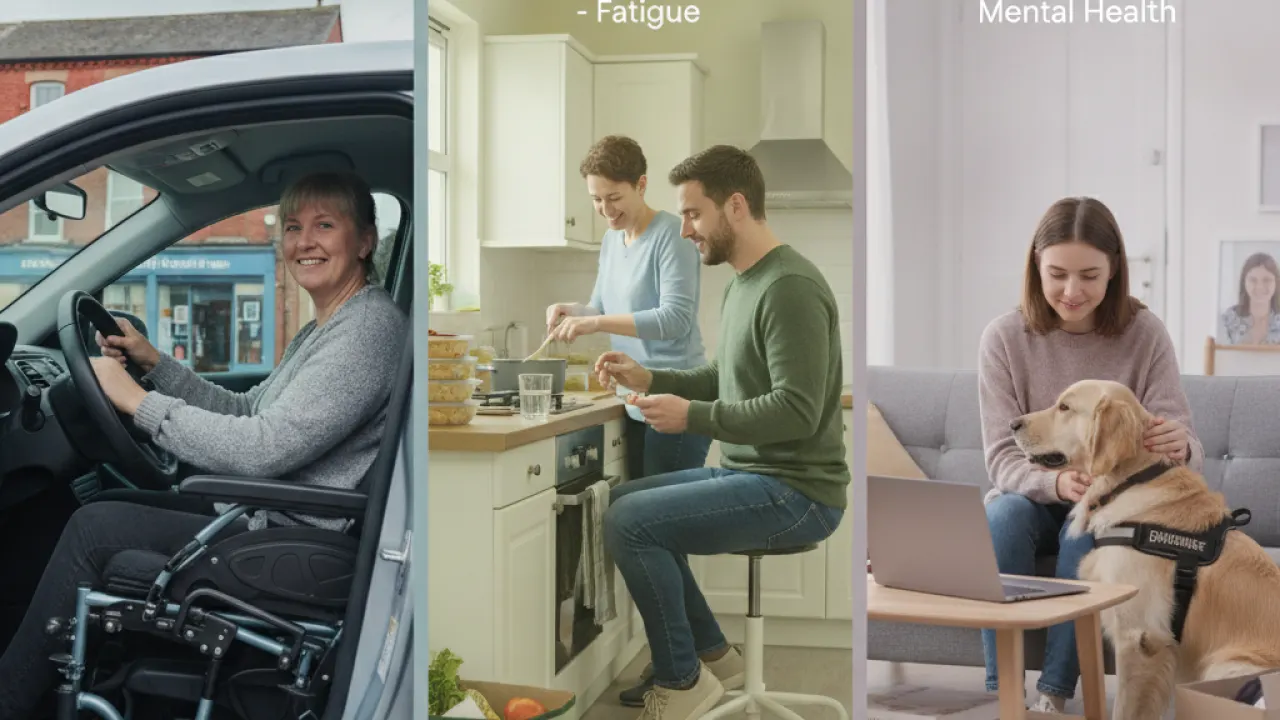
If you or someone living in your property is disabled, you can apply to your local council for a Disabled Facilities Grant. In England, the grant provides up to £30,000 (£36,000 in Wales and £25,000 in Northern Ireland) to fund major home modifications. Eligible works include widening doorways, building wheelchair access ramps, installing stairlifts or through-floor lifts, adapting heating controls, and fitting level-access wet rooms.
Council Tax Disabled Band Reduction Scheme
If your home has special features necessary for a disabled resident (such as a second bathroom, extra kitchen, or a dedicated room used primarily for therapy or medical equipment), you can apply for the Disabled Band Reduction Scheme. This reduces your council tax valuation by one full band. For instance, a property in Band D is billed at Band C rates. If your home is already in Band A, you receive a one-sixth discount on your annual bill.
Healthcare and Energy Bill Support
Securing a qualifying disability benefit uk award also grants automatic utility support. Households are often eligible for the Warm Home Discount, which applies a £150 one-off credit to electricity accounts during winter months. If health equipment requires substantial electricity or water consumption, check with water companies for the WaterSure capped bill scheme. Additionally, check our complete breakdown of exemptions for medical costs in our NHS dental costs and free treatment guide.
Managing the irregular timing of disability costs can place strain on household cash reserves. Maintaining an emergency savings buffer protects your family from unexpected care fees or equipment repair bills.
12. How to Prepare Your Application and Medical Evidence
Submitting a successful claim for disability benefit uk payments depends on providing detailed, functional medical evidence rather than relying solely on your clinical diagnosis.
When completing assessment forms (such as PIP2 ‘How your disability affects you’ or DLA1A), keep these essential strategies in mind:
The 50% Rule and Fluctuating Conditions
Under UK disability regulations, an activity is considered affected if you cannot carry it out reliably on more than 50% of days across the year. If you have conditions that flare up unpredictably (such as multiple sclerosis, fibromyalgia, lupus, depression, or Crohn’s disease), explain what happens on both your best days and your worst days, and estimate how many days each month are affected.
The Four Reliability Criteria
Under law, you are only treated as able to carry out an activity if you can do so:
- Safely: In a way unlikely to cause harm to yourself or others.
- To an acceptable standard: Completing the task properly and cleanly.
- Repeatedly: As often as the activity is reasonably required throughout the day.
- In a reasonable time period: Taking no more than twice the time a person without your condition would take.
If cooking a meal leaves you exhausted for the rest of the afternoon, you cannot cook repeatedly or safely. Be explicit about these limitations in your written answers.
Assembling Strong Supporting Evidence
Do not expect DWP or assessment providers to contact your doctors. Take responsibility for sending high-quality evidence alongside your form, including:
- Medical letters, diagnostic summaries, and hospital discharge notes.
- Letters from occupational therapists, physiotherapists, and mental health community nurses.
- A complete prescription printout showing your current medications and dosages.
- A seven-day symptom and care diary written by yourself or a family carer detailing exact incidents of falls, fatigue, breathlessness, confusion, or pain.
13. Mandatory Reconsiderations and Tribunal Appeals
Receiving an unfair decision or zero points from the DWP is very common. More than 40% of initial applications for a disability benefit uk payment are refused on first assessment. However, you have legal statutory rights to challenge the outcome.
Stage 1: Mandatory Reconsideration
You must request a Mandatory Reconsideration within one calendar month of the date printed on your decision letter. Call the DWP number on the letter to register your challenge, and follow up in writing. Request a full copy of the assessor’s report (form PA4 for PIP). Review the report line by line, point out factual errors or misquoted statements, and provide supplementary letters addressing each contested descriptor.
Stage 2: Independent First-tier Tribunal Appeal
If the DWP upholds its original decision at Mandatory Reconsideration, do not give up. You can lodge an appeal with HM Courts and Tribunals Service (HMCTS) using form SSCS1 or online via GOV.UK within one month.
The First-tier Tribunal is completely independent of the DWP. It consists of a legally qualified judge, an independent doctor, and a disability specialist. Ministry of Justice statistics consistently show that over 65% of claimants who appeal to an independent tribunal have decisions overturned in their favor. Attending your hearing in person or via video link substantially increases your chances of success because the panel can hear directly how your condition impacts your life.
14. Frequently Asked Questions
Does having savings stop you from claiming disability benefits?
No. Personal Independence Payment (PIP), Attendance Allowance, Child DLA, and New Style ESA are completely non-means-tested. You can have £50,000 or £100,000 in personal savings, own your home outright, or earn a high salary and still receive your full weekly entitlement. Only means-tested benefits, such as Universal Credit, Housing Benefit, and Pension Credit, look at household savings over £6,000.
Can you work while receiving PIP or ADP?
Yes. There are zero limits on working hours or earnings while receiving PIP or ADP. The benefit is based strictly on how your health affects daily living and mobility, not on whether you have a job. However, your employment activities must be consistent with the difficulties you describe in your claim forms.
Do UK disability benefits count as taxable income?
PIP, Attendance Allowance, Child DLA, and the Universal Credit LCWRA element are 100% tax-free. You do not declare them to HMRC or enter them on tax returns. However, New Style ESA and Carer’s Allowance are taxable income, although tax is only owed if your total annual income exceeds your £12,570 Personal Allowance.
Can you claim PIP and Attendance Allowance at the same time?
No. You cannot receive PIP and Attendance Allowance simultaneously. PIP is for individuals who apply before reaching State Pension age (66), whereas Attendance Allowance is for individuals who make their initial claim after State Pension age. If you were already awarded PIP before turning 66, you continue receiving PIP into retirement without switching.
What happens to disability benefits if you are admitted to hospital?
If you are admitted to an NHS hospital, payments of PIP, ADP, Attendance Allowance, and Child DLA pause after 28 consecutive days of inpatient care. Payments resume automatically as soon as you are discharged home. You must notify the DWP immediately upon admission and discharge to prevent overpayments or delays.
How often are disability benefit awards reviewed?
Awards are typically granted for a fixed period ranging from two to ten years, depending on whether your condition is expected to improve, remain stable, or deteriorate. HMRC and DWP send review forms roughly 6 to 12 months before your award expires. Individuals with severe lifelong conditions that will never improve can receive ongoing awards with light-touch reviews every ten years.
Securing the right disability benefit uk support helps you meet the extra costs of living with long-term illness with greater peace of mind. By identifying the correct scheme for your age group, gathering thorough medical evidence, and exercising your appeal rights if needed, you can access the full financial support you deserve.
Have you applied for a UK disability benefit recently, or are you preparing to challenge an assessment decision? Share your questions and experiences in the comments below to join the discussion.