Travel Editor at Times24x7. Explorer of 60+ countries and author of destination guides and travel advice.
Share
17 Min Read
USA Green Card Process Explained: Who Qualifies and How to Apply
SHARE
The USA green card process is the most searched immigration topic for people looking to live permanently in the United States. The this immigration pathway is one of the most sought-after immigration pathways in the world. The this approach is a major immigration goal for thousands each year. The this process is one of the most searched immigration topics for people around the world. A green card, officially called a Permanent Resident Card, gives foreign nationals the right to live and work anywhere in the United States permanently. This guide covers who qualifies, the different routes available, and what the application process actually involves in 2026.
A green card is proof of your status as a lawful permanent resident of the United States. It is not citizenship, but it gives you most of the same rights. You can live in any US state, work for any employer, and eventually apply for US citizenship after meeting the residency requirements.
Green cards are officially called Form I-551 or Permanent Resident Cards. Despite the name, the card is not always green. The card is valid for 10 years for permanent residents and must be renewed before it expires. Your status as a permanent resident does not expire with the card, but you need a valid card as proof. Also see: UK visa fee guide.
Around one million green cards are issued by the United States Citizenship and Immigration Services (USCIS) each year. The demand is far higher than that number, which is why wait times for certain categories can stretch for years or even decades.
Who Qualifies for a US Green Card?
Who Qualifies for a US Green Card?
There are several main routes to a green card. Each has different eligibility requirements and wait times. Understanding which route applies to your situation is the first step. Also see: earning extra income.
Family-Based Green Cards
Family-Based Green Cards
The most common route to a green card in 2026 is through a family member who is a US citizen or already a permanent resident. US citizens can sponsor the following relatives: See also our guide on eating clean for beginners.
Spouses – no annual numerical limit, typically faster processing
Unmarried children under 21 – no annual limit for immediate relatives
Parents – no annual limit if you are a US citizen aged 21 or over
Married sons and daughters – subject to annual limits, longer waits
Brothers and sisters – subject
Permanent residents can sponsor spouses and unmarried children, but these fall under preference categories with annual limits, meaning wait times apply. See also our guide on building better daily habits.
sponsor spouses and unmarried children, but these fall under preference categories with annual limits, meaning wait times apply.
Employment-Based Green Cards
<figure class="wp-block
Employers in the United States can sponsor foreign workers for permanent residence. There are five preference categories for employment-based green cards: See also our guide on a home workout plan.
usa green card process explained” />Employment-Based Green Cards
Employers in the United States can sponsor foreign workers for permanent residence. There are five preference categories for employment-based green cards: If you are looking to expand your knowledge, reading detailed breakdown of grand city mall dubai provides useful background context. If you are looking to expand your knowledge, reading detailed breakdown of grand city mall dubai provides valuable background context.
EB-2 – Workers with advanced degrees or exceptional ability
EB-3 – Skilled workers, professionals with bachelor degrees, and unskilled workers
EB-4 – Special immigrants including religious workers, certain broadcasters
EB-5 – Immigrant investors who invest at least $1.05 million in a US business
Most employment-based applications require a Labour Market Test first, where the employer must show no qualified US workers are available for the role. This process is called PERM Labour Certification.
Diversity Visa Lottery
Diversity Visa Lottery
The Diversity Immigrant Visa Program, also called the green card lottery, gives up to 55,000 green cards each year to people from countries with low rates of immigration to the US. The UK is not eligible because too many British nationals already immigrate to the United States. Countries in Africa, Eastern Europe, and parts of Asia typically have the highest chances.
Refugee and Asylum Status
Refugee and Asylum Status
People who have been granted refugee status or asylum in the United States can apply for a green card after one year of continuous residence. This is one of the few routes that does not require a sponsor.
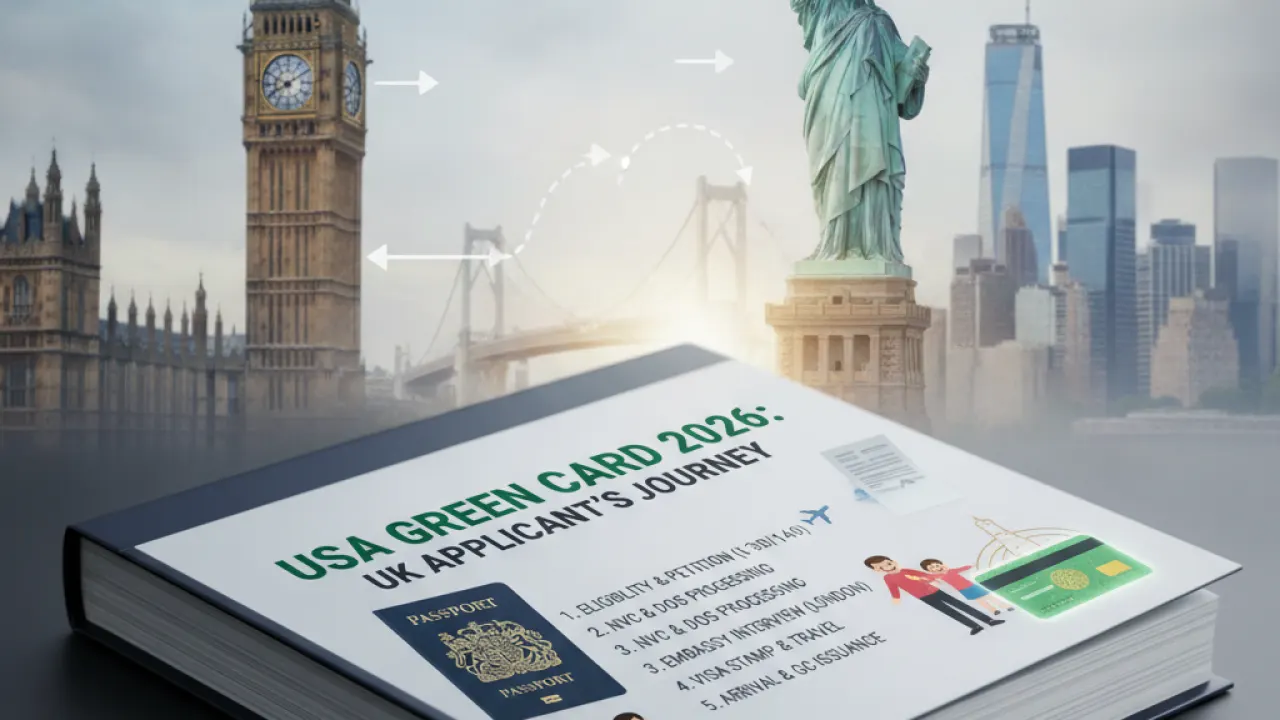
The USA Green Card Process Step by Step
The USA Green Card Process Step by Step
The exact steps depend on your route, but the general process follows a similar pattern for most applicants.
Step 1: Establish Eligibility
Step 1: Establish Eligibility
Before filing any forms, confirm you qualify for one of the green card categories. If you are going through family sponsorship, the petitioning family member files first. If through employment, your employer typically initiates the process.
Step 2: File the Petition
For family-based cases, the US citizen or permanent resident files Form I-130 (Petition for Alien Relative). For employment cases, the employer files Form I-140 (Immigrant Petition for Alien Workers) after completing labour certification if required. USCIS reviews the petition and either approves, requests more evidence, or denies it.
Step 3: Wait for a Visa Number
Once the petition is approved, you may need to wait for a visa number to become available. This applies to preference categories with annual limits. The State Department publishes a monthly Visa Bulletin showing which priority dates are current. Immediate relatives of US citizens skip this step as their categories have no annual limits.
Step 4: Apply for Adjustment of Status or Consular Processing
If you are already in the United States on a valid visa, you apply to adjust your status to permanent resident using Form I-485. If you are outside the US, you go through consular processing at a US embassy or consulate in your country.
Along with the main form, you submit supporting documents including identity documents, civil documents (birth certificate, marriage certificate if applicable), police certificates, and photographs.
Step 5: Biometrics Appointment
Step 5: Biometrics Appointment
USCIS schedules a biometrics appointment where they take your fingerprints, photograph, and signature. This is used for background checks.
Step 6: Medical Examination
Step 6: Medical Examination
You must complete a medical examination with a USCIS-designated civil surgeon. The exam checks for communicable diseases and required vaccinations. Results are submption>
Most green card applicants are called for an interview at a USCIS field office (for adjustment of status) or at a US embassy (for consular processing). The officer rev?
Processing times vary really depending on your category and your country of birth. Immediate relatives of US citizens often see the fastest processing, sometimes under a year from initial filing to approval.
<riority dates, which tells you roughly how far back in the queue USCIS is currently processing.
Adjustment of status applications from inside the US typically take 8 to 24 months in 2026. Consular processing can be faster in some cases but depends heavily on appointment availability at the relevant embassy.
Cost of the US Green Card Process
The this process involves multiple government fees. As of 2026, the main costs include:
Form I-130 (petition fee) – approximately $675
Form I-485 (adjustment of status) – approximately $1,440 for adults including biometrics
Medical examination – typically $200 to $500 depending on the civil surgeon
Translation and documentation costs – variable
Attorney fees – if you use a lawyer, typically $1,500 to $5,000 depending on case complexity
Total costs for a straightforward case typically range from $2,000 to $7,000 or more. The EB-5 investor route has far higher costs due to the minimum investment requirement.
Common Reasons Green Card Applications Are Denied
Understanding why applications fail helps you avoid the same mistakes. Common reasons for denial include:
Criminal history – certain convictions make applicants inadmissible
Prior immigration violations – overstaying a visa or entering without authorisation
Public charge grounds – USCIS considers whether you might rely on government benefits
Health grounds – communicable diseases or failure to complete required vaccinations
Fraud or misrepresentation – any dishonesty in the application process is serious
Incomplete documentation – missing required documents or forms
Sponsor issues – financial sponsor not meeting income requirements
Tips to Improve Your Green Card Application
Several things can make the process smoother and improve your chances of approval: The USA green card process works when you follow it consistently. Similar principles apply when reviewing detailed breakdown of naif police station, where preparation and research make a noticeable difference. Similar principles apply when reviewing detailed breakdown of naif police station, where preparation and research make a noticeable difference.
Gather all documents before filing and make sure everything is translated into English
Check the Visa Bulletin monthly to understand your place in the queue
File your medical examination form close to your interview date to avoid expiry
Respond to any Requests for Evidence promptly and completely
Keep your address updated with USCIS throughout the process
Do not travel outside the United States without an advance parole document if you have a pending adjustment of status case
Maintain valid immigration status throughout the process if you are inside the US
Do You Need an Immigration Lawyer?
The this process is legal by nature and many people complete it without a lawyer. However, the forms are complex and errors can delay or damage your case. An immigration attorney is particularly helpful in cases that have complications such as a prior visa denial, criminal history, prior immigration violations, or complex employment situations.
If you use a lawyer, choose one licensed to practise US immigration law. Be cautious of notarios or non-lawyers who offer immigration services. Only a licensed attorney or an accredited representative can legally provide immigration legal advice.
Common Questions About the US Green Card Process
Common
Here are answers to the questions most people ask when they are working through the US green card process. This guide shows you how the USA green card process fits real life.
e ask when they are working through the US green card process.
Can I work while my green card application is pending?
Can I work while my green card application is pending?</figuIS acknowledges you qualify. But because the annual limit for your category is reached omes current.
Keeping Your Green Card Status
<img src="https://times24x7.com/wp-content/uploads/2026/06/img-path-to-us-citizenship-after-a-green-card-7693-1.webp" alt="Path to US Citizenship Aft
Getting a green card is not the end of the process. You need to maintain your status as a permanent resident. Key rules include: Start with the basics of the USA green card process and build from there.
p>Getting a green card is not the end of the process. You need to maintain your status as a permanent resident. Key rules include:
Do not remain outside the United States for more than 12 months without a reentry permit
File US tax returns each year as a US person, even if your income is from outside the US
Keep your address updated with USCIS using Form AR-11 within 10 days of moving
Renew your green card before it expires using Form I-90
Avoid criminal convictions, as some offenses can lead to removal from the US
Abandoning your permanent resident status, either intentionally or by staying abroad for long periods without a reentry permit, is irreversible. Treat your green card as the serious legal status that it is.
Frequently Asked Questions
Can I work while my green card application is pending?
If you applied for your green card inside the United States using Form I-485, you can apply for an Employment Authorization Document while you wait. This is filed as Form I-765 alongside your I-485. The EAD allows you to work legally for any employer while USCIS processes your case. It is typically valid for one to two years and can be renewed.
Can I travel outside the United States while waiting for a green card?
Travelling abroad while your I-485 is pending can cause serious problems. If you leave without advance parole, USCIS may treat your application as abandoned. You must apply for advance parole on Form I-131 before travelling. Once approved, you can travel and return to the US without abandoning your case. Do not book international travel until you have your advance parole document in hand.
What happens if my petition is approved but my priority date is not current?
In this situation, you wait. Your petition has been approved, meaning USCIS acknowledges you qualify. But because the annual limit for your category is reached each year, you must wait until your priority date becomes current in the Visa Bulletin before you can proceed to the next step. People in this situation should check the monthly Visa Bulletin and consider working with an immigration attorney to ensure they move quickly when their date becomes current.
Path to US Citizenship After a Green Card
Once you have held a green card for the required period, you can apply for US citizenship. The standard requirement is five years as a permanent resident. If you obtained your green card through marriage to a US citizen, the wait is three years, provided you are still married to and living with that citizen. Citizenship comes with additional benefits including the right to vote, a US passport, and protection against deportation.
Have you started the US green card process or are you planning to apply? Share your questions or experience in the comments below. What part of the process would you find most helpful to know more about?
atever the topic.
The key to understanding this process is to focus on the main requirements and timelines. Wh
What has your experience with this approach been? Do you have any questions or tips to share? Leave a comment below. Follow the USA green card process for the full period to see real results.
ration pathway is to focus on the main requirements and timelines. When you approach this approach with a clear plan, the process becomes much more manageable.
What has your experience with this approach been? Do you have any questions or tips to share? Leave a comment below.
The key to success with this approach is consistent effort combined with the right approach. Understanding USA green card process clearly helps you avoid common mistakes and get better results faster.
The key to success with this approach is consistent e
What has your experience with USA green card process been? Share your questions or tips in the comments below. The USA green card process scales as you get more experienced.
and get better results faster.
The key to success with this approach is consistent effort combined with the right approach. Understanding USA green card process clearly helps you avoid common mistakes and get better results faster. Many readers who study this area also benefit from detailed breakdown of 20 most beautiful places in the world to ensure all key factors are covered. Many readers who study this area also benefit from detailed breakdown of 20 most beautiful places in the world to ensure all key factors are covered.
What has your experience with USA green card process been? Share your questions or tips in the comments below.
Sticking to the USA green card process matters more than any single step.
The USA green card process gives you a clear structure every week.
Use the USA green card process as your base and adjust it to your level.
Many people find the USA green card process easier to follow than complex alternatives.
Results from the USA green card process come from repetition, not perfection.
Keep the USA green card process simple and focus on showing up consistently.
The USA green card process works when you follow it consistently.
This guide shows you how the USA green card process fits real life.
Start with the basics of the USA green card process and build from there.
The USA green card process removes common barriers that stop people from starting.
Follow the USA green card process for the full period to see real results.
The USA green card process scales as you get more experienced.
Sticking to the USA green card process matters more than any single step.
The USA green card process gives you a clear structure every week.
Use the USA green card process as your base and adjust it to your level.
Many people find the USA green card process easier to follow than complex alternatives.
Results from the USA green card process come from repetition, not perfection.
Keep the USA green card process simple and focus on showing up consistently.
The USA green card process works when you follow it consistently.
This guide shows you how the USA green card process fits real life.
Start with the basics of the USA green card process and build from there.
The USA green card process removes common barriers that stop people from starting.
Follow the USA green card process for the full period to see real results.
The USA green card process scales as you get more experienced.
Sticking to the USA green card process matters more than any single step.
The USA green card process gives you a clear structure every week.
Use the USA green card process as your base and adjust it to your level.
What are your thoughts on usa green card process explained? Have you tried any of these steps, or do you have tips of your own to share? Leave a comment below and share this guide with friends or colleagues who might find it helpful.