


Best home workout plan for 2026 isn’t another flashy app or trendy YouTube series. It’s a 12 week framework that builds real strength, real cardio, and real consistency using nothing more than a yoga mat and your own bodyweight. Optional add ons – one set of resistance bands and a jump rope – take the same plan further. This guide walks through what the plan looks like, the exercises that actually matter, the weekly schedule, and the mistakes that kill most home workout attempts in the first month.
Why home workouts work in 2026
The case for training at home has gotten stronger every year. Gym memberships still average $50 to $80 per month. Commute time adds 30 to 60 minutes per session. Crowded gyms during peak hours waste another 10 to 15 minutes per workout waiting for equipment. The math on a home routine is hard to argue with for most people.
The honest case against home workouts. The gym has community, equipment variety, and accountability that home training doesn’t. Most people who try home workouts quit within 3 to 6 weeks. The plan below addresses both – it’s structured enough to give you the accountability gym membership provides, and varied enough to keep working long term.
The bigger truth most fitness content misses. Consistency beats intensity, every single time. A boring routine done 4 times a week for 12 months produces more results than a perfect routine done 3 times one week and then dropped.
The 12 week framework, week by week
The plan is structured in three 4 week blocks. Block one builds the habit and base strength. Block two adds intensity and complexity. Block three pushes the limits of bodyweight training. After 12 weeks the routine either continues, modifies, or upgrades to include equipment.
Weeks 1 to 4 – Foundation. Three workout days per week. Each session 25 to 35 minutes. Focus on form and consistency, not intensity. Most people are sore for the first two weeks. Don’t push past discomfort that lingers more than 48 hours.
Weeks 5 to 8 – Build. Four workout days per week. Each session 30 to 45 minutes. Add cardio circuits and exercise variations. Strength increases noticeably this block.
Weeks 9 to 12 – Push. Four to five workout days per week. Each session 40 to 50 minutes. Advanced bodyweight progressions like pistol squat work, archer push ups, and pull up variations if you have a doorway bar.
The 6 exercises that form the core of the plan
The plan revolves around 6 fundamental bodyweight movements. Master these and you can train productively for years without setting foot in a gym.
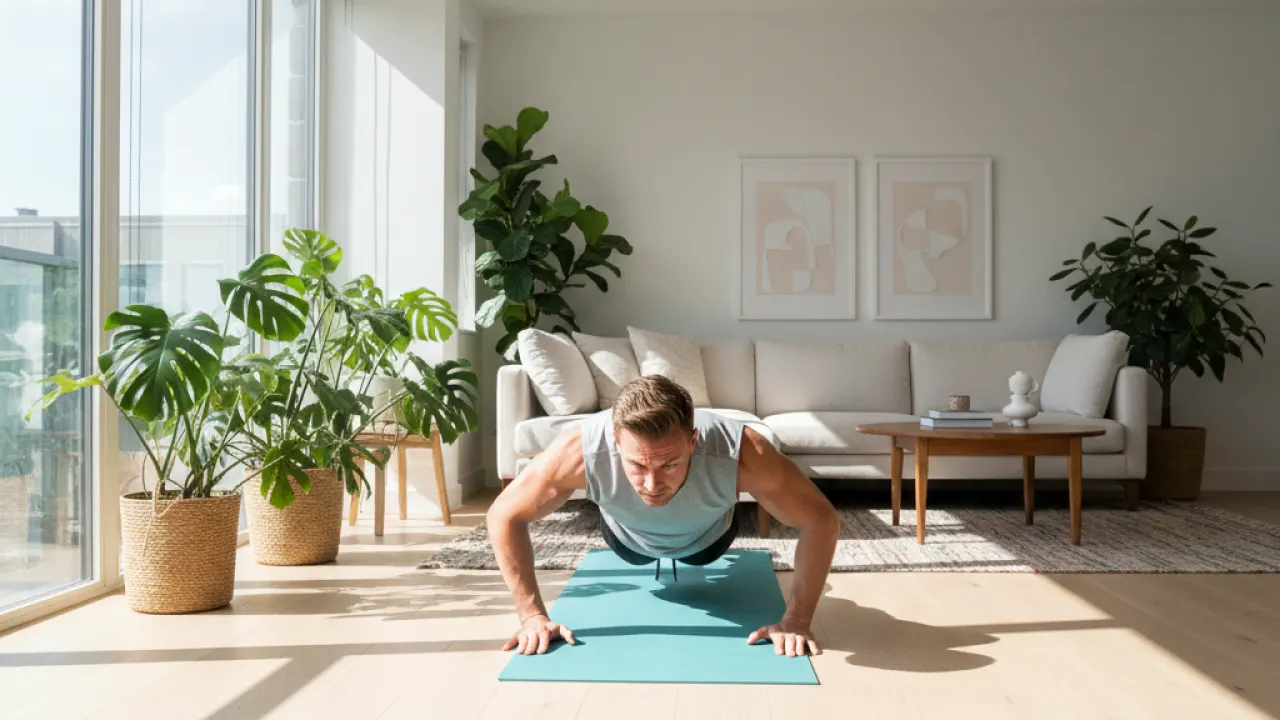
Push ups – the upper body builder
The most versatile exercise in any home workout. Push ups train the chest, shoulders, triceps, and core all at once. Progressions exist for every level – from incline push ups against a wall to one arm push ups for advanced lifters.
The progression ladder. Wall push ups – incline push ups on a bench – knee push ups – standard push ups – decline push ups (feet elevated) – diamond push ups – one arm push ups. Most people start somewhere on this ladder and progress one rung per 4 to 6 weeks.
The form check. Hand position slightly wider than shoulders. Body in a straight line from head to heels. Lower until chest is 1 inch from the floor. Push back up smoothly. The cheat most beginners make is not lowering all the way down.
Squats – the lower body foundation
Squats train the quads, glutes, hamstrings, and core. Bodyweight squats might not load the legs the way a barbell does, but with high reps and slow tempo they still build real strength.
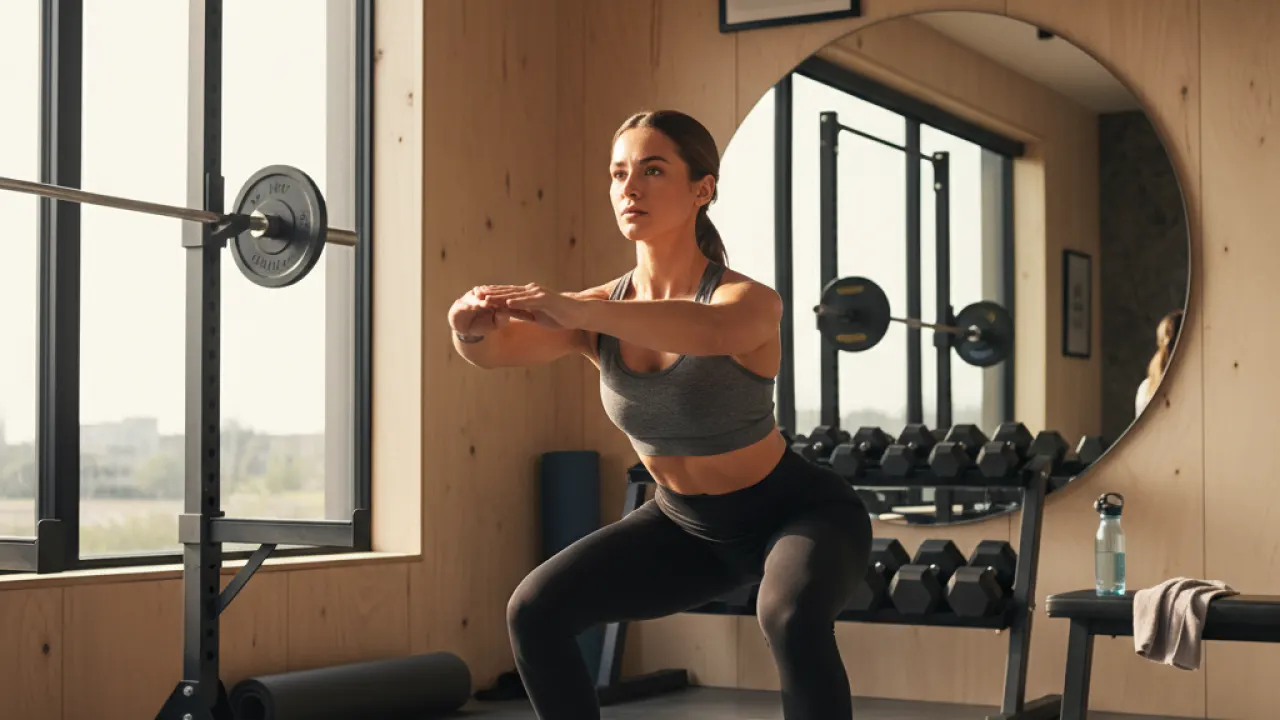
The progression ladder. Half squats – full bodyweight squats – tempo squats (3 seconds down, 1 second up) – bulgarian split squats – jump squats – pistol squats (one leg). Pistols are the gold standard for bodyweight leg strength and take most people 6 to 12 months to master.
The form check. Feet shoulder width. Hips push back first, then knees bend. Chest stays up. Knees track over toes, not collapsing inward. Lower until thighs are parallel to floor or below.
Planks – the core builder
The plank is the single most effective core exercise outside of a gym. 60 seconds of a good plank builds more functional core strength than 100 crunches because it trains the core to stabilise rather than just flex.
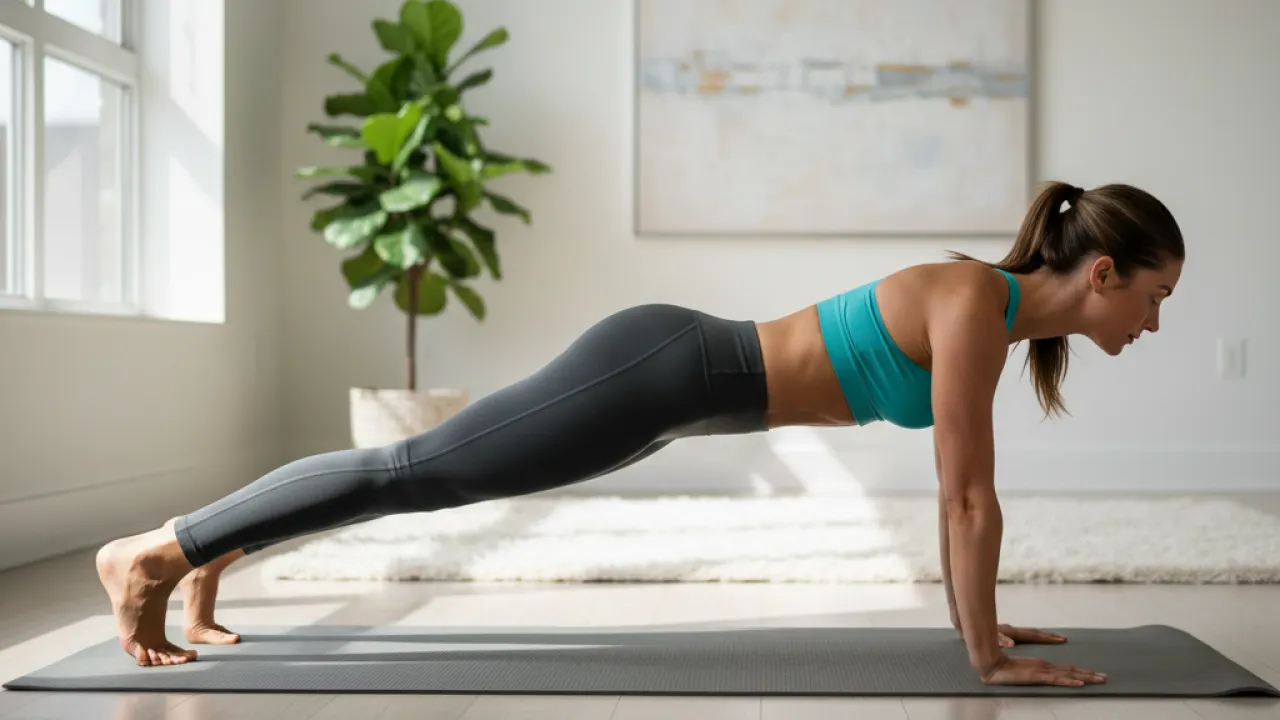
The progression ladder. 30 second plank – 60 second plank – 90 second plank – side planks – plank with leg lift – hollow body hold – dragon flag holds. After 60 seconds becomes too easy, switch to variations rather than just extending time.
The form check. Elbows directly under shoulders for forearm plank, or hands directly under shoulders for high plank. Body straight from head to heels. Hips not sagging or piking up. Brace the core actively as if expecting a punch.
Lunges – the unilateral strength builder
Lunges train each leg independently, which exposes and corrects imbalances that squats can mask. The walking lunge or reverse lunge are the two most useful versions for a home routine.
The progression ladder. Stationary lunges – walking lunges – reverse lunges – lateral lunges – jump lunges – bulgarian split squats. The bulgarian split squat is the closest a bodyweight exercise gets to a barbell back squat in difficulty.
The form check. Step forward or back with one leg, lower until both knees form 90 degree angles. Front knee tracks over front foot. Back knee hovers just above the floor. Push through the front heel to return.
Glute bridges and hip thrusts – the posterior chain
The glutes are the most underdeveloped muscle group in sedentary populations. Glute bridges and hip thrusts target them directly and produce noticeable shape changes in 6 to 8 weeks.
The progression ladder. Glute bridges – hip thrusts (shoulders on couch) – single leg glute bridges – elevated single leg hip thrusts – banded hip thrusts. Adding a resistance band around the knees makes any version harder.
The form check. Push through the heels, not the toes. Squeeze the glutes at the top of each rep. Don’t hyperextend the lower back trying to push higher.
Burpees – the conditioning exercise
The most hated exercise in home workouts, and the most effective. Burpees combine squats, push ups, and jumps into one movement that elevates the heart rate fast and develops conditioning that translates to almost any sport.
The progression ladder. Modified burpees (no push up, no jump) – standard burpees – burpees with push up – burpees with tuck jump – burpee broad jumps – devil press burpees. Most people work up to 10 standard burpees per minute and stop there – that’s already a strong fitness benchmark.
The form check. Drop into squat. Hands on floor. Jump or step feet back to plank. Push up if able. Jump or step feet forward. Stand and jump. Smooth, not jerky.
The optional add ons that double the value
Two pieces of equipment, under $40 combined, dramatically expand what a home routine can do.
Jump rope – the cardio multiplier
A $15 jump rope replaces 30 minutes of jogging with 15 minutes of more intense conditioning that builds calves, shoulders, and full body coordination. Five minutes of jump rope equals roughly 15 minutes of running for cardiovascular benefit.
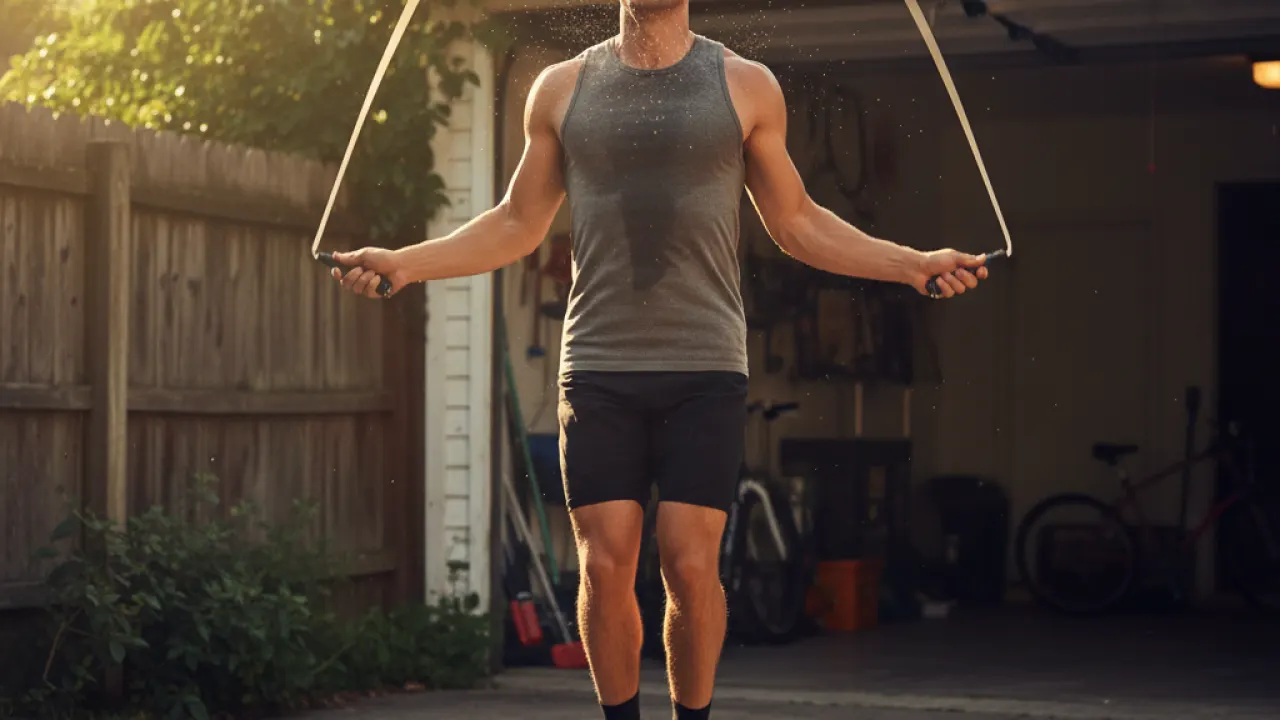
How to add it. Start with 30 seconds on, 30 seconds rest, for 10 rounds. Build to 60 seconds on, 30 seconds rest, for 15 rounds within 4 weeks. The skill improves rapidly.
Resistance bands – the strength multiplier
A set of 5 loop resistance bands – light, medium, heavy, extra heavy – costs $20 and adds 50 plus new exercise variations to the home routine. Banded push ups, banded squats, banded rows, banded face pulls, banded lateral raises, banded pull aparts. All these movements that were impossible with pure bodyweight become trainable.
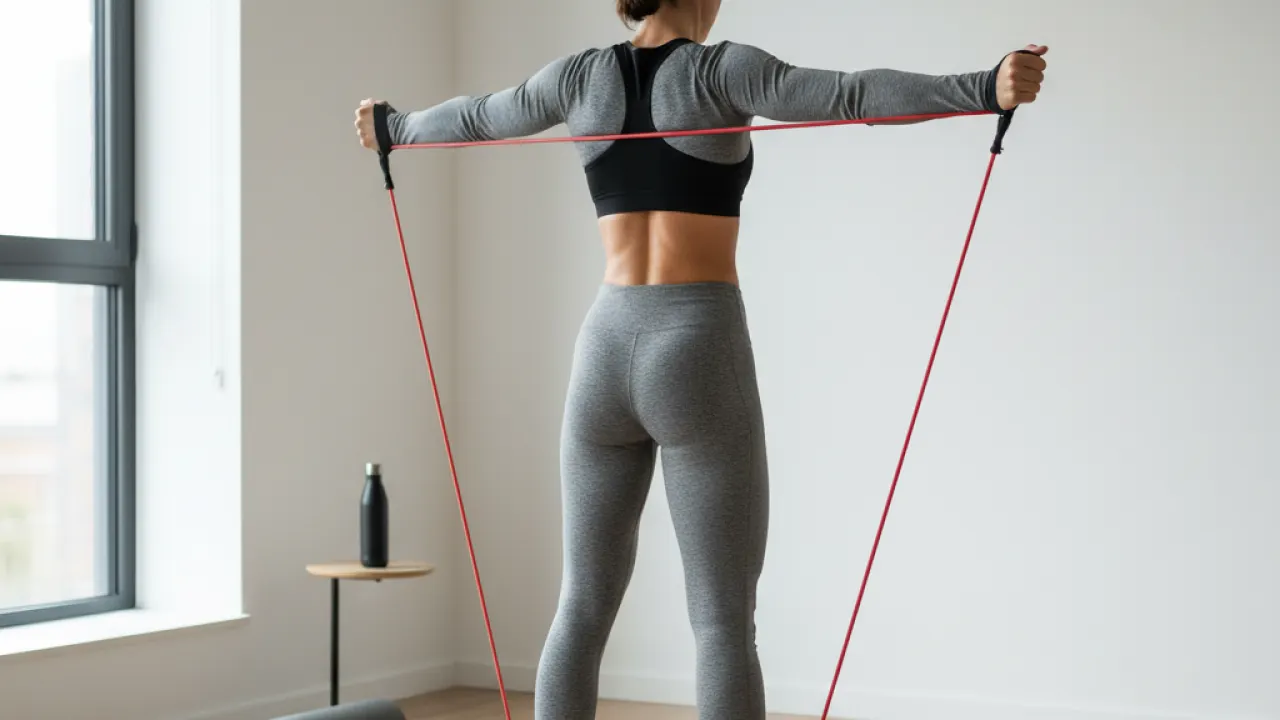
The exercise that bands solve uniquely. The home routine struggles with rowing motions because there’s nothing to pull against. A band looped around a sturdy door handle creates instant rowing variations – bent over rows, face pulls, banded reverse flies. The upper back gets trained without a pull up bar.
The weekly schedule that actually works
Block one (weeks 1 to 4) follows a 3 day per week schedule with full body workouts.
Monday – Push and Core. Push ups 4 sets of 10. Plank 3 sets of 30 seconds. Pike push ups 3 sets of 8. Plank with shoulder taps 3 sets of 20.
Wednesday – Legs and Glutes. Bodyweight squats 4 sets of 15. Lunges 3 sets of 10 each leg. Glute bridges 3 sets of 15. Calf raises 3 sets of 20.
Friday – Full body conditioning. Burpees 5 sets of 5. Mountain climbers 3 sets of 30 seconds. Jumping jacks 5 sets of 30 seconds. Hold last set as long as possible.
Block two (weeks 5 to 8) adds a fourth day and increases intensity.
Monday – Upper body push. Wednesday – Lower body. Thursday – Conditioning circuit with jump rope. Saturday – Pull focus with resistance bands and core. Rest days are Tuesday, Friday, Sunday.
Block three (weeks 9 to 12) splits muscle groups and adds advanced variations.
Monday – Push focus with advanced push up variations. Tuesday – Active recovery with mobility work. Wednesday – Lower body with bulgarian split squats and pistol squat progressions. Thursday – Cardio intervals. Friday – Pull and core with band work. Saturday or Sunday – Optional active recovery walk or light yoga.
How to actually start without quitting
The five biggest reasons home workouts fail, and the fixes.
Starting too aggressively. Most beginners try to do 5 days a week immediately. They’re sore, demotivated, and quit by week 3. Start with 3 days. Earn the 4th and 5th day as the body adapts.
Not setting a fixed time. Working out “sometime today” almost always becomes “not today.” Pick a fixed window – 6:30 AM, lunch break, 7 PM – and protect it like a meeting on the calendar.
Working out in the bedroom or living room without a clear space. A cluttered space sends the brain the wrong message. Clear a corner specifically for training. Mat down, water bottle ready, no distractions.
Skipping the warm up. Cold muscle injuries derail home workouts more than any other cause. Five minutes of jumping jacks, arm circles, and bodyweight movements before the real workout prevents 90 percent of preventable injuries.
Trying to copy advanced YouTube routines on day one. The 15 minute “intense full body burner” videos are designed for people already in shape. They demoralise beginners. Stick to the simple plan above for the first 8 weeks before chasing the entertaining content.
How to know the plan is working
Three honest signs of progress, beyond the scale.
Energy through the day improves. People who train consistently sleep better, wake up sharper, and crash less in the afternoon. This shows up in 2 to 3 weeks.
The same workout feels easier. The push ups that left you wrecked in week 1 feel routine by week 6. Same time, same exercises, lower perceived effort. This is fitness progressing in real time.
Strength benchmarks improve. The number of push ups you can do in a row. How long you can hold a plank. How fast you finish the circuit. Track these once a month. Improvement, even small improvement, is the signal that the plan works.
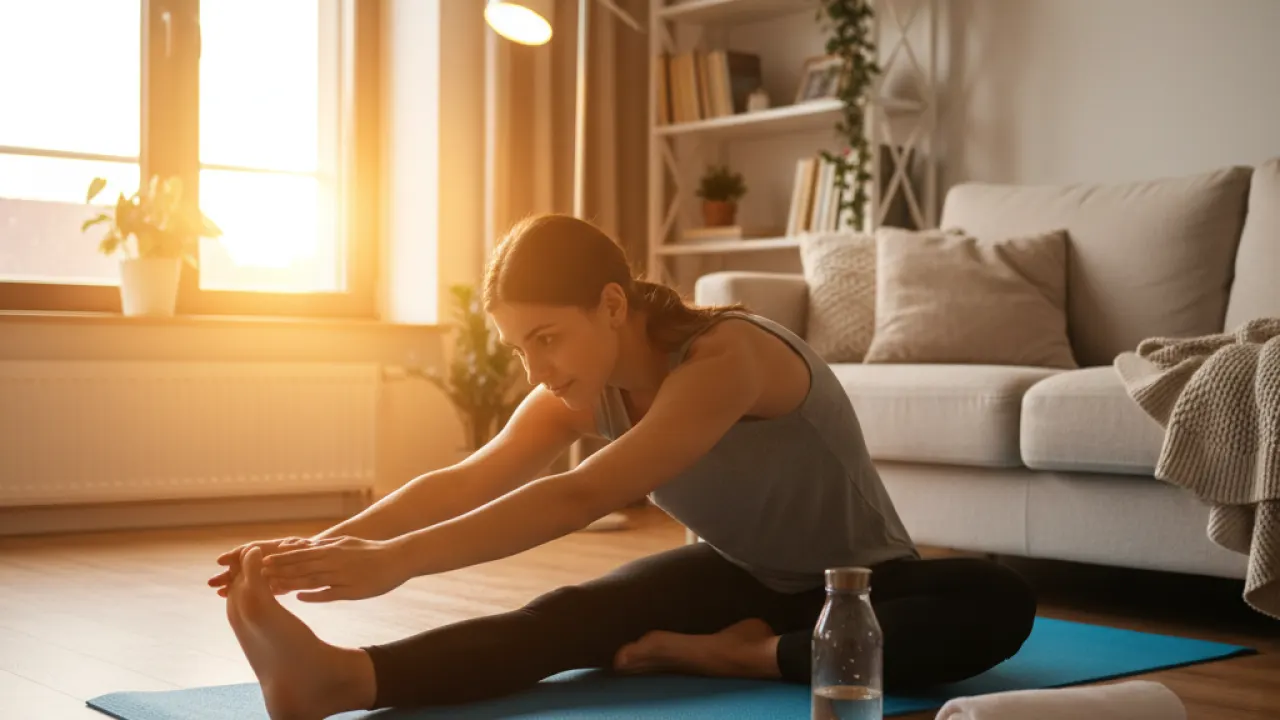
The 5 minute cool down nobody does. Light stretching after every workout reduces next day soreness, improves long term mobility, and signals to the nervous system that training is over. Skipping it is the single most common mistake in home routines.
What to do after 12 weeks
Three paths after the 12 week plan ends.
Repeat the block with progressions. Restart week 1, but with harder versions of each exercise and longer time under tension. This keeps the routine effective for another 3 months.
Add light equipment. A pair of adjustable dumbbells under $200 expands the home routine into proper strength training. Suddenly rows, presses, deadlift variations, and curls are all available.
Move to a gym for compound lifts. Some people max out home workouts and want to lift heavier. The 12 week home plan builds the foundation that makes joining a gym productive – new gym members who can already do 30 push ups and squat 80 reps with good form skip the awkward learning phase.
For more on the broader habits that make a training plan sustainable for years, our piece on 15 daily habits that actually work covers the sleep, food, and stress habits that compound with training.
The role of nutrition in a home workout plan
Training without addressing food is roughly half the picture. Three principles that pair with the plan.
Protein matters. Around 0.7 grams of protein per pound of bodyweight per day for active people. For a 150 pound person that’s 105 grams. Real food sources work fine – eggs, chicken, fish, beans, yogurt, milk. Supplements optional.
Don’t eat back the calories burned. The biggest mistake people make after starting a workout routine is rewarding themselves with extra food. A 30 minute home workout burns 200 to 350 calories. One celebratory pastry undoes the deficit entirely.
Hydration is non negotiable. Two to three litres of water per day for someone training 4 times a week. Dehydration shows up as fatigue, soreness, and motivation crashes that get misattributed to other causes.
Final thoughts and your turn
Best home workout plan for 2026 isn’t the most intense or the most photogenic. It’s the simplest plan you’ll actually follow for 12 weeks straight. Bodyweight basics, three to five sessions a week, progressive overload, fixed schedule. Add a jump rope and a band set for $35 and the program scales for years.
Which week of the 12 week plan would you start on – the basic foundation block or skip ahead to the build block? Drop a comment with where you’d start and the day of the week you’ll commit to. Share the post with someone in your circle who keeps saying they need to start training again.
For related guidance, see our guides on start an online business, best businesses to start, best places in the US, AI business solutions.
Frequently Asked Questions
How quickly can I see results with best home workout plan 2026?
Most people notice initial changes within 2 to 4 weeks of consistent effort. More significant, lasting changes typically become visible within 8 to 12 weeks. The timeline depends on your starting point, how consistently you apply the recommendations, and individual factors like genetics and overall lifestyle. Tracking your progress helps you stay motivated through the process.
What is the most common mistake people make with best home workout plan 2026?
The most common mistake is expecting overnight results and giving up before seeing meaningful progress. Other frequent errors include being inconsistent with the approach, not getting enough sleep and recovery, ignoring nutrition while focusing only on exercise, and comparing progress to others rather than tracking personal improvement over time.
Do I need special equipment or expensive products for best home workout plan 2026?
In most cases, no. Many of the most effective approaches require minimal or no specialized equipment. Focus on the fundamentals first, such as consistent habits and sound principles, before investing in supplements or expensive equipment. When you do need tools, starting with affordable basics and upgrading as you progress is the smartest approach.
Is best home workout plan 2026 safe for everyone?
Most general health and fitness approaches are safe for healthy adults. However, if you have existing medical conditions, are pregnant, or have been inactive for a long period, consulting a healthcare professional before making significant changes is always advisable. Individual circumstances vary and personalized medical guidance ensures the safest possible approach for your specific situation.