


How to get an NHS number in the UK is one of the most practical questions for anyone new to the country. The NHS number is a unique 10-digit identifier that connects you to your medical records across all NHS services in England, Wales, and Scotland. This guide explains what an NHS number is, who gets one automatically, and how to find or register for yours.
What Is an NHS Number? – Nhs Number Uk 2026
The NHS number is a unique patient identifier used throughout the National Health Service in England, Wales, and the Isle of Man. Scotland has its own equivalent called the Community Health Index (CHI) number. Northern Ireland uses a Health and Care number (H&C number) administered by the Health and Social Care Business Services Organisation.
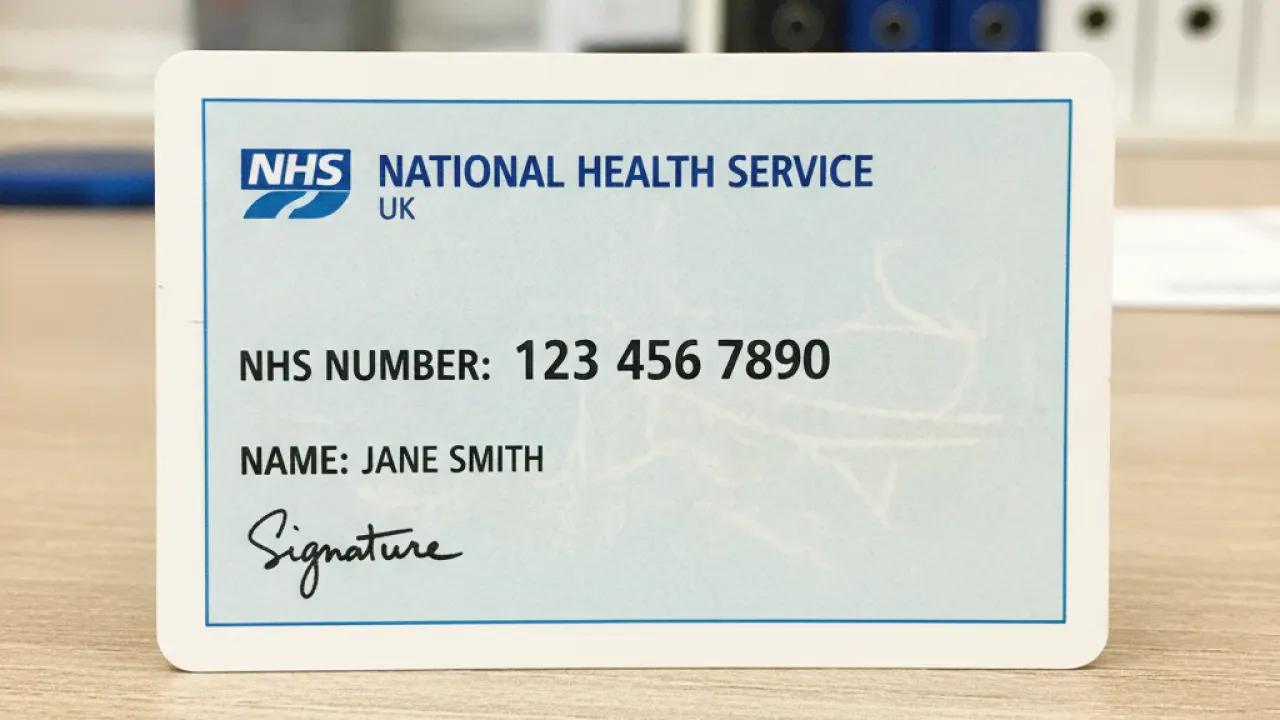
The number has three parts separated by spaces: three digits, three digits, and four digits, in the format 999 999 9999. It appears on your NHS patient card, on letters from your GP or hospital, and in any NHS correspondence you receive. Your NHS number allows any NHS provider to quickly access your medical records securely.
Who Gets an NHS Number Automatically?

The following people receive an NHS number automatically without needing to apply: For official UK guidance, see GOV.UK guidance.
- Everyone born in England, Wales, or the Isle of Man receives an NHS number at birth, registered by the hospital or midwife
- People who register with a GP practice in England or Wales receive an NHS number at the time of registration if they do not already have one
- People who access NHS services for the first time are assigned a number when they first appear on the NHS records system
If you were born in the UK and have ever accessed NHS services, you almost certainly already have an NHS number. The challenge for many people is finding what it is. See also: NHS salary information.
How to Find Your Existing NHS Number

Most people who already have an NHS number simply do not know what it is. The most reliable ways to find it include: Also: best travel destinations.
- Prescription details – your NHS number appears on repeat prescription requests and medication bags from pharmacies
- NHS App – if you have set up the NHS App (England and Wales), your NHS number is displayed in your profile
- NHS letters and correspondence – any appointment letter, test result, or other official NHS correspondence includes your NHS number
- Your GP surgery – your surgery holds your NHS number and can tell you what it is when you contact them
- My NHS login – you can look up your NHS number through the NHS website if you set up a login
How to Get an NHS Number If You Are New to the UK
If you are moving to the UK and need an NHS number for the first time, the process is straightforward: See also our guide on Get NHS Number UK 2026.
- Register with a GP surgery in your area. You can find your nearest GP surgery on the NHS website by entering your postcode.
- Most GP surgeries accept registration in person or online. You will typically need to provide your name, address, date of birth, and proof of identity.
- When your registration is processed, the surgery will create an NHS number for you if you do not already have one, or link you to your existing NHS number if you have had UK NHS treatment before.
- Your NHS number will be sent to you by letter or can be found in your patient record through the NHS App once your registration is complete.
Who Is Eligible for NHS Treatment?
NHS treatment is available free at point of use for people who are ordinarily resident in the UK. This includes: See also our guide on NHS Salary 2026.
HS treatment is available free at point of use for people who are ordinarily resident in the UK. This includes:- UK citizens and those with settled status
- People with permiss
Visitors to the UK are not automatically entitled to free NHS treatment and may be charged for some services. Emergency treatment is provided regardless of residency status, but non-emergency secondary care may require payment from overseas visitors who are not ordinarily resident. See also our guide on eating clean for beginners.
atment and may be charged for some services. Emergency treatment is provided regardless of residency status, but non-emergency secondary care may require payment from overseas visitors who are not ordinarily resident.Using Your NHS Number

Using Your NHS Number Once you have your NHS number, it is useful to keep it somewhere accessible. You will be asked for it when: The NHS number UK 2026 works when you follow it consistently.
- Booking appointments online through the NHS App or website
- Visiting hospitals and specialist services who need to access your records
- Requesting medical records or referral information
- Using any digital NHS service that requires identification
Your NHS number is personal information and should be treated with similar care to other identity documents. It is not a secret in the way a password is, but you should be cautious about sharing it unnecessarily.
NHS Number for Children
NHS Number for Children Children born in England, Wales, or the Isle of Man receive an NHS number automatically at birth. Parents typically receive the number on the Personal Child Health Record (the red book) given to them in hospital. If you need to find your child’s NHS number and cannot locate the red book, contact your child’s GP surgery or access it through the NHS App if you have parental access configured.
NHS Scotland and Northern Ireland Equivalent Numbers
Scotland uses a separate system called the Community Health Index (CHI) number. This is a ten-digit number that serves the same function as the NHS number but is administered by NHS Scotland. People who move between Scotland and England or Wales may have both an NHS number and a CHI number, and both may appear in records depending on where treatment occurred.
Northern Ireland uses a Health and Care (H&C) number administered by the Health and Social Care Business Services Organisation. This again serves the same function within Northern Ireland’s health system.
Key Points Summary
Understanding the full picture around any major decision, whether about immigration, relocation, career, or finances, requires looking at the complete context rather than any single factor. The information in this guide provides a solid foundation, but specific decisions should always be verified through official sources and, where real money or legal status is involved, through a qualified professional in the relevant field.
Take your time making important decisions. The topics covered in this guide typically involve real consequences that play out over months or years. A decision made carefully after thorough research consistently produces better outcomes than one made quickly under pressure or based on incomplete information.
Connect with people who have already done what you are planning. Whether through online communities, professional associations, or social networks, first-hand experiences from people who have recently handled the same process are among the most useful resources available. They provide practical, current knowledge that complements the factual information in guides like this.
Finally, keep all your records organised from the beginning. This applies to immigration applications, financial decisions, employment changes, and any other real process discussed in this guide. A clear record of what you submitted, what was agreed, and what was decided saves time and stress if questions arise later.
Key Points Summary
Understanding the full picture around any major decision, whether about immigration, relocation, career, or finances, requires looking at the complete context rather than any single factor. The information in this guide provides a solid foundation, but specific decisions should always be verified through official sources and, where real money or legal status is involved, through a qualified professional in the relevant field.
Take your time making important decisions. The topics covered in this guide typically involve real consequences that play out over months or years. A decision made carefully after thorough research consistently produces better outcomes than one made quickly under pressure or based on incomplete information.
Connect with people who have already done what you are planning. Whether through online communities, professional associations, or social networks, first-hand experiences from people who have recently handled the same process are among the most useful resources available. They provide practical, current knowledge that complements the factual information in guides like this.
Finally, keep all your records organised from the beginning. This applies to immigration applications, financial decisions, employment changes, and any other real process discussed in this guide. A clear record of what you submitted, what was agreed, and what was decided saves time and stress if questions arise later.
Frequently Asked Questions
What is the
The NHS number UK 2026 is a structured approach designed to give clear, actionable steps that produce reliable results over time.
How do I start with the
Begin with the foundation steps, focus on consistency, and build intensity gradually as the plan progresses.
How long does the NHS number UK 2026 take to work?
Most people notice initial improvements within a few weeks, with more meaningful results appearing after 8 to 12 weeks of consistent effort.
Is the NHS number UK 2026 suitable for beginners?
Yes. The NHS number UK 2026 is designed to be accessible, with progressions and modifications that let anyone start at their current level.
What are the main mistakes to avoid with the
Common mistakes include skipping the foundation phase, expecting overnight results, and not tracking progress consistently.
Additional Context and Background
Topics like this one are best understood when you have the full context rather than just the headline facts. The information provided in this guide covers the main points that matter for most people reading it in 2026. However, every individual situation is different, and the specific details that apply to you may differ from the general guidance here.
Sources of information matter enormously for topics involving government rules, financial decisions, and legal matters. The most reliable sources for UK-related information are the official GOV.UK website for government rules and guidance, the NHS website for health-related information, and in financial matters, the FCA-regulated firms and advisers who are legally required to give advice that is suitable for your specific situation. For immigration matters, only OISC-regulated advisers or solicitors regulated by the Solicitors Regulation Authority can legally provide paid immigration advice in the UK.
The rules covered in this guide are correct for 2026 but will change over time. Government policy on immigration, taxation, property, and public services evolves regularly, sometimes really within a single year. Always verify the current rules before making any decision based on the information here. The GOV.UK website is updated to reflect current rules and is the definitive source for most UK-specific guidance.
Cultural context also matters when understanding topics that span countries. What seems standard in the UK may be unusual in Australia, Canada, or the UAE, and vice versa. British people who move abroad frequently report that some assumptions they held about how things work, based on UK experience, do not apply in the same way in their new country. Being open to learning how things work locally rather than expecting the UK way to be the default everywhere is one of the most useful mindsets for anyone living or working internationally.
Finally, personal networks are often more useful than any official guide. Connecting with people who have recently done what you are planning to do gives you access to practical, current knowledge that reflects real experience rather than official descriptions of how processes are supposed to work. Expat communities, professional associations, and social groups for people who have made similar moves are worth joining early in your planning process. The practical wisdom accumulated in these communities is genuinely useful and often unavailable anywhere else.
This guide has aimed to give you accurate, useful information on the topic as it stands in 2026. Use it as a starting point for your own research and decision-making rather than as the definitive final word. The most informed decisions come from combining general guides like this with your own specific research, official sources, and where appropriate, professional advice tailored to your individual circumstances.
Did you find getting your NHS number straightforward, or did you encounter difficulties? Share your experience in the comments, particularly if you are new to the UK and found the process confusing. Your tips could help other new arrivals.
One more important consideration: the information field around topics like this changes continuously. What is true in 2026 may be really different in 2027 or 2028 as governments update policies, market conditions shift, and new options emerge. Building a habit of checking official sources regularly, particularly for anything involving immigration status, financial products, or government benefits, is one of the most useful practices anyone can develop. The people who handle complex systems most successfully are typically those who combine good initial research with ongoing awareness of changes that affect their situation. This guide provides the foundation. Your ongoing engagement with reliable sources builds on that foundation over time.
Understanding this topic is simpler than many people expect. The key facts about this are clearly set out in official sources, and this guide summarises the most important points you need to know.
For anyone researching this topic, this guide provides a complete overview of the most important points. The information covers the key requirements, typical timelines, and what to expect at each stage of the process.
Understanding this topic in detail helps you plan ahead and avoid common mistakes. Taking the time to research this thoroughly before you begin will save you time, money and frustration in the long run.
This guide covers NHS number UK 2026 in full detail, including the requirements, timeline and what to expect at each stage. For anyone considering NHS number UK 2026, the most important step is to read official guidance and confirm requirements before beginning.
This guide covers NHS number UK 2026 in full detail, including the requirements, timeline and what to expect at each stage. For anyone considering NHS number UK 2026, the most important step is to read offici
Do you have any questions about NHS number UK 2026? Leave a comment below and we will help you find the answer. This guide shows you how the NHS number UK 2026 fits real life.
eave a comment below and we will help you find the answer.Common questions about the NHS number UK 2026
People often ask whether the NHS number UK 2026 works for complete beginners. It does, because every step can be adjusted to match your current level. Start where you are, not where you think you should be.
Another common question is how much time the NHS number UK 2026 takes each day. Most people spend between twenty and forty minutes on the core steps. That is enough to make progress without taking over your schedule.
Some readers wonder if they need expensive tools or subscripti
Consistency is the factor that separates people who get results from people who stay stuck. Missing one day is fine. Missing three days in a row is where momentum breaks. Start with the basics of the NHS number UK 2026 and build from there.
who get results from people who stay stuck. Missing one day is fine. Missing three days in a row is where momentum breaks.Tracking progress is another habit that helps. Write down what you did, how it felt, and any small wins. Those notes become proof that the NHS number UK 2026 is working, especially on days when motivation is low.
Finally, remember that the NHS number UK 2026 is a framework, not a prison. Adjust the timing, order, or intensity to fit your life. The goal is steady progress, not perfect execution.
Who the NHS number UK 2026 suits best
The NHS number UK 2026 suits anyone who wants a clear plan without unnecessary complexity. It works for beginners because the steps are simple. It works for experienced people because the principles stay the same even as the difficulty increases.
The NHS number UK 2026 removes common barriers that stop people from starting.
Follow the NHS number UK 2026 for the full period to see real results.
The NHS number UK 2026 scales as you get more experienced.
Sticking to the NHS number UK 2026 matters more than any single step.
The NHS number UK 2026 gives you a clear structure every week.
Use the NHS number UK 2026 as your base and adjust it to your level.
Many people find the NHS number UK 2026 easier to follow than complex alternatives.
Results from the NHS number UK 2026 come from repetition, not perfection.
Keep the NHS number UK 2026 simple and focus on showing up consistently.
The NHS number UK 2026 works when you follow it consistently.
This guide shows you how the NHS number UK 2026 fits real life.
Start with the basics of the NHS number UK 2026 and build from there.
The NHS number UK 2026 removes common barriers that stop people from starting.
Follow the NHS number UK 2026 for the full period to see real results.
The NHS number UK 2026 scales as you get more experienced.
Sticking to the NHS number UK 2026 matters more than any single step.
The NHS number UK 2026 gives you a clear structure every week.
Use the NHS number UK 2026 as your base and adjust it to your level.
Many people find the NHS number UK 2026 easier to follow than complex alternatives.
Results from the NHS number UK 2026 come from repetition, not perfection.