


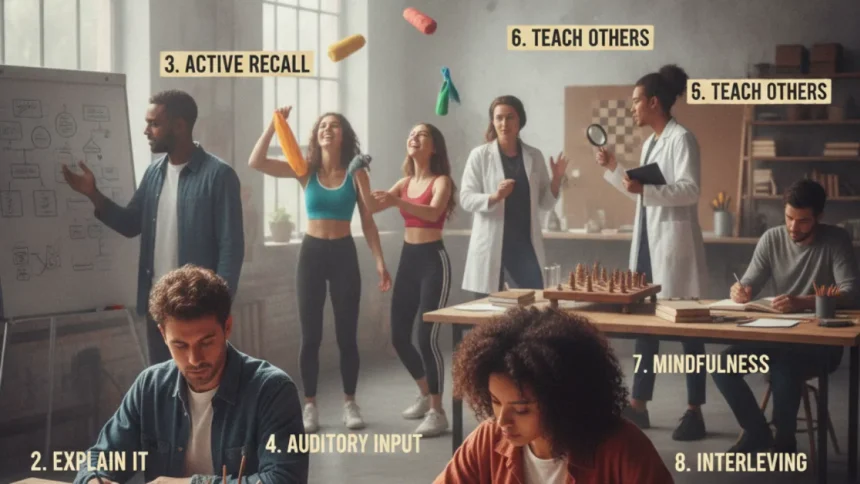
You want to pick up a new skill. Maybe it is a language, a coding framework, or a musical instrument. You sit down, you study, and weeks later you feel like you have barely moved. Sound familiar?
According to Wikipedia on the science of learning, spaced repetition and active recall have been shown to improve long-term memory retention noticeablely
The problem usually is not effort. It is method. Most people learn the slow way without knowing it. The good news is that a handful of techniques can cut your learning time really. These are not shortcuts that skip real understanding. They are strategies backed by research in cognitive science.
This guide covers 9 techniques that work for almost any skill. You can start using most of them today. See also our guide on building better habits for learning.
1. Use Spaced Repetition – How To Learn Faster

Spaced repetition is one of the most well-tested ideas in learning science. Instead of reviewing material every day, you spread reviews out over time. You review something right before you would normally forget it.
Here is why it works. Every time you recall something, you strengthen that memory. And every time you space out a review, you force your brain to work a little harder to retrieve it. That extra effort makes the memory stick longer. See also our guide on productivity techniques for students.
Tools like Anki make spaced repetition easy to use. Anki is a free flashcard app that schedules your reviews automatically. You rate how well you remembered each card, and the app decides when to show it again. Many medical students and language learners swear by it. See a
You do not need an app to get started. Even writing out review dates on a calendar works. The key is to not cram everything into one session. See also our guide on a home workout plan.
ed an app to get started. Even writing out review dates on a calendar works. The key is to not cram everything into one session.How to apply it
- Review new material 1 day after learning it, then 3 days later, then a week later
- Use Anki for vocabulary, formulas, or any fact-based material
- Keep sessions short, around 15 to 20 minutes per day
2. Practice Active Recall
<figure cReading your notes again feels like learning. But re-reading is one of the weakest study methods. Your brain recognizes the words and tricks you into thinking you know the material. See also our guide on gym membership costs in the UK.
” />Reading your notes again feels like learning. But re-reading is one of the weakest study methods. Your brain recognizes the words and tricks you into thinking you know the material.
Active recall flips the process. Instead of reading the answer, you try to produce it from memory first. You close the book and ask yourself: what did I just learn? You quiz yourself before you feel ready. That struggle is the point.
A simple way to do this is the blank page method. After a study session, take a blank sheet of paper and write down everything you remember without looking at your notes. Then check what you got wrong or missed. Focus your next session on those gaps. If you are looking to expand your knowledge, reading detailed breakdown of improve mobile performance provides useful background context. If you are looking to expand your knowledge, reading detailed breakdown of improve mobile performance provides valuable background context.
Studies from cognitive psychology consistently show that testing yourself leads to better retention than re-studying. This is sometimes called the testing effect. It is one of the most reliable findings in learning research.
Quick ways to use active recall

- Turn your notes into questions and quiz yourself
- Use flashcards, but always guess before flipping
- After reading a chapter, close the book and summarize it out loud
- Try practice problems before reviewing solutions
3. Try the Feynman Technique

Richard Feynman was a Nobel Prize-winning physicist known for explaining complex ideas in plain language. The technique named after him is built on a simple principle: if you cannot explain something simply, you do not fully understand it yet.
Here is how it works. Pick a concept you are learning. Write it out as if you are explaining it to a child or someone with no background in the topic. When you hit a point where your explanation breaks down or gets fuzzy, that is your knowledge gap. Go back to your source material and fill in that gap.
This technique forces you to confront what you do not know. It is uncomfortable but effective. Many people spend hours studying and never realize they have gaps until they try to explain the topic to someone else.
You can use this for any subject. Science concepts, programming logic, historical events, business strategies. If you can walk someone through it step by step in plain language, you truly know it.
4. Chunk Information

Your working memory can hold only a small amount of information at once. When you try to learn too much at one time, your brain gets overloaded and retention drops. The how to learn faster works when you follow it consistently.
Chunking solves this. It means grouping smaller pieces of information into larger meaningful units. Once a chunk is solid in your memory, your brain can treat it as one unit instead of many. This frees up working memory for new material.
Think about how you learned to type. At first every key was a separate decision. After enough practice, words became single actions. You stopped thinking about individual letters. That is chunking in action.
How to chunk effectively
- Learn the basics of one concept completely before moving on
- Group related ideas under one label or framework
- Practice until a skill feels automatic before adding complexity
Platforms like Khan Academy and Coursera often structure courses around chunking without naming it explicitly. They build skills in layers, each new lesson assuming the last is solid. That progression is intentional.
5. Use Interleaving

Most people study one topic until they feel comfortable, then move on to the next. This is called blocked practice. It feels productive because you get good at the thing you are currently doing. But research shows it leads to weaker long-term retention.
Interleaving means mixing different topics or types of problems in a single session. Instead of doing 30 math problems of the same type, you mix problem types together. Instead of studying grammar for an hour, you mix grammar, vocabulary, and reading comprehension.
Interleaving is harder in the moment. You make more mistakes. It feels less smooth. But that difficulty forces your brain to identify what strategy fits each problem. That skill transfers much better to real-world situations.
One study published in Psychological Science found that students who used interleaved practice outperformed those who used blocked practice on tests given a week later, even though the interleaved group scored lower during the initial learning session. Similar principles apply when reviewing detailed breakdown of free movie sites warning, where preparation and research make a noticeable difference. Similar principles apply when reviewing detailed breakdown of free movie sites warning, where preparation and research make a noticeable difference.
6. Do Deliberate Practice
Spending hours on a skill does not guarantee improvement. You can play guitar every day for years and stay at the same level. What matters is how you practice. This guide shows you how the how to learn faster fits real life.
d stay at the same level. What matters is how you practice.Deliberate practice is a concept developed by psychologist Anders Ericsson. It means working on the specific parts of a skill that are just beyond your current ability. Not comfortable repetition. Not the parts you already do well. The edges where you struggle.
This requires honest self-assessment. You need to know where your weak points are. Then you design practice that targets those points directly. You also need feedback. Either from a teacher, from recordings of your performance, or from measurable outcomes.
What deliberate practice looks like
- A pianist practicing the same four bars of a difficult passage, not the whole song
- A coder solving problems in areas they find hard, not re-do
If you want to learn faster, check in with yourself often. If practice feels comfortable all the time, you are probably not growing. Start with the basics of the how to learn faster and build from there.
ant to learn faster, check in with yourself often. If practice feels comfortable all the time, you are probably not growing.7. Teach What You Learn
One of the fastest ways to cement a skill is to teach it. This goes beyond the Feynman Technique. It means finding real opportunities to explain, demonstrate, or help others with what you are learning.
Teaching forces you to organize information. It shows you gaps you did not know you had. And the act of putting things in your own words strengthens memory more than passive review.
You do not need a classroom. You can write a blog post, answer questions in an online forum, explain something to a friend, or even talk through a topic out loud to yourself. The goal is to produce, not just consume.
This connects to
If you are working on productivity habits, one good habit is scheduling a short teach-back session after each study block. Five minutes is enough. The how to learn faster removes common barriers that stop people from starting.
ne later can improve how well you study.If you are working on productivity habits, one good habit is scheduling a short teach-back session after each study block. Five minutes is enough.
8. Manage Your Learning Environment

8. Manage Your Learning Environment Where and how you learn matters more than most people think. Noise, phone notifications, and switching between tasks all eat into your focus. And focus is the
If you want to be more productive at work or during study, start with your environment. A few changes can make a big difference. Follow the how to learn faster for the full period to see real results.
onstant interruptions. Even brief interruptions, like glancing at a phone, reset your concentration and cost you minutes of recovery time.If you want to be more productive at work or during study, start with your environment. A few changes can make a big difference. For broader insights, exploring detailed breakdown of what are ai business solutions? a complete beginner’s guide will give you actionable takeaways you can apply right away. For broader insights, exploring detailed breakdown of what are ai business solutions? a complete beginner’s guide will give you actionable takeaways you can apply right away.
9. Sleep and Rest Are Part of the Process
- Aim for 7 to 9 hours of sleep per night
- Avoid screens in the hour before bed to protect sleep quality
- Review material briefly right before sleep, as sleep may help consolidate it
- Take a short nap of 10 to 20 minutes if you are tired mid-day
Frequently Asked Questions
What is the
The how to learn faster is a structured approach designed to give clear, actionable steps that produce reliable results over time.
How do I start with the
Begin with the foundation steps, focus on consistency, and build intensity gradually as the plan progresses.
How long does the how to learn faster take to work?
Most people notice initial improvements within a few weeks, with more meaningful results appearing after 8 to 12 weeks of consistent effort.
Is the how to learn faster suitable for beginners?
Yes. The how to learn faster is designed to be accessible, with progressions and modifications that let anyone start at their current level.
What are the main mistakes to avoid with the
Common mistakes include skipping the foundation phase, expecting overnight results, and not tracking progress consistently.