



The best index funds UK 2026 are a straightforward way for ordinary people to invest in hundreds of companies at once, for very little cost. This guide covers the top ETFs available on the UK market right now, how they work, and exactly how to buy them through an ISA or SIPP.
If you want to grow your money without paying a fund manager to pick stocks, exchange-traded funds are the most practical tool available. They track a market index, they trade on the stock exchange like any share, and their fees are a fraction of what active funds charge. The best index funds UK 2026 offer some of the lowest costs of any investment product in the world.

What Is an ETF?
An ETF, or exchange-traded fund, is a fund that holds a basket of assets, usually designed to track the performance of a market index. The FTSE 100 index tracks the 100 biggest companies listed in the UK. If you buy a FTSE 100 ETF, you own a tiny slice of all 100 of those companies in one purchase.
ETFs are different from traditional unit trusts. They trade on a stock exchange throughout the day, just like individual shares. That means you can buy or sell them any time the market is open. The price moves in real time. You get the same exposure as buying dozens of stocks, but with a single transaction and a single annual fee.
The annual fee is called the Total Expense Ratio, or TER. For most major ETFs in the UK, the TER sits between 0.07% and 0.25% per year. That’s between 70 pence and 2.50 pounds on every 1,000 pounds invested annually. Compare that to the average active fund charge of around 1.5% per year, which is 15 pounds on every 1,000 pounds.
That difference sounds small, but over 20 or 30 years it compounds dramatically. A lower fee means more of your money stays invested and keeps growing. For official UK guidance, see GOV.UK guidance.
How ETFs Work in the UK
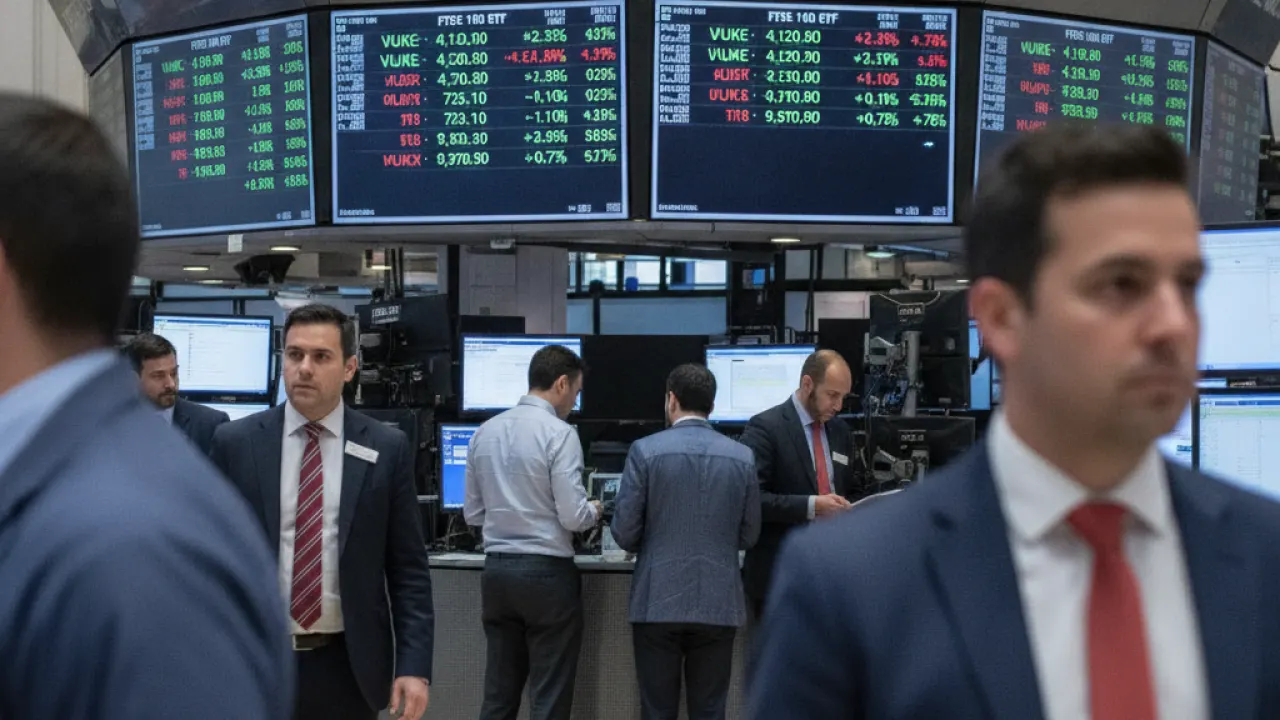
In the UK, most ETFs that private investors use are listed on the London Stock Exchange. They carry the UCITS label, which stands for Undertakings for Collective Investment in Transferable Securities. This is a European regulatory standard that survived Brexit and still applies in the UK. UCITS rules set limits on how much of any single asset a fund can hold, which protects investors from concentration risk.
When you buy an ETF through a UK broker, you’re buying it in pounds sterling. Some ETFs hold assets denominated in US dollars or euros, but your shares in the fund are priced in GBP. This removes the hassle of currency conversion for most transactions.
ETFs can be physically replicated or synthetically replicated. Physical ETFs actually hold the underlying assets. If you buy the Vanguard FTSE All-World ETF, Vanguard genuinely holds shares in thousands of companies. Synthetic ETFs use financial contracts called swaps to replicate returns without directly holding the assets. For most UK retail investors, physical replication is the safer and more transparent choice.
The UK’s Financial Conduct Authority regulates ETFs. They must publish a Key Investor Information Document (KIID) that outlines fees, risks, and past performance. Always read the KIID before buying any fund.
Best Global ETFs for UK Investors in 2026

These are the most-used ETFs among UK investors right now. They represent the best index funds UK 2026 has to offer across different market segments, so the right one depends on what you want to own.
Vanguard FTSE All-World (VWRP)
VWRP tracks the FTSE All-World Index, giving you exposure to around 3,700 companies across 50 countries, including both developed and emerging markets. It covers roughly 90% of the global investable market. The TER is 0.22% per year. This is the most popular single-fund solution for UK investors who want global diversification in one holding. It reinvests dividends automatically, which is ideal for long-term growth inside an ISA.
iShares Core MSCI World (IWDA)
IWDA tracks the MSCI World Index, which covers about 1,400 large and mid-cap companies across 23 developed markets. Emerging markets like China and India are not included. The TER is 0.20% per year. IWDA is one of the most liquid ETFs on the London Stock Exchange. Its lower TER compared to VWRP is attractive, but you’re trading away emerging market exposure. Many investors pair IWDA with a small emerging market ETF to fill that gap.
SPDR S&P 500 (SPY5)
SPY5 tracks the S&P 500 Index, giving you the 500 largest companies listed in the United States. This includes Apple, Microsoft, Amazon, Alphabet, and Nvidia. The TER is 0.03%, making it one of the cheapest ETFs available in the UK. The downside is concentration: the US represents around 70% of the global market cap, and the S&P 500 is heavily weighted towards a handful of technology stocks. It’s a strong standalone fund but not a globally diversified one.
Vanguard FTSE 100 (VUKE)
VUKE tracks the FTSE 100 Index, the 100 largest companies listed on the London Stock Exchange. The TER is 0.09%. This fund gives you concentrated UK exposure. The FTSE 100 is historically dividend-heavy, with many energy, mining, banking, and pharmaceutical companies paying above-average dividends. It’s a good complement to a global ETF if you want more UK domestic exposure, but it has lagged global markets over the past decade. Use it as part of a blend rather than a standalone investment.
iShares MSCI Emerging Markets (EMIM)
EMIM tracks the MSCI Emerging Markets Investable Market Index, covering over 3,000 companies across 27 developing countries, including China, India, Taiwan, South Korea, and Brazil. The TER is 0.18%. Emerging markets historically have higher growth potential than developed markets, but they come with greater volatility and political risk. Many investors allocate 10% to 20% of their equity holding to EMIM alongside a developed-world ETF like IWDA.
Invesco FTSE All-World (FWRG)
FWRG is a newer competitor to VWRP. It also tracks the FTSE All-World Index but charges a slightly lower TER of 0.15%. It was launched to compete with Vanguard on price. The trade-off is lower trading liquidity compared to VWRP, so the bid-ask spread can be slightly wider. For long-term buy-and-hold investors, this difference is minor.
You can read more about how stocks and ETFs compare in our guide to the best stocks to buy in the UK in 2026.
Best Bond ETFs for UK Investors

Bonds are loans. When you buy a bond ETF, you’re effectively lending money to governments or companies in exchange for regular interest payments. They tend to fall less than equities during market crashes, which is why many investors hold a mix of equity and bond ETFs.
iShares Core UK Gilts (IGLT)
IGLT holds UK government bonds (gilts) of various maturities. The TER is 0.07%. It’s one of the lowest-cost bond ETFs available in the UK. Gilts are considered very low risk because they’re backed by the UK government, but they’re not risk-free. When interest rates rise, gilt prices fall. Over the past two years that relationship has been painfully visible for gilt holders.
Vanguard Global Bond Index (VAGS)
VAGS gives you exposure to thousands of government and corporate bonds from developed markets worldwide. The TER is 0.10%. It’s currency-hedged to pounds sterling, which removes foreign exchange risk. This is a useful core bond holding for UK investors who want global diversification on the fixed income side of their portfolio.
iShares USD Corporate Bond (LQDE)
LQDE holds investment-grade corporate bonds denominated in US dollars. The TER is 0.20%. Corporate bonds pay higher interest than government bonds, but they carry more risk if the issuing companies run into trouble. LQDE is suited to investors who want income and can accept a degree of credit risk alongside the interest rate risk all bonds carry.
For most new investors, a simple portfolio of one global equity ETF and one bond ETF covers the main asset classes at minimal cost. See our piece on how to save for retirement in the UK for guidance on how much to allocate to each.
ETF vs Actively Managed Funds

Active fund managers try to beat the market by picking individual stocks. Most of them fail to do this consistently after fees are taken into account. The evidence is stark: over a 15-year period, around 85% to 90% of active equity funds in the UK underperform their benchmark index after charges, according to S&P’s SPIVA scorecards.
The reasons are straightforward. Active fund managers charge higher fees, typically 1% to 2% per year. They trade more often, which creates transaction costs inside the fund. And finding stocks that consistently outperform is genuinely difficult. Even skilled managers have bad years, and those bad years often arrive exactly when investors need their fund to hold up.
There are exceptions. Some niche areas of the market, like smaller companies, may be less efficiently priced, giving active managers a better chance of adding value. Some active managers do genuinely outperform over very long periods. But identifying them in advance is nearly impossible, and their higher fees eat into the advantage even when they succeed.
For most UK investors, a simple portfolio of low-cost index ETFs gives better long-term results than chasing active fund performance.
How to Buy ETFs in the UK

You buy ETFs through an investment platform, also called a stockbroker. In the UK you have several good options, each with a different fee structure.
Stocks and Shares ISA
The best index funds UK 2026 selections are most efficiently held inside a Stocks and Shares ISA. In fact, most UK investors treat the ISA as the default account for holding the best index funds UK 2026 offers. An ISA is a tax wrapper, not a fund itself. Any gains, dividends, and income you earn inside an ISA are completely free from UK tax. The 2026 annual ISA allowance is 20,000 pounds. You can open one with any UK investment platform.
Once money is inside an ISA, it grows tax-free indefinitely. You don’t pay capital gains tax when you sell, and you don’t pay income tax on dividends. This is genuinely the most powerful benefit available to ordinary UK investors and the first place you should invest before considering other accounts.
Self-Invested Personal Pension (SIPP)
A SIPP is another tax-efficient wrapper for holding ETFs. Contributions to a SIPP receive tax relief at your marginal rate. A basic-rate taxpayer contributes 80 pounds and the government adds 20 pounds, topping it up to 100 pounds. Higher-rate taxpayers claim further relief through their tax return.
The trade-off is that you can’t access a SIPP until age 57 (rising to 58 from 2028). It’s ideal for long-term retirement savings. Many UK investors max their ISA first, then contribute to a SIPP for the tax relief boost. You can read more about pensions in our guide to the best pension schemes in the UK for 2026.
General Investment Account (GIA)
A GIA has no annual contribution limits and no restrictions on access. The downside is that gains above the capital gains tax annual exempt amount (currently 3,000 pounds for the 2025/26 tax year) are taxable, and dividends above 500 pounds per year attract income tax. Most investors use a GIA only once they’ve filled their ISA and SIPP allowances.
Best Platforms for Buying ETFs in the UK
Four platforms dominate the UK market for ETF investing:
- Vanguard Investor – Best for low-cost simplicity. The platform fee is 0.15% per year, capped at 375 pounds. It only sells Vanguard funds and ETFs, which keeps things simple. Ideal if you plan to use VWRP or VUKE.
- Hargreaves Lansdown – The UK’s largest investment platform. It offers nearly every ETF available on the London Stock Exchange. Platform fees are 0.45% per year for shares and ETFs, capped at 45 pounds per year. Good for investors who want wide choice and a reliable interface.
- AJ Bell – Charges 0.25% per year for ETFs and shares, capped at 3.50 pounds per month. Competitive pricing with a solid range of ETFs. It has improved its platform a great deal in recent years.
- Interactive Investor – Uses a flat monthly fee rather than a percentage. The basic plan is 4.99 pounds per month. This makes it cheaper for larger portfolios where percentage-based fees add up. Each account includes one free trade per month.
Total Expense Ratios Explained
The TER is the annual cost of owning an ETF, expressed as a percentage. It covers the fund manager’s fee, administration, legal costs, and custody. It does not include the brokerage platform’s own fee or any trading commissions you pay when you buy or sell.
The TER is deducted daily from the fund’s net asset value. You never receive a bill. You simply notice that the fund grows slightly less than the raw index return. A 0.22% TER means on a 10,000 pound holding you pay 22 pounds per year in fund costs, taken automatically.
Always compare TERs when choosing between similar ETFs tracking the same index. VWRP charges 0.22%, FWRG charges 0.15%. Over 20 years on a large portfolio, that 0.07% difference adds up to a meaningful sum.
Tax Efficiency of ETFs Inside an ISA
When you hold ETFs outside a tax wrapper like an ISA, two taxes can apply. Capital gains tax applies when you sell at a profit above the annual exempt amount. Income tax applies to dividends received above the dividend allowance.
Inside a Stocks and Shares ISA, both of these are eliminated. This makes an ISA the best container for long-term ETF investing in the UK. HMRC’s guidance on ISAs confirms that all investment growth inside an ISA is free of UK tax, permanently.
If you’re investing through a SIPP, dividends received are also free of tax inside the pension wrapper. When you eventually draw an income from your SIPP in retirement, you pay income tax on 75% of each withdrawal, with the first 25% tax-free (subject to the lump sum limit). The tax relief on contributions typically more than outweighs the tax paid on withdrawal, especially for higher-rate taxpayers.
For anyone just starting out, our guide on achieving financial freedom in the UK covers how to build a solid investment base from the ground up.
Common Mistakes New ETF Investors Make
Most mistakes come from impatience or overcomplication. Here are the most common ones to avoid.
Checking prices every day – ETF investing works best over years and decades. Watching daily price movements is not just pointless, it actively encourages bad decisions. Most people who sell during a dip lock in losses they would have recovered if they’d stayed put.
Buying too many ETFs – More ETFs don’t mean better diversification once you’ve covered the main asset classes. Owning VWRP and EMIM together creates duplication because VWRP already includes emerging markets. A portfolio of 12 overlapping ETFs is not more diversified than two well-chosen ones. It’s just more complex and more expensive to maintain.
Choosing funds based on past performance – Past performance is not a reliable guide to future returns. An ETF that returned 30% last year might have been heavily weighted in a sector that has since corrected. Stick to broad index ETFs rather than themed or sector-specific ones that have recently performed well.
Ignoring the TER – A 1% TER difference over 30 years on a 50,000 pound portfolio can cost you tens of thousands of pounds in foregone growth. The TER is the one cost you control directly when choosing between similar funds.
Forgetting about currency risk – Many ETFs hold foreign assets. If the pound strengthens against the dollar, a US-heavy ETF like SPY5 will underperform in GBP terms even if US stocks rise. For long-term investors this tends to average out, but it’s worth understanding that short-term returns in GBP can diverge from the index’s returns in local currency.
Frequently Asked Questions
What is the
The best index funds UK 2026 is a structured approach designed to give clear, actionable steps that produce reliable results over time.
How do I start with the
Begin with the foundation steps, focus on consistency, and build intensity gradually as the plan progresses.
How long does the best index funds UK 2026 take to work?
Most people notice initial improvements within a few weeks, with more meaningful results appearing after 8 to 12 weeks of consistent effort.
Is the best index funds UK 2026 suitable for beginners?
Yes. The best index funds UK 2026 is designed to be accessible, with progressions and modifications that let anyone start at their current level.
What are the main mistakes to avoid with the
Common mistakes include skipping the foundation phase, expecting overnight results, and not tracking progress consistently.
Which Are the Best Index Funds UK 2026 for You?
The honest answer depends on your time horizon, risk tolerance, and how much simplicity you want. Among all the best index funds UK 2026, the right choice comes down to what you’re trying to own and how hands-on you want to be.
If you want one fund and nothing else, VWRP covers the global market, reinvests dividends automatically, and costs 0.22% per year. It’s the closest thing to a one-stop-shop for long-term equity investing in the UK. A huge number of UK investors use nothing else inside their ISA.
If you want a slightly cheaper option with the same global exposure, FWRG is identical in what it tracks but costs 0.15% per year. The trade-off is lower daily trading volume, so it’s better suited to regular monthly purchases than frequent trading.
If you want to exclude emerging markets and focus on developed economies only, IWDA at 0.20% gives you clean developed-world exposure. Pair it with EMIM at 0.18% if you want emerging market exposure as a separate allocation you can control.
If you’re building for retirement and want bonds in the mix, add IGLT or VAGS. A common rule of thumb is to hold your age as a percentage in bonds (so 35 years old means 35% bonds, 65% equities), though many younger investors go 100% equity for longer because of the higher growth potential over multi-decade time horizons.
The most important step is to start. Picking between VWRP and IWDA matters far less than actually investing and staying invested. Time in the market beats timing the market, every time.
Which ETF are you considering for your ISA or SIPP in 2026? Drop your question below and we’ll point you in the right direction. The best index funds UK 2026 works when you follow it consistently.
This guide shows you how the best index funds UK 2026 fits real life.
Start with the basics of the best index funds UK 2026 and build from there.
The best index funds UK 2026 removes common barriers that stop people from starting.
Follow the best index funds UK 2026 for the full period to see real results.
The best index funds UK 2026 scales as you get more experienced.
Sticking to the best index funds UK 2026 matters more than any single step.
The best index funds UK 2026 gives you a clear structure every week.
Use the best index funds UK 2026 as your base and adjust it to your level.
Many people find the best index funds UK 2026 easier to follow than complex alternatives.
Results from the best index funds UK 2026 come from repetition, not perfection.
Keep the best index funds UK 2026 simple and focus on showing up consistently.
The best index funds UK 2026 works when you follow it consistently.
This guide shows you how the best index funds UK 2026 fits real life.
Start with the basics of the best index funds UK 2026 and build from there.
The best index funds UK 2026 removes common barriers that stop people from starting.
Follow the best index funds UK 2026 for the full period to see real results.
The best index funds UK 2026 scales as you get more experienced.
Sticking to the best index funds UK 2026 matters more than any single step.
The best index funds UK 2026 gives you a clear structure every week.
Use the best index funds UK 2026 as your base and adjust it to your level.
Many people find the best index funds UK 2026 easier to follow than complex alternatives.
Results from the best index funds UK 2026 come from repetition, not perfection.
Keep the best index funds UK 2026 simple and focus on showing up consistently.
The best index funds UK 2026 works when you follow it consistently.
This guide shows you how the best index funds UK 2026 fits real life.
Start with the basics of the best index funds UK 2026 and build from there.
The best index funds UK 2026 removes common barriers that stop people from starting.
Follow the best index funds UK 2026 for the full period to see real results.