



The best pension UK 2026 options come down to four main types: the State Pension, workplace pensions, SIPPs, and the Lifetime ISA. Knowing which one suits your situation can mean the difference between retiring comfortably and running short of money. This guide covers all four, the key 2026 numbers, and how to get the most from whatever pension you already have.

What Types of Pension Exist in the UK?
The best pension UK savers can access falls into four categories. Each works differently and suits different life stages. Most people end up using two or three of them over a career. For official UK guidance, see GOV.UK guidance.
State Pension. The government-backed pension paid from State Pension age (currently 66). You earn it through National Insurance (NI) contributions. In 2026, the full new State Pension is 221.20 pounds per week. You need 35 qualifying years of NI contributions for the full amount. Ten years is the minimum to get anything at all.
Workplace pension. An employer-sponsored pension scheme. Since auto-enrolment became law, most UK workers are enrolled automatically. The employer must contribute at least 3% of qualifying earnings. Employees add at least 5%. Many employers contribute more.
SIPP (Self-Invested Personal Pension). A pension you set up yourself with a provider like Vanguard, Hargreaves Lansdown, AJ Bell, or PensionBee. You choose where the money is invested. SIPPs suit the self-employed, people who want more investment control, or those who want to consolidate old pensions.
Lifetime ISA (LISA). Not technically a pension, but widely used for retirement saving. The government adds a 25% bonus on up to 4,000 pounds per year. You can open a LISA between ages 18 and 39 and use the money at 60 or later without penalty. Withdraw before 60 for any other reason and you lose the bonus plus pay a penalty.
State Pension UK 2026: What You Need to Know
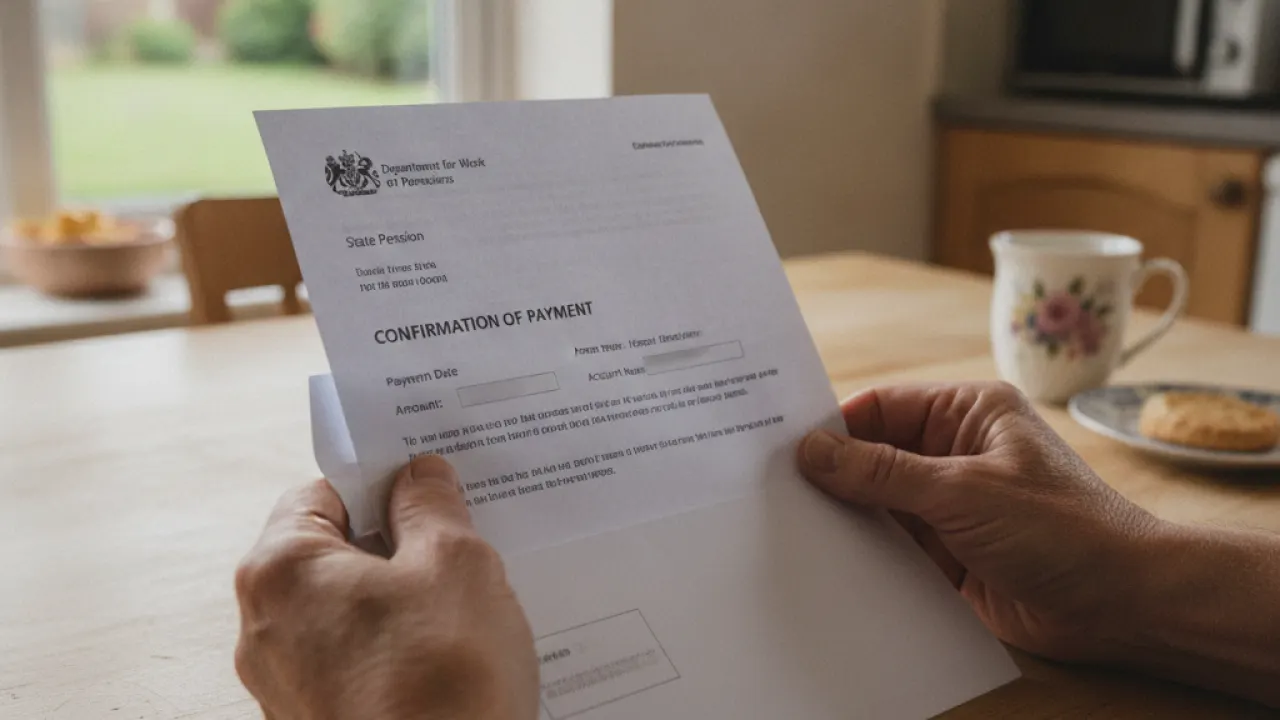
The State Pension is the foundation of most UK retirement plans. In 2026, the full new State Pension pays 221.20 pounds per week, or roughly 11,502 pounds per year. That figure is based on the triple lock guarantee, which uprates the pension each April by whichever is highest: inflation, average earnings, or 2.5%.
You can check your State Pension forecast through the government gateway at gov.uk. The forecast tells you your NI record, how many qualifying years you have, and what you are on track to receive at State Pension age.
If you have gaps in your NI record, you can usually fill them by buying voluntary NI contributions. The cost versus benefit is almost always worth it for people short of 35 qualifying years. Each qualifying year adds around 6.32 pounds per week to your State Pension, which compounds over a 20 to 30 year retirement.
State Pension age is 66 for both men and women as of 2026. Planned increases to 67 are scheduled between 2026 and 2028. Further rises to 68 are being debated. Check your personal State Pension age if you are under 55.
If you are building retirement income alongside your pension, the guide to building wealth in the UK covers strategies that complement pension saving.
Workplace Pensions and Auto-Enrolment

Workplace pensions are the most common pension for employed people in the UK. Auto-enrolment has been in place since 2012 and now covers most employed workers aged 22 to 66 who earn above 10,000 pounds per year.
The minimum total contribution under auto-enrolment in 2026 is 8% of qualifying earnings. At least 3% must come from the employer. The employee pays the remaining 5%, though many employers match contributions above the minimum.
NEST (National Employment Savings Trust) is the government-backed workplace pension for employers who need a default provider. NEST is used by millions of workers, particularly at smaller companies. It is low cost but offers limited investment choice.
If your employer uses Scottish Widows, Aviva, Legal and General, or NOW:Pensions, the rules are the same but investment options and charges vary. Check your scheme annual management charge. Anything above 0.75% per year is cutting into your long-term returns.
One thing many employees overlook: if your employer offers to match extra contributions above the minimum, that is free money. If your employer matches up to 6% and you only pay 5%, increase your contributions. The employer match is an instant 100% return on that extra 1%.
Best SIPP Providers UK 2026

A SIPP is the best pension UK option for the self-employed, freelancers, and anyone who wants full investment control. The four most used SIPP providers in 2026 are:
Vanguard. The cheapest option for index fund investing. Platform fee is 0.15% per year, capped at 375 pounds. Fund charges average 0.07 to 0.22%. Best for passive investors who want a global tracker fund and low costs.
Hargreaves Lansdown (HL). The largest UK investment platform with the widest fund and share choice. Platform fee is 0.45% per year for funds, capped at 200 pounds. More expensive than Vanguard but better for picking individual shares or a wide range of funds.
AJ Bell. Good middle ground between Vanguard and HL. Platform fee is 0.25% per year. Wide investment choice with a user-friendly app.
PensionBee. Designed for simplicity. One plan, one monthly fee, one app. Best for people who want to consolidate old workplace pensions without making their own investment decisions. Plans range from 0.50% to 0.95% per year.
For self-employed people, a SIPP is often the best pension UK vehicle because there is no employer contribution. Tax relief makes up part of that gap. Basic rate taxpayers get 20% tax relief automatically. Higher rate taxpayers can claim an additional 20% through self assessment.
If you are comparing investment options beyond pensions, the guide to the best ETFs UK explains how index funds work inside and outside a pension wrapper.
Pension Allowances UK 2026
Understanding the limits is part of choosing the best pension UK 2026 strategy. Two numbers matter most.
Annual allowance: 60,000 pounds. This is the maximum you can contribute to all your pensions combined in a tax year and still receive tax relief. Most people never reach this limit. But higher earners and people who receive large employer contributions should track the total.
Lifetime allowance: abolished. The previous cap of 1.07 million pounds was scrapped in April 2024. There is no overall pot size limit in 2026. The lump sum commutation allowance sits at 268,275 pounds but the pension pot itself is uncapped.
Money purchase annual allowance (MPAA): 10,000 pounds. Once you start taking flexible income from a defined contribution pension in drawdown, your allowance for future contributions drops to 10,000 pounds. This matters if you plan to access pension income before fully retiring.
For anyone also building a stocks portfolio, the best stocks UK guide covers holding shares both inside and outside a pension.
Tax Relief on Pension Contributions

Tax relief is what makes pensions so powerful. Every pound you put in is topped up by the government. The rate depends on your income tax band.
Basic rate taxpayers (20%): for every 80p you contribute, HMRC adds 20p, making it 1 pound in your pension. Your pension provider claims this automatically under relief at source.
Higher rate taxpayers (40%): you get 20% added automatically, plus you can claim another 20% through self assessment. A 100-pound pension contribution costs you just 60 pounds after full tax relief.
Additional rate taxpayers (45%): the same mechanism applies, but you get 25% back through self assessment. A 100-pound pension contribution costs just 55 pounds.
Non-taxpayers can still contribute up to 2,880 pounds per year and receive basic rate relief, making the actual pension pot contribution 3,600 pounds. This is worth doing for children, non-working spouses, and anyone between jobs.
When Can You Access Your Pension?
The normal minimum pension age (NMPA) is 55 as of 2026. It rises to 57 from April 2028. If you plan to retire early, this date matters. Accessing a pension before the minimum age triggers an unauthorised payments charge of up to 70% of the amount taken, except in cases of serious ill health.
From age 55 (or 57 from 2028) you have three main ways to take money from a defined contribution pension:
Drawdown. Move the pension into a drawdown product and take income as you need it. The remaining pot stays invested. This is the most flexible option and the most used for people who want their money to keep growing.
Annuity. Use the pension pot to buy a guaranteed income for life from an insurer. Annuity rates in 2026 are the best in 15 years following the rise in interest rates. A 100,000-pound pot can now buy an income of around 6,500 to 7,500 pounds per year for life.
Lump sum withdrawals. Take cash directly from the pension. The first 25% of each withdrawal is tax-free. The remaining 75% is taxed as income. Taking large amounts can push you into a higher tax band.
Pension vs ISA: Which Is Better?
The best pension UK approach for many people is to use both a pension and an ISA. Each has advantages the other lacks.
Pensions give you tax relief going in, which makes them more powerful for higher rate taxpayers. The trade-off is that withdrawals above the tax-free lump sum are taxed as income. Pensions are also locked away until age 55 (57 from 2028).
ISAs give you no tax relief on contributions, but all withdrawals are completely tax-free. ISAs are also fully accessible at any age. If you need flexibility or are a basic rate taxpayer, ISAs often make sense alongside a pension.
A common strategy: max out employer pension contributions first (always take the full employer match), then use a Lifetime ISA if you are under 40, then split remaining savings between a SIPP and a stocks and shares ISA based on your tax position.
For more on building wealth through multiple streams, the legal wealth-building guide UK covers how to layer different savings products.
How to Consolidate Old Pensions

The average UK worker changes jobs 12 times in their career. Most leave behind a workplace pension at each employer. Tracking and consolidating these lost pensions is one of the best actions you can take for your retirement.
The Pension Tracing Service at gov.uk helps you find lost workplace pensions using old employer details. It is free to use and locates contact details for schemes you have forgotten about.
Once you find them, you can leave them where they are or transfer to a single provider such as a SIPP or your current workplace scheme. Consolidating makes it easier to manage investments, reduces paperwork, and avoids multiple sets of charges.
Before transferring, check three things. First: does the old scheme have a guaranteed annuity rate or a defined benefit promise? These can be very difficult to replace and you may be giving up a guaranteed income by transferring. Second: are there transfer penalties? Some older schemes charge exit fees. Third: are the receiving scheme charges lower than the old scheme?
If the total transfer value is above 30,000 pounds from a defined benefit scheme, you are legally required to take regulated financial advice before transferring.
For building extra savings to boost pension contributions, the side hustle ideas UK guide covers realistic options for earning more each month.
How to Choose the Best Pension UK 2026 for Your Situation
The right pension depends on three things: employment status, income, and time horizon.
Employed workers. The best pension UK 2026 option for most employees is maximising the workplace pension first, then opening a SIPP if you want more investment control or have additional income to save. Always take the full employer match before adding anything to a SIPP.
Self-employed workers. The best pension UK 2026 option for the self-employed is a SIPP with one of the four providers above. You control the contributions, the investment, and the timing. Set up a standing order on the same day each month so contributions happen automatically.
People with old workplace pensions. The best pension UK 2026 action for people who have changed jobs multiple times is to trace all old pensions, compare their charges, and consolidate into a single low-cost SIPP or your current workplace scheme.
People in their 50s. The best pension UK 2026 priority for those approaching retirement is understanding drawdown versus annuity, checking whether they should fill NI gaps before April 2029 (the deadline for purchasing older voluntary contributions), and reviewing their State Pension forecast.
Whatever your situation, the best pension UK 2026 decision you can make today is to start. The difference between starting pension contributions at 25 versus 35 is enormous due to compound growth. A 25-year-old contributing 200 pounds per month into a pension with 7% annual growth will have roughly double the pot at 65 compared to someone who starts at 35 with the same contributions.
How Much Do You Need to Retire Comfortably?
The Pensions and Lifetime Savings Association (PLSA) publishes annual retirement living standards for the UK. For 2026, the figures are:
Minimum retirement income: 14,400 pounds per year for a single person. This covers basic needs with some leisure but no car.
Moderate retirement income: 31,300 pounds per year for a single person. This includes some holidays, a small car, and regular leisure activities.
Comfortable retirement income: 43,100 pounds per year for a single person. Regular holidays, a newer car, home improvements, and hobbies.
The full State Pension of 11,502 pounds per year means you need an additional 2,898 pounds from private sources to hit even the minimum standard. For a comfortable retirement, you need private pension income of around 31,600 pounds per year on top of the State Pension.
Using the 4% drawdown rule (withdrawing 4% of your pot per year), a comfortable retirement for a single person requires a pension pot of around 790,000 pounds in 2026. With 30 to 40 years of contributions and investment growth, that is achievable for people who start early and contribute consistently.
Common Pension Mistakes to Avoid
These mistakes cost UK savers tens of thousands in retirement income. Most are easy to avoid once you know about them.
Not taking the full employer match. If your employer matches up to 6% and you only pay 5%, you are leaving free money on the table every year. Increase your contributions to the employer cap.
Leaving pensions behind when changing jobs. Dormant pots often sit in default funds with high charges. Trace and consolidate them.
Cashing out small pensions when leaving a job. Anything under 10,000 pounds can be taken as a lump sum. Most people spend it. Leaving it invested for 20 more years is almost always better.
Taking too much too early in drawdown. Withdrawing 6% or 7% per year in your 60s can deplete the pot before you reach your 80s, precisely when care costs tend to rise.
Ignoring NI gaps. Check your State Pension forecast at gov.uk. If you have gaps, filling them is often the cheapest pension boost available.
Frequently Asked Questions
What is the
The best pension uk 2026 is a structured approach designed to give clear, actionable steps that produce reliable results over time.
How do I start with the
Begin with the foundation steps, focus on consistency, and build intensity gradually as the plan progresses.
How long does the best pension uk 2026 take to work?
Most people notice initial improvements within a few weeks, with more meaningful results appearing after 8 to 12 weeks of consistent effort.
Is the best pension uk 2026 suitable for beginners?
Yes. The best pension uk 2026 is designed to be accessible, with progressions and modifications that let anyone start at their current level.
What are the main mistakes to avoid with the
Common mistakes include skipping the foundation phase, expecting overnight results, and not tracking progress consistently.
Your Next Step with the Best Pension UK 2026
The best pension UK 2026 strategy depends on your employment status, income, age, and how hands-on you want to be. Most people should be using at least two pension types: the State Pension by building NI years, and either a workplace pension or a SIPP.
Start by checking your State Pension forecast at gov.uk. Then find any lost pensions using the Pension Tracing Service. Review your workplace pension contributions to make sure you are taking the full employer match. If you are self-employed, set up a SIPP with one of the four providers listed above and start contributing today.
Which type of pension are you currently using, and is it doing enough for your retirement? Leave a comment and let us know your biggest pension question right now. The best pension uk 2026 works when you follow it consistently.
This guide shows you how the best pension uk 2026 fits real life.
Start with the basics of the best pension uk 2026 and build from there.
The best pension uk 2026 removes common barriers that stop people from starting.
Follow the best pension uk 2026 for the full period to see real results.
The best pension uk 2026 scales as you get more experienced.
Sticking to the best pension uk 2026 matters more than any single step.
The best pension uk 2026 gives you a clear structure every week.
Use the best pension uk 2026 as your base and adjust it to your level.
Many people find the best pension uk 2026 easier to follow than complex alternatives.
Results from the best pension uk 2026 come from repetition, not perfection.
Keep the best pension uk 2026 simple and focus on showing up consistently.
The best pension uk 2026 works when you follow it consistently.
This guide shows you how the best pension uk 2026 fits real life.
Start with the basics of the best pension uk 2026 and build from there.
The best pension uk 2026 removes common barriers that stop people from starting.
Follow the best pension uk 2026 for the full period to see real results.
The best pension uk 2026 scales as you get more experienced.
Sticking to the best pension uk 2026 matters more than any single step.
The best pension uk 2026 gives you a clear structure every week.
Use the best pension uk 2026 as your base and adjust it to your level.
Many people find the best pension uk 2026 easier to follow than complex alternatives.