



The income tax rates UK 2026 haven’t changed from last year, but that doesn’t mean your tax bill stays the same. If your pay went up, you could have moved into a higher band without realising it. This guide breaks down every rate, every threshold, and every allowance you can use to pay less.

What the Income Tax Rates UK 2026 Actually Are
Most people in England, Wales, and Northern Ireland pay tax under four bands. These are set by the UK Government and collected by HMRC. The bands apply to your taxable income, which is your total earnings minus your Personal Allowance. For official UK guidance, see GOV.UK guidance.
Here are the rates for 2025/26, which cover the current tax year running from 6 April 2025 to 5 April 2026:
- Personal Allowance — £12,570. You pay 0% on this amount.
- Basic rate — 20% on earnings between £12,571 and £50,270.
- Higher rate — 40% on earnings between £50,271 and £125,140.
- Additional rate — 45% on everything above £125,140.
The Personal Allowance is the most important number. It is the amount you earn completely free of income tax. Everyone gets it automatically unless their income goes above £100,000, at which point it starts to reduce.
So if you earn £35,000 a year, your taxable income is £35,000 minus £12,570, which leaves £22,430. You pay 20% on that figure, which is £4,486 in income tax for the year. You don’t get pushed into the 40% band until your earnings clear £50,270.
How PAYE Works and Why You Rarely Have to Think About It
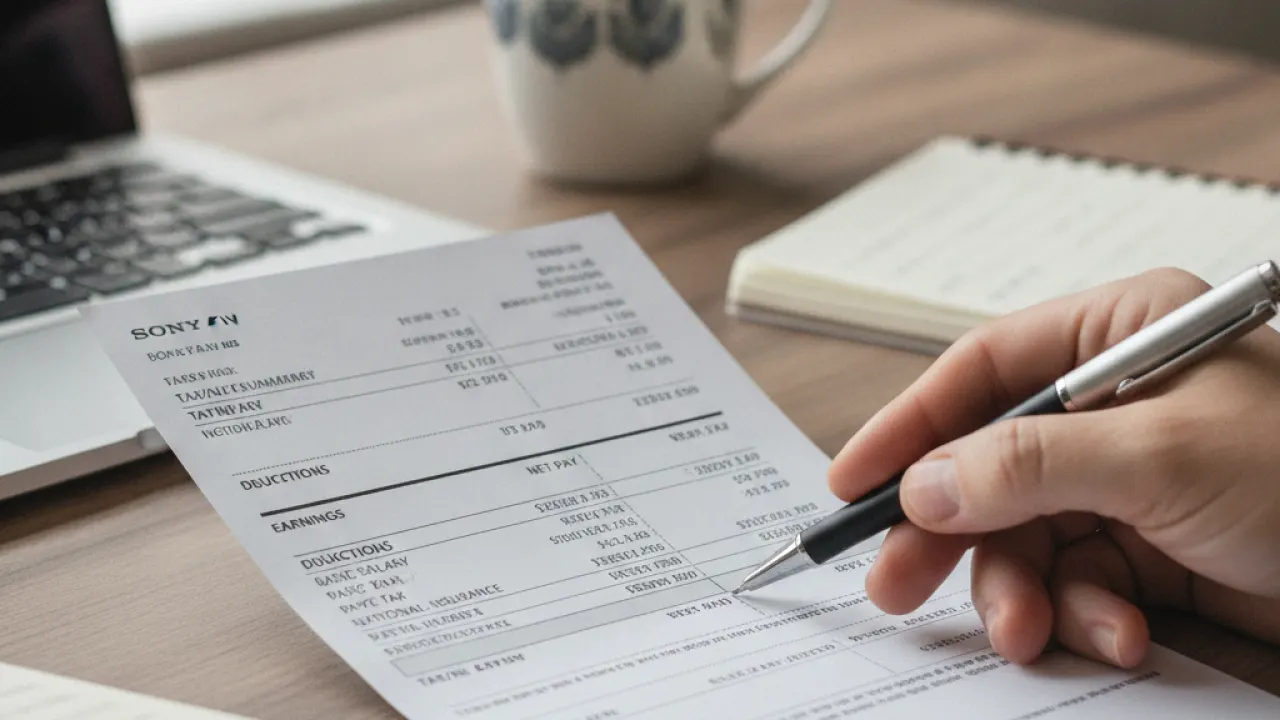
If you work for an employer, your income tax is collected through PAYE, which stands for Pay As You Earn. Your employer deducts the right amount from every payslip and sends it directly to HMRC. You never see that money. It never hits your bank account.
HMRC sends your employer a tax code that tells them how much to deduct. The most common code in 2026 is 1257L. That number means you get a Personal Allowance of £12,570. The “L” suffix means you are entitled to the standard allowance with no adjustments.
If your tax code has a “K” prefix, it means you have a negative allowance, usually because of untaxed income elsewhere like a company benefit or state pension. If your code ends in “M” or “N”, it relates to the Marriage Allowance, which is covered below.
Check your tax code every year. HMRC does make mistakes, and an incorrect code can mean you have been paying too much or too little tax for months. You can check your current code and update your details through the HMRC app or your personal tax account at gov.uk.
What to Do If Your Tax Code Is Wrong
Contact HMRC directly by phone on 0300 200 3300 or update your details through your online personal tax account. If you have overpaid tax, HMRC will usually adjust your code automatically and refund the difference at the end of the tax year. If you have underpaid, HMRC will spread the repayment through your code the following year rather than sending you a single demand.
National Insurance in 2026: The Other Tax You Pay
Income tax is not the only deduction on your payslip. National Insurance Contributions (NICs) are a separate charge and many people confuse the two. Understanding both is the only way to know what you are actually taking home.
For employees in 2026, the NI rates are:
- Class 1 NI (employee) — 8% on earnings between £12,570 and £50,270 per year.
- Above £50,270 — 2% on earnings above that threshold.
- Below £12,570 — 0%. You pay nothing on earnings below the Primary Threshold.
Employers also pay their own NI on top of what you see deducted, currently 13.8% on earnings above £5,000 per year. That is a cost your employer bears, not something you see on your payslip directly.
For the self-employed, the rates are different. Class 4 NICs apply at 6% on profits between £12,570 and £50,270, then 2% above that. Class 2 NICs are no longer compulsory for the self-employed from April 2024 onwards, though voluntary contributions are still possible to protect your State Pension entitlement.
Here is a quick example of what a £40,000 salary actually costs in tax and NI. After your Personal Allowance of £12,570, you pay 20% on £27,430, which is £5,486 in income tax. You also pay 8% NI on £27,430, which is £2,194. Total deductions: £7,680. Your take-home pay is £32,320 before any pension contributions or other deductions.
Scottish Income Tax Rates Are Different

If you live in Scotland, you pay Scottish income tax on your non-savings income. The Scottish Parliament sets these rates independently, and in 2026 there are six bands instead of the three that apply in the rest of the UK.
The Scottish income tax bands for 2025/26 are:
- Starter rate — 19% on income between £12,571 and £14,876.
- Scottish basic rate — 20% on income between £14,877 and £26,561.
- Intermediate rate — 21% on income between £26,562 and £43,662.
- Higher rate — 42% on income between £43,663 and £75,000.
- Advanced rate — 45% on income between £75,001 and £125,140.
- Top rate — 48% on income above £125,140.
Scotland’s Personal Allowance remains the same as the rest of the UK at £12,570. But once you earn past that, Scottish rates kick in. Someone earning £50,000 in Scotland pays noticeably more in income tax than someone earning the same amount in England. The difference can be over £1,500 a year for earnings around that level.
Your tax residency is determined by where you live, not where you work. If you live in Scotland but commute to a job in England, you still pay Scottish income tax. Your employer receives a different tax code from HMRC specifically for Scottish taxpayers, prefixed with “S”.
For those managing their own credit score and financial planning, understanding which tax band you fall into in Scotland versus England makes a real difference to your net income calculations.
The Personal Allowance and When It Disappears
The standard Personal Allowance is £12,570. It has been frozen at this level since April 2021 and will remain frozen until at least April 2028 under current government plans. This freeze is what economists call “fiscal drag.” As wages rise with inflation, more people gradually move into higher tax bands even though the headline rates have not changed.
If your income goes above £100,000, your Personal Allowance starts to reduce. For every £2 you earn above £100,000, you lose £1 of your allowance. So at £112,570, your allowance is gone completely. This creates an effective marginal tax rate of 60% on earnings between £100,000 and £125,140, because you are paying 40% income tax on that extra pound AND losing allowance that would have sheltered another pound from tax.
If your income is close to £100,000, making pension contributions is one of the few ways to bring your adjusted net income below that threshold and recover your Personal Allowance. It is worth looking at your pension options carefully if you are near this level.
Blind Person’s Allowance
If you are registered as blind or severely sight impaired, you get an extra Blind Person’s Allowance of £3,070 on top of your Personal Allowance for 2025/26. That means your total tax-free allowance becomes £15,640. If your allowance is more than your income, your spouse or civil partner can claim the unused portion.
Marriage Allowance: How Couples Can Pay Less Tax

Marriage Allowance lets one spouse or civil partner transfer up to £1,260 of their Personal Allowance to the other. It is available when one partner earns below the Personal Allowance of £12,570, and the other pays income tax at the basic rate (not higher rate).
The receiving partner’s tax bill reduces by up to £252 a year (20% of £1,260). That is not a huge saving, but it is free money that many couples miss. HMRC estimates that around a million eligible couples have not claimed it yet.
You can claim Marriage Allowance back for up to four previous tax years if you were eligible and did not apply. That is potentially over £1,000 in backdated tax reductions. Apply through the HMRC website or the HMRC app. The lower-earning partner applies and transfers the allowance to the other.
To qualify:
- You must be married or in a civil partnership (not just living together).
- One partner must earn below £12,570.
- The other must be a basic rate taxpayer (earning between £12,571 and £50,270).
- Neither partner can be in Scotland paying Scottish income tax at the starter, basic, or intermediate rate (Scottish Marriage Allowance has slightly different eligibility rules).
Income from Savings: The Personal Savings Allowance

Interest you earn from a savings account is taxable income. But most people don’t pay tax on it because of the Personal Savings Allowance (PSA), which works separately from your main income tax allowance.
The PSA for 2025/26 is:
- Basic rate taxpayers — £1,000 of savings interest tax-free.
- Higher rate taxpayers — £500 of savings interest tax-free.
- Additional rate taxpayers — £0. No savings allowance at all.
With savings rates higher in 2025 and 2026 than they were a few years ago, more people are going over their PSA than in previous years. If you earn more than £1,000 in savings interest (basic rate) or £500 (higher rate), the excess is added to your total income and taxed at your marginal rate. HMRC usually collects this through your tax code the following year rather than requiring a separate payment.
A cash ISA lets you earn savings interest tax-free with no limit, regardless of your tax band. Up to £20,000 can go into ISAs each tax year. For those building up an emergency fund, a cash ISA is one of the most tax-efficient places to keep accessible money.
Dividend Income Tax Rates UK 2026
If you own shares in a company and receive dividends, those are taxed separately from your other income. Dividends have their own rates and their own annual allowance.
The Dividend Allowance for 2025/26 is £500. This is the amount of dividend income you can receive tax-free. It was cut from £2,000 in 2023 and then from £1,000 in 2024, so the trend has been downward.
Above the £500 allowance, dividends are taxed at:
- Basic rate band — 8.75%.
- Higher rate band — 33.75%.
- Additional rate — 39.35%.
Dividends are added to your other income to determine which band they fall into. So if you earn £45,000 from employment and £10,000 in dividends, the first £500 of dividends is free, then £4,770 falls in the basic rate band (at 8.75%), and the remaining £4,730 crosses into the higher rate band (at 33.75%). Many company directors use an accountant to manage their dividend strategy because of this complexity.
How to Get a Tax Refund If You Have Overpaid

Overpaying income tax is more common than people realise. It happens when you change jobs, leave work mid-year, work on a temporary contract, or have an emergency tax code applied in error. HMRC doesn’t always catch it automatically in the year it happens.
If you are employed and paid through PAYE, HMRC reconciles your account at the end of each tax year. If you have overpaid, they will usually send a P800 tax calculation letter by September of the following tax year. This shows what you earned, what tax you paid, and what you are owed back.
If your P800 says you are owed a refund, you can claim it online through your personal tax account, which is the fastest route. The money arrives in your bank account within five working days if you provide your bank details. If you don’t act, HMRC will eventually send a cheque, but that can take several weeks longer.
Common reasons for overpayment include:
- Starting a new job with an emergency tax code (often BR or 0T).
- Leaving employment part-way through the year (meaning you did not use your full annual Personal Allowance).
- Working multiple jobs where each employer deducts tax separately.
- Receiving a one-off payment like redundancy or a large bonus that pushed you into a higher band temporarily.
- Incorrectly coded benefits that do not reflect your actual situation.
If you have overpaid in previous years (up to four years back) and HMRC has not refunded you automatically, you can claim directly through your personal tax account or by writing to HMRC. Keep any P60 or P45 forms from those years as evidence.
Income Tax Rates UK 2026 vs Previous Years: The Freeze Effect
The actual headline rates have not changed since 2017 for the basic and higher rate, and since 2010 for the additional rate. What has changed is the thresholds, and the current freeze is quietly pulling more people into higher tax territory.
The Personal Allowance and basic rate threshold have been frozen at £12,570 and £50,270 since 2021. They are locked at these levels until April 2028. With average UK earnings rising, more households are crossing the £50,270 line and entering the higher rate band for the first time, without any deliberate policy decision to raise their tax rate.
The Office for Budget Responsibility has forecast that the freeze will pull an additional 3.2 million people into income tax and 2.6 million into the higher rate band by the time it ends. That is a tax rise in practice, even though no rate has officially changed. Anyone planning their retirement savings should factor this into long-term income projections.
What the Welsh Rates Look Like
Wales has the power to vary income tax rates for Welsh taxpayers, but as of 2025/26, the Welsh Government has chosen to set Welsh Rates of Income Tax at the same level as England. So Welsh taxpayers effectively pay the same rate as English taxpayers. This could change in future years if the Welsh Government decides to diverge.
Reducing Your Income Tax Bill Legally
There are several straightforward ways to reduce how much income tax you pay without doing anything complicated or risky.
Pension contributions are the most powerful tool for most people. When you pay into a pension, the contribution is made from pre-tax income. The government tops up basic rate contributions automatically (this is called tax relief at source). So every £80 you put into a pension becomes £100, because HMRC adds £20. Higher rate taxpayers can claim an additional 20% through their tax return or tax code. This means a £100 pension contribution costs a higher rate taxpayer just £60 out of pocket.
Gift Aid donations work in a similar way. When you donate to a registered charity and tick the Gift Aid box, the charity reclaims 25p for every £1 you give. Higher rate taxpayers can claim back an additional 20% relief on their tax return, effectively making a £100 donation cost £75 after tax relief.
Salary sacrifice schemes let you give up part of your salary in exchange for a benefit, such as extra pension contributions, childcare vouchers, or a cycle-to-work bike. Because you are reducing your gross salary, you pay less income tax and less National Insurance. Many employers offer these arrangements and they can be surprisingly effective.
Transferring income-producing assets to a lower-earning spouse can shift investment income from your higher-rate band into their basic-rate band. Dividends and rental income are the most common examples. This needs to be a genuine transfer of ownership to be valid, not just a paper arrangement.
For those thinking about building income streams on top of a salary, understanding how additional income stacks on top of your existing tax bands matters a lot. Every extra pound you earn does not get the same tax rate as your first pound.
Income Tax and Benefits: The Hidden Interactions
Your income tax position also affects several benefits and allowances that are income-tested. This is where the tax system gets complicated for families.
Child Benefit is one of the clearest examples. If either partner in a household earns over £60,000, they face the High Income Child Benefit Charge, which claws back 1% of Child Benefit for every £200 earned above that threshold. Above £80,000, all Child Benefit is effectively repaid through the charge. If you are in this range, you need to either register for Self Assessment to report and pay the charge, or stop claiming Child Benefit entirely.
The Tax-Free Childcare scheme is also income-related. You can get up to £2,000 per child per year in government top-up through a tax-free childcare account, but you lose eligibility if either parent earns over £100,000. The cut-off is sharp and there is no taper.
Understanding how your income interacts with these benefits is part of understanding your true net financial position. Knowing your options around claiming benefits in the UK can help you avoid leaving money on the table.
How to Check Your Tax Position Right Now
The fastest way to understand your current tax situation is to log in to your HMRC personal tax account at gov.uk. You can see your current tax code, your estimated income for the year, what tax you have paid, and whether you have any underpayment or overpayment being collected.
The HMRC app on iOS and Android also gives you quick access to your tax code, National Insurance record, and any upcoming payments. Most people who download it say they wish they had done it sooner.
If you are self-employed or have other income not taxed through PAYE, you will need to file a Self Assessment tax return. The deadline for online submission is 31 January following the end of the tax year. Miss it and you face an automatic £100 penalty, regardless of whether you owe any tax.
For most employed people, the PAYE system handles everything automatically. But it is still worth checking your tax code once a year, especially after a job change, a pay rise, or a change in your personal circumstances like marriage or having a child.
Frequently Asked Questions
What is the
The income tax rates UK 2026 is a structured approach designed to give clear, actionable steps that produce reliable results over time.
How do I start with the
Begin with the foundation steps, focus on consistency, and build intensity gradually as the plan progresses.
How long does the income tax rates UK 2026 take to work?
Most people notice initial improvements within a few weeks, with more meaningful results appearing after 8 to 12 weeks of consistent effort.
Is the income tax rates UK 2026 suitable for beginners?
Yes. The income tax rates UK 2026 is designed to be accessible, with progressions and modifications that let anyone start at their current level.
What are the main mistakes to avoid with the
Common mistakes include skipping the foundation phase, expecting overnight results, and not tracking progress consistently.
Income Tax Rates UK 2026: Key Numbers at a Glance
Here is a quick reference for the 2025/26 tax year:
- Personal Allowance — £12,570 (0% tax).
- Basic rate — 20% on £12,571 to £50,270.
- Higher rate — 40% on £50,271 to £125,140.
- Additional rate — 45% above £125,140.
- National Insurance (employee) — 8% on £12,570 to £50,270, then 2%.
- Marriage Allowance — transfer up to £1,260 to spouse, saving up to £252.
- Personal Savings Allowance — £1,000 (basic rate), £500 (higher rate).
- Dividend Allowance — £500 before dividend tax applies.
- Blind Person’s Allowance — extra £3,070 on top of Personal Allowance.
- Annual ISA limit — £20,000.
The UK income tax system is not designed to be simple. But once you understand the core bands and the allowances available to you, you can make much smarter decisions about pay, savings, and investment income. Have you checked your tax code recently, and do you know whether you might be owed a refund from HMRC this year?
The income tax rates UK 2026 works when you follow it consistently.
This guide shows you how the income tax rates UK 2026 fits real life.
Start with the basics of the income tax rates UK 2026 and build from there.
The income tax rates UK 2026 removes common barriers that stop people from starting.
Follow the income tax rates UK 2026 for the full period to see real results.
The income tax rates UK 2026 scales as you get more experienced.
Sticking to the income tax rates UK 2026 matters more than any single step.
The income tax rates UK 2026 gives you a clear structure every week.
Use the income tax rates UK 2026 as your base and adjust it to your level.
Many people find the income tax rates UK 2026 easier to follow than complex alternatives.
Results from the income tax rates UK 2026 come from repetition, not perfection.
Keep the income tax rates UK 2026 simple and focus on showing up consistently.
The income tax rates UK 2026 works when you follow it consistently.
This guide shows you how the income tax rates UK 2026 fits real life.
Start with the basics of the income tax rates UK 2026 and build from there.
The income tax rates UK 2026 removes common barriers that stop people from starting.
Follow the income tax rates UK 2026 for the full period to see real results.
The income tax rates UK 2026 scales as you get more experienced.
Sticking to the income tax rates UK 2026 matters more than any single step.
The income tax rates UK 2026 gives you a clear structure every week.
Use the income tax rates UK 2026 as your base and adjust it to your level.
Many people find the income tax rates UK 2026 easier to follow than complex alternatives.
Results from the income tax rates UK 2026 come from repetition, not perfection.
Keep the income tax rates UK 2026 simple and focus on showing up consistently.
The income tax rates UK 2026 works when you follow it consistently.
This guide shows you how the income tax rates UK 2026 fits real life.
Start with the basics of the income tax rates UK 2026 and build from there.
The income tax rates UK 2026 removes common barriers that stop people from starting.
Follow the income tax rates UK 2026 for the full period to see real results.
The income tax rates UK 2026 scales as you get more experienced.
Sticking to the income tax rates UK 2026 matters more than any single step.
The income tax rates UK 2026 gives you a clear structure every week.
Use the income tax rates UK 2026 as your base and adjust it to your level.
Many people find the income tax rates UK 2026 easier to follow than complex alternatives.
Results from the income tax rates UK 2026 come from repetition, not perfection.
Keep the income tax rates UK 2026 simple and focus on showing up consistently.
The income tax rates UK 2026 works when you follow it consistently.
This guide shows you how the income tax rates UK 2026 fits real life.
Start with the basics of the income tax rates UK 2026 and build from there.
The income tax rates UK 2026 removes common barriers that stop people from starting.
Follow the income tax rates UK 2026 for the full period to see real results.
The income tax rates UK 2026 scales as you get more experienced.