


How to start journaling in 2027 is simpler than most guides make it sound. You write. You reflect. You do it again tomorrow. The habit is not complicated, but building it in a way that sticks requires knowing what to write, when to write it, and how to handle the blank page. This guide on how to start journaling in 2027 gives you the practical steps that work for beginners.
Why You Should Learn How to Start Journaling in 2027
How to start journaling in 2027 matters more than it did in previous years. The average person processes more information daily than at any point in history. Social media, news, notifications and constant digital input create mental noise that goes unprocessed. Journaling gives you a structured way to process that noise, make sense of your reactions, and maintain clarity about what you actually think and want.
The Mental Health Case for How to Start Journaling in 2027
Research on how to start journaling in 2027 for mental health is consistent. Expressive writing reduces anxiety, improves emotional regulation and reduces the psychological impact of stressful events over time. When you write about a difficult situation, you engage your analytical mind rather than staying trapped in the emotional response. This is the core mechanism behind why how to start journaling in 2027 is recommended for mental wellbeing: writing creates distance from emotional reactivity. You do not need a therapist to begin. You need a notebook and five minutes.
How to Start Journaling in 2027 for Clarity
People who learn how to start journaling in 2027 and stick with it report one benefit consistently: they understand their own priorities better. When you write about problems or decisions regularly, patterns emerge. You notice what you return to repeatedly. You see what actually matters versus what you thought mattered. How to start journaling in 2027 as a clarity practice is about surfacing what is already in your mind rather than generating new ideas. Many people describe journaling as the most useful thinking tool they have ever used once they actually do it consistently.
How to Start Journaling in 2027: What You Need

How to start journaling in 2027 requires almost no equipment. A notebook and a pen, or a simple document or app on your phone. The format matters less than the commitment to write regularly. Here is what to consider when deciding how to start journaling in 2027 in a way that actually fits your life.
Paper vs Digital When Learning How to Start Journaling in 2027
How to start journaling in 2027 comes in two main formats. Paper journaling is slower, which makes it more deliberate. The act of writing by hand forces you to process thoughts rather than just transferring them. It also removes the distraction of notifications and other apps. Digital journaling is faster and searchable. Apps like Day One are built specifically for journaling and include reminders, streak tracking and photo integration. If you are looking to expand your knowledge, reading our complete guide to the best productivity apps for students and professionals provides useful background context. If you are looking to expand your knowledge, reading our complete guide to the best productivity apps for students and professionals provides useful background context. If you are looking to expand your knowledge, reading our complete guide to the best productivity apps for students and professionals provides valuable background context.
How to start journaling in 2027 with paper works best for people who want depth and reflection. Digital works best for people who journal on the go or want to search past entries. Either works. The one you will actually use is the right choice when deciding how to start journaling in 2027. See our guide on daily habits that work for context on how journaling fits into broader personal development.
Entry Length When You Learn How to Start Journaling in 2027
How to start journaling in 2027 effectively does not require long entries. Three sentences is enough. Two paragraphs is enough. A full page is enough. The goal when figuring out how to start journaling in 2027 is consistency rather than length. A two-minute entry every day builds the habit faster than an hour-long entry once a week. If you make length a requirement, you will skip sessions when time is short. The how to start journaling in 2027 rule on entry length: write until you have said what needed saying, then stop.
When to Journal in 2027
How to start journaling in 2027 with the best timing is usually morning or evening. Morning journaling clears your head before the day starts. Evening journaling reflects on what happened. Both are valid approaches to how to start journaling in 2027. The time that works best is the one you can protect most consistently. If your mornings are already rushed, journal at night. If evenings are unpredictable, journal in the morning. The specific time matters less than keeping it consistent each day.
What to Write When Learning How to Start Journaling in 2027

The blank page is the biggest barrier for anyone figuring out how to start journaling in 2027. These approaches solve that problem reliably. For more background, see Wikipedia reference.
Stream of Consciousness: The Simplest How to Start Journaling in 2027 Approach
Stream of consciousness writing is the most direct answer to how to start journaling in 2027 when you do not know what to write. Set a timer for five minutes. Write continuously without stopping to edit, correct or re-read. Put whatever is in your head onto the page. Do not judge it. This approach to how to start journaling in 2027 removes the self-censorship that makes people feel they have nothing worth writing. After several sessions, you will notice that interesting insights emerge from what seems like random output. This is the standard recommended approach for beginners figuring out how to start journaling in 2027. Similar principles apply when reviewing practical advice on how to plan your, where preparation and research make a noticeable difference. Similar principles apply when reviewing practical advice on how to plan your, where preparation and research make a noticeable difference. Similar principles apply when reviewing practical advice on how to plan, where preparation and research make a noticeable difference.
Journaling Prompts for How to Start Journaling in 2027
Prompts give you a starting point and are particularly useful in the first weeks of how to start journaling in 2027. Good prompts to start with: What am I carrying right now that I have not put into words? What do I want to be different in six months? What happened today and how do I feel about it? What is something I believe now that I did not believe three years ago? What conversation am I avoiding? These prompts work for anyone learning how to start journaling in 2027 because they point toward what actually matters to you.
The questions that produce the most useful journal entries are the ones you feel slightly reluctant to answer honestly. That reluctance is a signal worth following. A free resource for guided journaling is available at the Journaling for Wellbeing project, which is worth bookmarking as you learn how to start journaling in 2027. Also see our guide on planning meaningful experiences for how journaling connects to intentional living.
Gratitude Journaling for Beginners in 2027
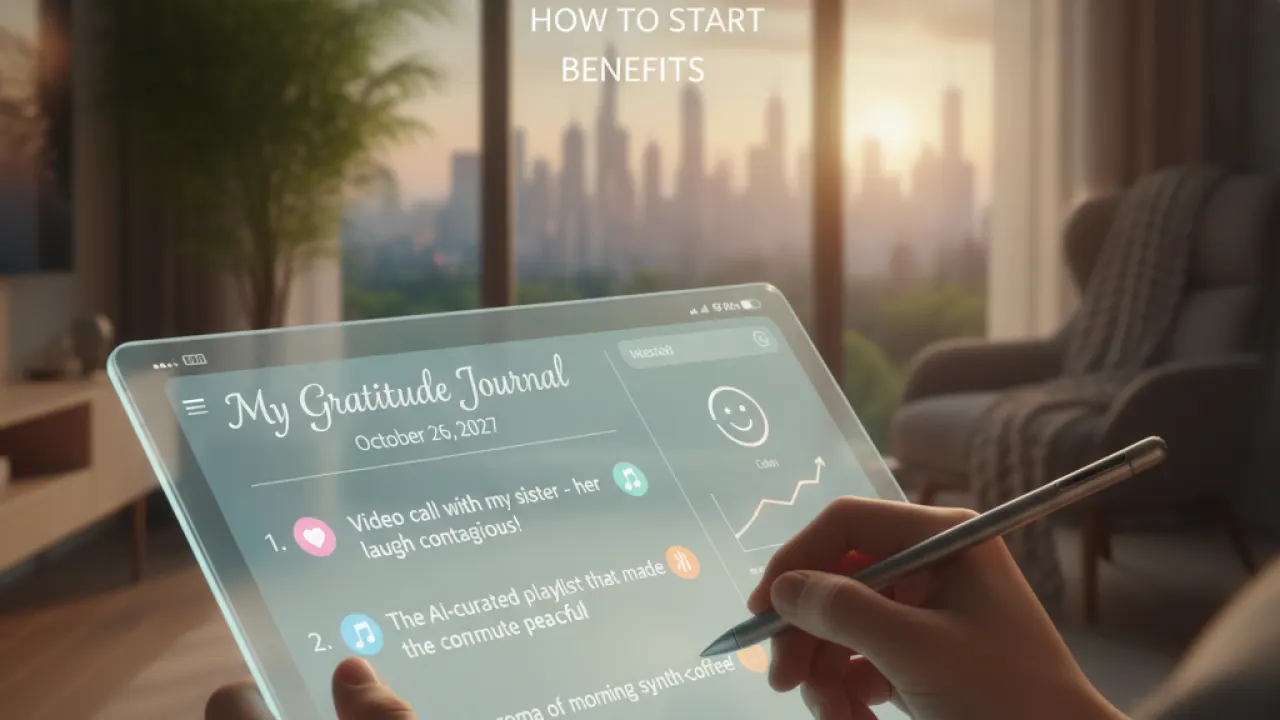
Gratitude journaling is one of the most studied formats for how to start journaling in 2027 for wellbeing. Writing three specific things you are grateful for each day, with a brief explanation of why you are grateful for each, produces measurable improvements in mood and life satisfaction over time. Specificity is what makes gratitude journaling effective. Not ‘I am grateful for my family’ but ‘I am grateful that my daughter called me today when she did not have to.’ The specific version activates emotional processing in a way that generic statements do not.
How to start journaling in 2027 with gratitude: do this at the same time each day, keep entries brief, and focus on what actually happened rather than general life circumstances.
Building the Habit: How to Start Journaling in 2027 and Keep Going
How to start journaling in 2027 is the easy part. How to keep journaling past the first two weeks is where most people need support. These strategies work. For broader insights, exploring practical advice on how to create a vision board that actually works will give you actionable takeaways you can apply right away. For broader insights, exploring practical advice on how to create a vision board that actually works will give you actionable takeaways you can apply right away. For broader insights, exploring practical advice on how to create a vision board that actually works will give you actionable takeaways you can apply right away.
Habit Stacking for How to Start Journaling in 2027
Habit stacking means attaching a new habit to something you already do. How to start journaling in 2027 using habit stacking: if you always make tea in the morning, journal while the kettle boils. If you always spend ten minutes before bed on your phone, replace that with journaling. The existing habit acts as the trigger for the new one. When you learn how to start journaling in 2027 this way, you are not trying to create new time. You are repurposing time that already exists. This works better than trying to find a new slot in an already full schedule.
What to Do When You Miss Days
How to start journaling in 2027 sustainably includes knowing how to handle gaps. Missing two or three days does not undo what you have built. The most common mistake when learning how to start journaling in 2027 is treating a missed day as a reason to quit. Write something the day you return, even if it is only a sentence about why you did not write. Then continue. The overall pattern over months is what matters, not whether every single day is perfect. How to start journaling in 2027 long-term means treating the habit as something you always come back to rather than something you either do perfectly or abandon.
Common How to Start Journaling in 2027 Mistakes to Avoid
How to start journaling in 2027 goes wrong most often in three ways. First, treating the journal as a performance rather than a private space. Your journal does not need to be well-written. It needs to be honest. Second, making the minimum entry too long. Start with two minutes. Build up naturally. Third, focusing only on problems. How to start journaling in 2027 effectively means capturing the full range of your experience, including what went well. A journal that only records difficulties reinforces negativity rather than helping you move through it.
What is stopping you from starting a journaling habit in 2027, and what would you write about first if you picked up a pen right now? Share it in the comments below.
Types of Journaling That Work in 2027
Gratitude journaling has the strongest research backing of any journaling format in 2027. Writing three specific things you are grateful for each day, with a brief explanation of why each matters, produces measurable wellbeing improvements within two to three weeks. The key is specificity. Grateful for a specific conversation is more effective than grateful for friends in general. Specificity activates emotional processing that abstractions do not. Many readers who study this area also benefit from detailed breakdown of goal setting methods that actually work to ensure all key factors are covered. Many readers who study this area also benefit from detailed breakdown of goal setting methods that actually work to ensure all key factors are covered. Many readers who study this area also benefit from detailed breakdown of goal setting methods that actually work to ensure all key factors are covered.
Reflective journaling for problem-solving is one of the most practically useful applications in 2027. Writing about a difficult situation creates psychological distance that improves your ability to see options. Externalising thoughts onto paper allows you to evaluate them more objectively than when they circulate entirely in your head. Many people find that journaling reveals solutions to problems they had been mentally circling for days.
Stream of consciousness journaling, writing continuously for a set time without editing, serves a different function. It clears mental clutter, processes emotions and surfaces thoughts that habitual self-editing prevents from appearing. Morning pages, three pages of longhand writing first thing in the morning, is the most widely known version of this approach and works particularly well during periods of creative block or high stress.
Five to fifteen minutes of daily journaling in 2027 is sufficient to produce documented benefits. The consistency of a five-minute daily practice vastly outperforms an occasional hour-long session for psychological benefit. Connect journaling to an existing habit, immediately after morning coffee or just before sleep, rather than trying to find new time in an already full day.
For related wellbeing guidance, see our journaling for mental health guide, our mindfulness guide and our self-care routine guide. Also see our daily habits guide for building the journaling habit alongside other positive practices.
What type of journaling has been most useful to you in 2027 and how long did it take before you noticed a genuine shift? Share in the comments below.
One of the most consistent findings about starting a journaling practice in 2027 is that the hardest part is the blank page at the beginning. The solution is to give yourself a prompt rather than starting from nothing. Questions like what am I thinking about most today, what went well and what would I change, and what do I want to be different about tomorrow give you something specific to respond to.
Once you are responding rather than initiating, the journaling flows more naturally. Over time, you will develop your ow n starting points that work for your specific journaling needs in 2027. The process from prompted to free-form journaling is one of the most satisfying aspects of building a consistent practice.
Frequently Asked Questions
What is the most important thing to understand about how to start journaling in 2027?
The fundamentals matter most. Before diving into advanced strategies or techniques, making sure you have a solid grasp of the core principles saves time and prevents common mistakes. Starting with quality sources of information, whether from books, courses, or established experts, gives you the knowledge foundation needed to make good decisions and avoid pitfalls that most beginners encounter.
How long does it take to get good at how to start journaling in 2027?
Progress depends on your starting point, how much time and focus you commit, and the complexity of what you are trying to achieve. Most people see meaningful progress within 3 to 6 months of consistent, focused effort. Reaching an expert level typically takes several years of dedicated practice and ongoing learning. The key is consistent application over time rather than intensive bursts followed by long breaks.
What resources are most helpful for learning about how to start journaling in 2027?
The best resources vary by topic, but a combination of well-reviewed books, reputable online courses, expert communities, and practical hands-on experience typically produces the best results. Look for resources from authors and instructors with verifiable track records. Communities of practice where you can ask questions and get feedback from experienced practitioners are particularly useful.
What are the most common mistakes people make with how to start journaling in 2027?
The most universal mistakes include trying to learn everything at once rather than mastering basics first, giving up before seeing meaningful results, not tracking progress to stay motivated, failing to learn from mistakes and adjust approaches, and not seeking help from those who have already succeeded. Patience and persistence combined with smart, focused effort typically outperform raw talent without discipline.
What are your thoughts on how to start journaling in? Have you tried any of these steps, or do you have tips of your own to share? Leave a comment below and share this guide with friends or colleagues who might find it helpful.