

Now Reading: NHS Salary UK 2026: Pay Bands and Roles Explained
-
01
NHS Salary UK 2026: Pay Bands and Roles Explained

NHS salary UK 2026 explained. All Agenda for Change pay bands, nurse salaries, doctor pay, consultant earnings and London weighting explained.
NHS salary rates in the UK for 2026 cover one of the largest workforces in the world. The NHS employs over 1.5 million people in England alone, across hundreds of different roles from healthcare assistants to consultants. This guide covers the NHS pay bands, current salaries for the most common roles, and how NHS pay progression works.

How NHS Pay Works: Agenda for Change
Most NHS staff in England, Wales, and Northern Ireland are paid according to the Agenda for Change pay framework. This system uses numbered bands from 1 to 9, with each band covering a range of roles at a similar skill and responsibility level. Within each band, there are incremental pay points that staff progress through based on years of service and satisfactory performance.
Medical staff including doctors and dentists are paid on separate pay scales. Doctors in training follow the doctors and dentists pay review body recommendations. Consultants are paid on a separate consultant pay scale. Senior managers and executives may be paid on local arrangements outside the standard framework.
Scotland has its own NHS pay arrangements through NHS Scotland, which generally follow a similar structure but with some differences in specific rates and allowances.
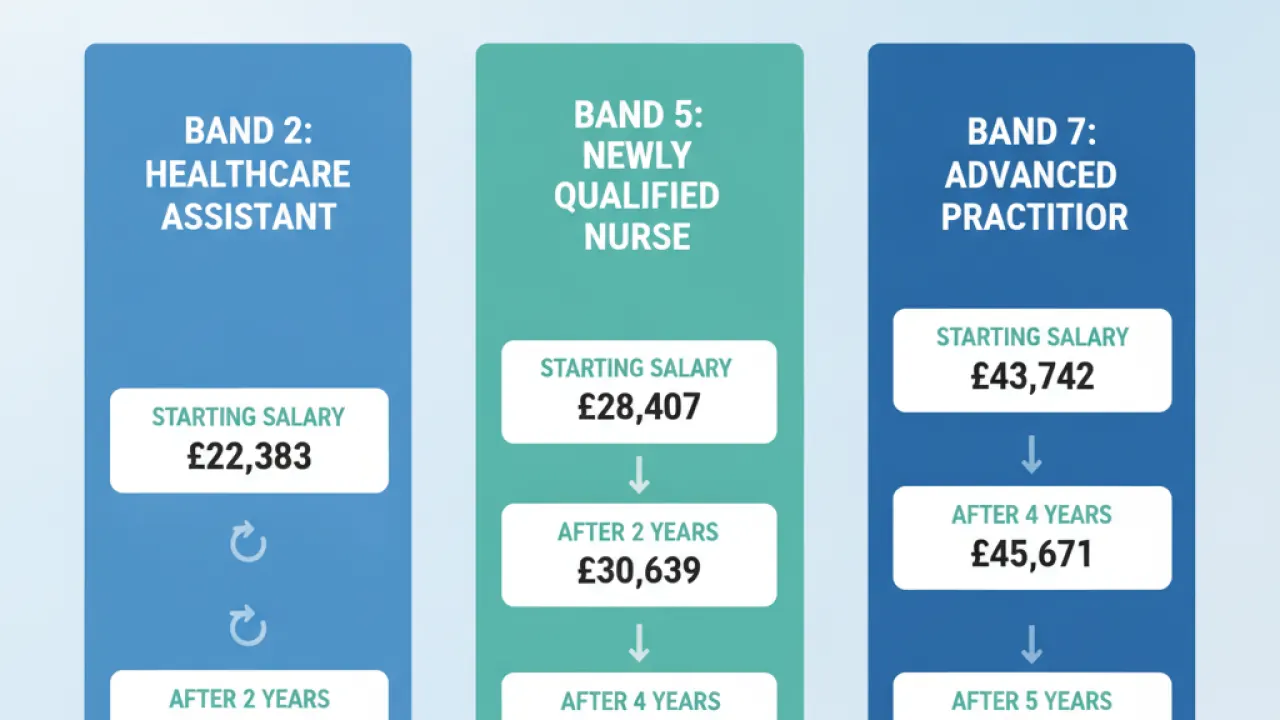
NHS Pay Bands and Salaries 2026
Band 1 – Approximately £23,000 to £24,000
Band 1 covers the most entry-level support roles in the NHS. In practice, very few Band 1 roles exist following changes to the framework that absorbed many into Band 2.
Band 2 – Approximately £23,000 to £24,500
Band 2 covers healthcare assistants, porters, catering staff, administration assistants, and other support roles. This is the entry point for many people who begin their NHS career.
Band 3 – Approximately £24,500 to £26,500
Band 3 covers senior healthcare assistants, receptionists with more responsibilities, and certain specialist support roles. Some phlebotomists work at this band.
Band 4 – Approximately £26,500 to £29,000
Band 4 covers assistant practitioners, pharmacy technicians in some trusts, and higher-level administrative roles including medical secretaries with significant responsibilities.
Band 5 – Approximately £29,000 to £36,000
Band 5 is where newly qualified registered nurses, midwives, physiotherapists, radiographers, and many other qualified healthcare professionals start their NHS careers. This band also covers many IT and administrative management roles. Pay progression through Band 5 takes several years.
Band 6 – Approximately £37,000 to £43,000
Band 6 covers senior or specialist practitioners. Experienced nurses with specialist qualifications, senior radiographers, senior physiotherapists, and team leaders often work at Band 6. This is a significant step up in both responsibility and pay.
Band 7 – Approximately £44,000 to £51,000
Band 7 covers advanced nurse practitioners, nurse consultants in certain specialties, senior pharmacists, team managers, and other senior clinical and professional roles. Many NHS professionals aspire to reach Band 7 during their career progression.
Band 8 – Approximately £54,000 to £97,000
Band 8 is divided into four sub-bands (8a, 8b, 8c, 8d). It covers senior managers, directors of nursing, consultant allied health professionals, and senior operational managers. Pay at the top of Band 8 reflects significant responsibility.
Band 9 – Approximately £100,000 to £115,000
Band 9 covers the most senior non-medical managers and directors. Executive directors of NHS trusts are sometimes paid at Band 9 or above.

NHS Doctor and Consultant Salaries UK 2026
Medical staff follow separate pay arrangements:
- Foundation Year 1 doctor – approximately £32,000 to £37,000
- Foundation Year 2 doctor – approximately £38,000 to £43,000
- Core training and specialty trainee – approximately £45,000 to £65,000 depending on grade
- Specialty doctor – approximately £52,000 to £88,000
- NHS consultant – approximately £105,000 to £140,000 on the standard scale
- GP salary – approximately £70,000 to £120,000 depending on seniority and list size
NHS London Weighting
Staff working in London receive a High Cost Area Supplement on top of their standard Agenda for Change salary. The Inner London supplement adds approximately £5,000 per year. Outer London adds approximately £3,900. This reflects the significantly higher cost of living in London compared to most of the rest of the country.
NHS Pension
The NHS Pension Scheme is one of the most valuable benefits of working for the NHS. It is a defined benefit scheme, meaning your pension is based on your salary and years of service rather than investment performance. The employer contribution to the NHS pension is around 20 percent of salary, which represents a substantial additional element of the total remuneration package.
For related guides, read our articles on how to be a better person, how to eat clean, best businesses to start, and how to start an online business.
NHS Pay Negotiations and Recent Changes
NHS pay has been the subject of significant national debate in recent years. Following the pandemic, widespread industrial action by nurses, junior doctors, and other NHS staff led to protracted pay negotiations between NHS employers and trade unions including the Royal College of Nursing (RCN), the British Medical Association (BMA), and Unison.
The 2024 and 2025 agreements resulted in above-inflation increases for most NHS staff, funded by a combination of the Treasury and NHS efficiency savings. In 2026, NHS pay is set by recommendations from the NHS Pay Review Body for Agenda for Change staff, and by the Doctors and Dentists Review Body (DDRB) for medical staff. These independent bodies make annual recommendations that the government chooses to implement in full, implement partially, or reject, though rejection of recommendations typically leads to industrial action.
NHS Pay in Scotland, Wales, and Northern Ireland
NHS pay arrangements vary between the four UK nations:
- Scotland – NHS Scotland follows its own pay framework, negotiated between NHS employers and trade unions including the Scottish BMA and RCN Scotland. Pay settlements have often differed slightly from the England arrangements
- Wales – NHS Wales follows the Agenda for Change framework but sometimes with different implementation dates or slight variation in the agreed increases
- Northern Ireland – NHS Northern Ireland also follows Agenda for Change but has at times lagged behind England in implementing increases during periods without a functioning devolved government
The differences in pay between NHS nations are generally small but matter to staff who work near borders or are considering moving between nations. In practice, most clinical roles pay within a few hundred pounds of each other across England, Scotland, Wales, and Northern Ireland at equivalent bands.
NHS Benefits Beyond Salary
The salary figures for NHS roles only tell part of the story. The NHS employment package includes several benefits that add significantly to the total value of working for the service:
- NHS Pension Scheme – the defined benefit pension is one of the most valuable employer benefits in the UK. The current NHS pension scheme for 2015 members pays 1/54th of your average salary for each year of membership. With employer contributions of approximately 20 percent of salary going into the scheme, the pension represents a very substantial element of total reward
- Annual leave – NHS staff receive 27 days annual leave plus bank holidays, rising to 33 days after 10 years of service
- Occupational sick pay – most NHS staff receive full pay for up to six months of sickness absence and half pay for a further six months, which is significantly more generous than statutory sick pay
- Maternity and paternity leave – NHS maternity pay is among the most generous of any UK employer, with full pay for the first eight weeks, reducing to 50 percent for the following 18 weeks
- Career development – NHS staff have access to funded training, CPD allowances, and structured career progression pathways
- NHS discounts – a wide range of retail, restaurant, and leisure discounts are available to NHS staff through schemes like Health Service Discounts and NHS Discount Offers
Bank and Agency Work in the NHS
Beyond substantive NHS employment, many healthcare professionals supplement their income through NHS bank work or agency shifts. NHS bank work means working extra shifts for the same NHS trust at set hourly rates, typically around 30 to 50 percent above the standard Agenda for Change equivalent hourly rate. Agency work through healthcare staffing agencies can pay even higher rates per hour, particularly for specialties in high demand, though agency workers do not receive NHS employment benefits and must manage their own tax and National Insurance arrangements.
Some NHS nurses, therapists, and doctors earn significant additional income through bank and agency work on top of their substantive salary. This can add £5,000 to £20,000 or more per year to the base salary, depending on the number of extra shifts worked and the specialty involved.
Private Sector Healthcare Pay vs NHS in UK
How does NHS pay compare to the private healthcare sector? The comparison is complex and depends heavily on the role and the specific private sector employer:
- For consultants, private practice can add very substantially to NHS consultant pay. A consultant who does two or three private sessions per week can double or triple their NHS income through private patient fees
- For nurses, private hospitals typically pay Band 5 equivalent rates similar to the NHS but without the NHS pension, which makes the total package lower overall
- For GPs, private GP services and occupational health roles can pay £120 to £200 per hour for experienced doctors
- For allied health professionals like physiotherapists and radiographers, private sector pay is often slightly higher per hour but with fewer benefits and less job security
How to Progress Through NHS Pay Bands
Progression through NHS pay bands follows a structured path. Within your current band, you progress annually through incremental pay points provided your manager confirms satisfactory performance. Once you reach the top of your current band, your pay does not increase unless you apply for and are appointed to a role in a higher band.
Moving up a band requires either applying for a promoted post when one becomes available or demonstrating that your current role has grown in scope and responsibility to justify a higher band. The latter process, known as banding review or job evaluation, can be contentious and varies significantly between NHS trusts. Many NHS staff underestimate the importance of keeping their job description current and documenting their expanded responsibilities, which are essential for a successful banding review.
NHS Salary FAQs
Do NHS nurses earn enough to live on in the UK?
This depends heavily on where you live. A Band 5 newly qualified nurse on approximately 29,000 pounds can live reasonably in most parts of England, Wales, Scotland, and Northern Ireland. In London, even with the weighting allowance, many nurses report finances are extremely tight due to rental costs. The Royal College of Nursing has campaigned for higher starting salaries, citing recruitment difficulties caused by affordability challenges in major cities.
Can NHS staff receive pay rises outside the Agenda for Change process?
There are limited ways. Incremental progression through pay points within a band happens automatically each year. Moving to a higher band through promotion provides a step increase. Some specialist or hard-to-fill roles carry recruitment and retention premia as additional payments on top of the standard band rate. These are approved locally by NHS trusts and are not universally available.
Is NHS pay taxed the same as other employment income?
Yes. NHS salary is taxed through the PAYE system exactly the same as any other employment income. Income tax at standard UK rates and National Insurance are deducted before you receive your pay. Pension contributions are also deducted through payroll. The NHS pension employee contribution rate in 2026 ranges from 5.1 to 13.5 percent depending on salary level.
Do you work for the NHS and would like to share your experience of the pay system? Or are you considering a career in the NHS and have questions about pay progression? Leave a comment below and join the conversation.