

You don’t need a professional trainer to teach your dog basic commands. Most dogs can learn sit, stay, come, down, and leave it in a few weeks if you train consistently and use the right method. The key is short sessions, clear signals, and rewards that actually motivate your dog.
This guide walks you through how to train your dog at home step by step. It covers the five commands every dog should know, how to handle common mistakes, and what to do when progress stalls. For more background, see Wikipedia reference.
Why Home Training Works
Professional dog trainers are useful, but they’re not required for basic obedience. What matters most isn’t where training happens, it’s how consistent it is. A dog that gets clear, repeated signals from their owner at home learns faster than a dog that only gets training once a week in a class.
The AKC (American Kennel Club) and the RSPCA both recommend positive reinforcement as the most effective and humane training method. That means rewarding the behavior you want, not punishing the behavior you don’t. It works with every breed and every temperament.
Home training also strengthens your bond with your dog. When they learn that listening to you leads to good things, they start paying more attention to you generally, not just during training sessions.
Before You Start: What You Need
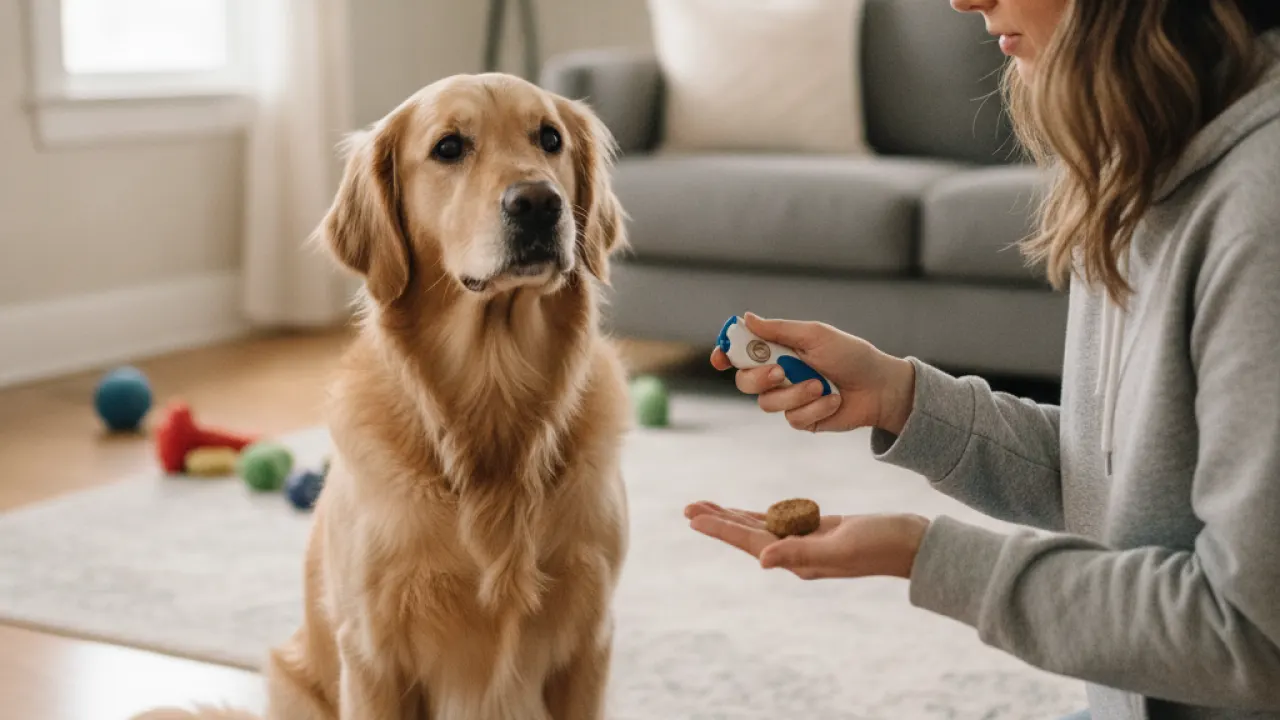
You don’t need much equipment. A bag of small, soft training treats, a quiet space with few distractions, and five to ten minutes a day is enough to get started.
Choose the Right Treats
The treat needs to be something your dog actually wants. Plain kibble works for some dogs. For others you need something higher value, like small pieces of chicken, cheese, or commercial training treats. If your dog is not very food-motivated, a short game with a toy or a moment of praise can work instead.
Keep treats small. About the size of a pea is ideal. You might give 20 to 30 treats in a single session, so they need to be low calorie or you’ll overfeed.
Pick the Right Time and Place
Train when your dog is calm and alert, not right after a long run when they’re exhausted, and not when they’re overstimulated by guests or other animals. A quiet room with the door closed is better than the garden at the start, because gardens have too many interesting smells and distractions.
Keep Sessions Short
Dogs learn better in short bursts. Five minutes per session, two or three times a day, is more effective than a single 30-minute session. End every session on a win. Ask for something you know they can do, give them the treat, and stop there.
The 5 Basic Commands to Teach First
These five commands form the foundation of a well-behaved dog. Learn them in this order because each one builds on the previous.
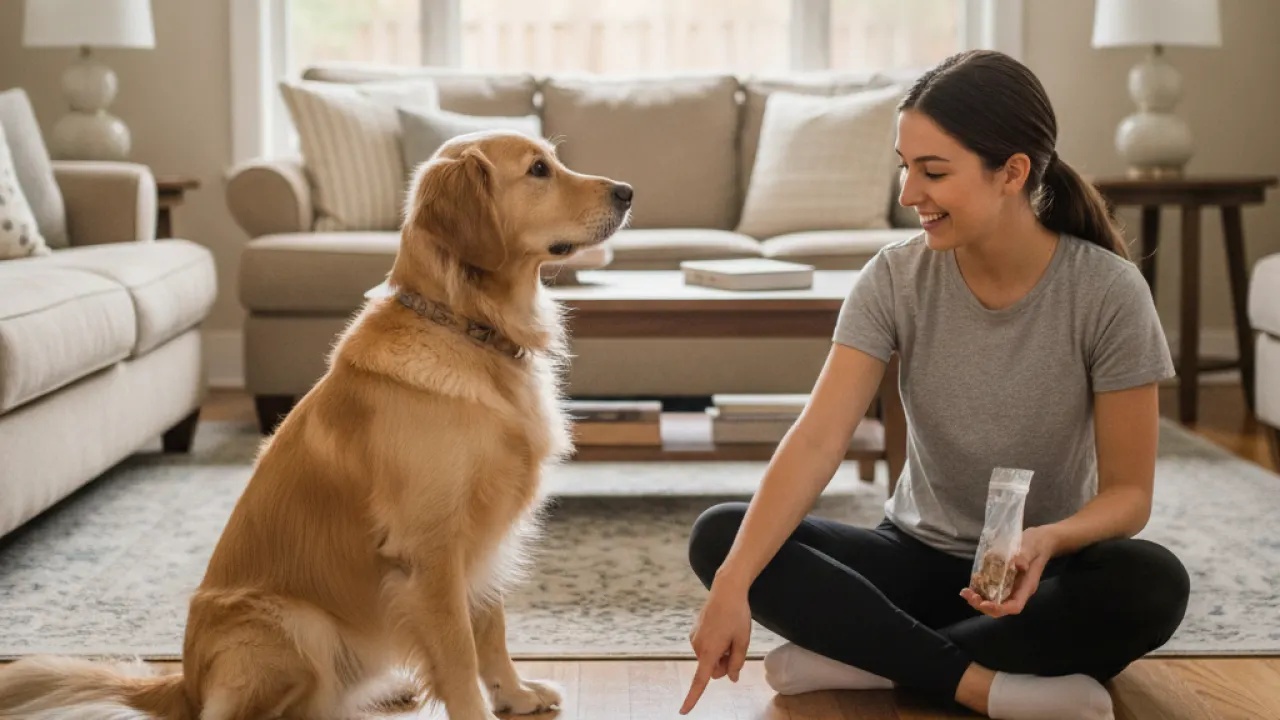
1. Sit
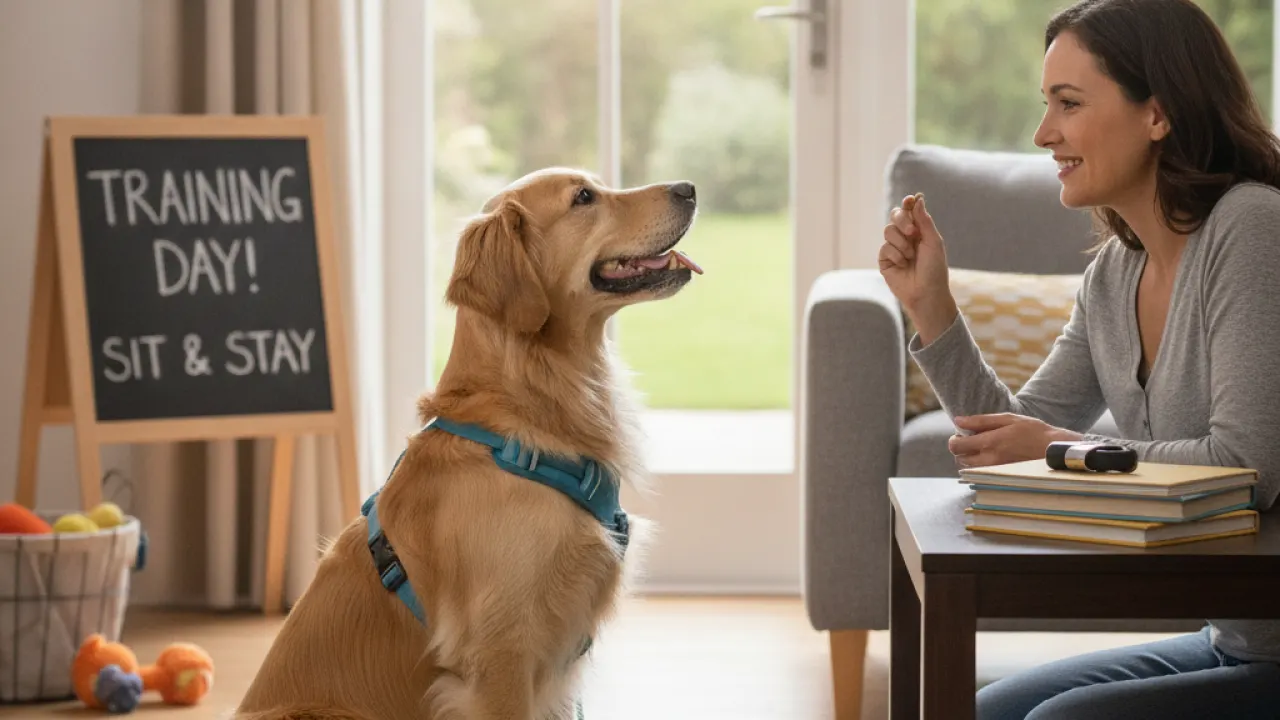
Sit is the easiest command to start with. Hold a treat close to your dog’s nose, then slowly move your hand up. Their bottom will naturally lower as they follow the treat with their eyes. The moment they sit, say “sit” clearly, give the treat, and praise them.
Repeat this five to ten times per session. After a few sessions, most dogs will start sitting on the verbal cue alone, without needing to see the treat first. If you are looking to expand your knowledge, reading our complete guide to the best family dogs provides useful background context. If you are looking to expand your knowledge, reading our complete guide to the best family dogs provides valuable background context.
2. Stay
Once your dog knows sit, add stay. Ask them to sit, open your palm toward them, and say “stay.” Take one step back. If they hold the sit for even two seconds, return to them and reward. Don’t call them to you for the reward at first, go back to them instead. This teaches them that staying put is what earns the treat.
Gradually increase the distance and duration over multiple sessions. Never increase both at the same time. Add distance first, then increase how long they hold it.
3. Come
A reliable recall is the most important safety command your dog can learn. Crouch down, open your arms, and say “come” in an excited, happy voice. When they reach you, reward heavily. This command should always be associated with something great happening.
Never call your dog to come and then do something they dislike, like bathing or nail trimming. If you need to do those things, go to your dog instead. A contaminated recall command is very hard to fix.
4. Down
Hold a treat near your dog’s nose, then slowly move it down to the ground between their front paws. As they follow the treat down, their elbows and belly should lower to the floor. The moment they’re fully down, say “down,” give the treat, and praise them.
Down takes a bit longer than sit for most dogs because it puts them in a more vulnerable position. Be patient and don’t push them physically.
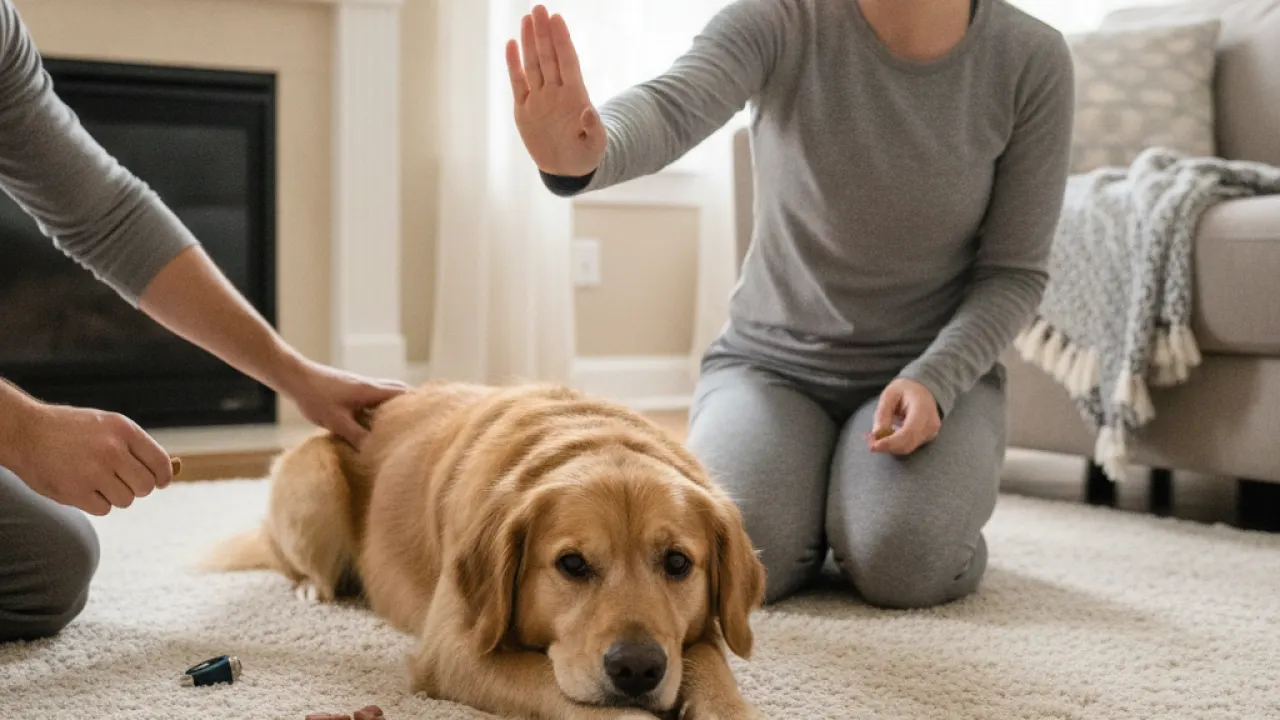
5. Leave It
Leave it prevents your dog from picking up things they shouldn’t, whether that’s food on the ground, a sock, or something potentially dangerous. Place a treat in a closed fist and present it to your dog. They’ll sniff, lick, and paw at your hand. Wait. The moment they stop and pull away, say “leave it” and reward them with a different treat from your other hand.
The key is always rewarding from the other hand, not from the one they left alone. That teaches them that leaving something leads to something better, which is what the command is built on.
How Positive Reinforcement Actually Works
Positive reinforcement means adding something good immediately after a behavior to make that behavior more likely to happen again. The timing is critical. The reward must come within one to two seconds of the behavior, or your dog won’t connect the two things.
Many people use a marker to bridge the gap between behavior and reward. A clicker or a short word like “yes” works as the marker. You click or say “yes” the instant the behavior happens, then deliver the treat. This precision speeds up learning noticeably.
What Not to Do
- Don’t repeat commands multiple times if your dog doesn’t respond. Ask once, help them succeed with a lure, then try again
- Don’t train when you’re frustrated because dogs read your mood and training becomes stressful
- Don’t use punishment for getting a command wrong. Just withhold the treat and try again
- Don’t skip rewards too early by assuming the dog knows the command before they’ve really got it
- Don’t train for too long in one go. Mental effort tires dogs out faster than physical exercise
- Don’t move too fast to harder commands before the basic ones are solid
Training Different Breeds and Temperaments
Different breeds have different learning styles. Working breeds like border collies, German shepherds, and Labrador retrievers tend to pick up commands fast and enjoy the mental challenge of training. Scent hounds like beagles get distracted by their noses. Terriers are independent and may need more patience.
That said, breed is not destiny. Individual temperament matters more than breed generalizations. A laid-back golden retriever might be slower to engage than a motivated rescue of unknown mix. Read your dog, not the breed stereotype. Similar principles apply when reviewing practical advice on how to choose the right dog breed for your family, where preparation and research make a noticeable difference. Similar principles apply when reviewing practical advice on how to choose the right dog breed for your family, where preparation and research make a noticeable difference.
Socialization Alongside Training
Training commands in isolation isn’t enough. Dogs also need socialization: exposure to different people, environments, sounds, and other animals in a positive way. A well-trained dog who panics at loud noises or other dogs is only partially prepared for the world.
Introduce new environments and experiences gradually, at a pace your dog is comfortable with. Forcing a fearful dog into overwhelming situations makes it worse. Go slowly and let them build confidence.
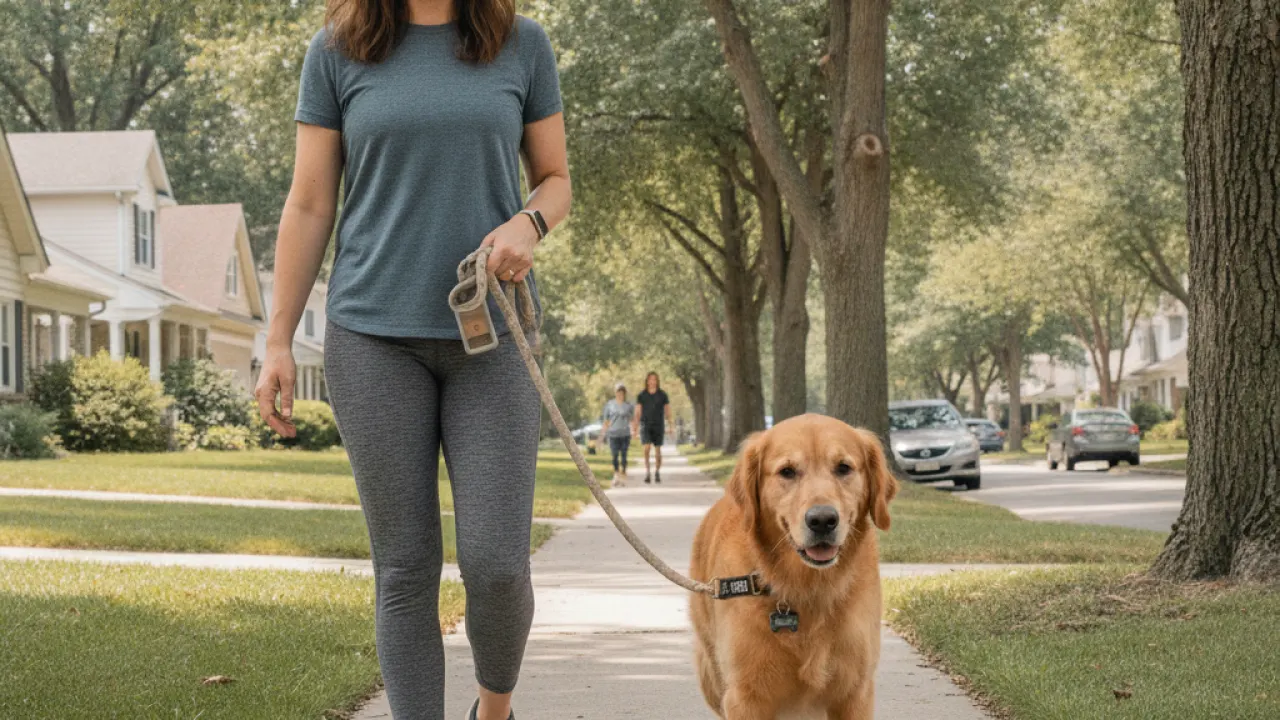
Teaching Loose Leash Walking
Pulling on the leash is one of the most common complaints from dog owners. Dogs pull because walking faster gets them to the interesting smells faster. Teaching loose leash walking requires changing that equation.
Start in a low-distraction environment. When your dog pulls, stop completely. Don’t move forward until the leash is loose. The moment they return to your side or the leash loosens, start walking again and reward them. It’s slow at first but dogs figure out quickly that pulling stops all progress.
Reward your dog frequently for walking beside you. Don’t wait for them to pull and then stop. Reward the good behavior proactively while it’s happening.
Common Problems and How to Handle Them
My Dog Won’t Focus During Training
If your dog keeps looking away or seems uninterested, the environment may be too distracting, the treats may not be motivating enough, or the dog may be tired. Move training indoors, use a higher value treat, or try a different time of day.
My Dog Knows the Command Indoors But Not Outside
This is very common. Dogs don’t generalize well. Learning something in one environment doesn’t automatically transfer to a different one. Practice each command in multiple locations, starting with low distraction and building up. Each new environment is like starting from scratch, but it goes faster each time.
Progress Has Stalled
If your dog was progressing and has stopped, you may have moved too fast. Go back a few steps to where they were succeeding confidently, then build up again more slowly. Regression is normal and doesn’t mean something is wrong.
Building Beyond the Basics
Once your dog has solid sit, stay, come, down, and leave it, you can build on them. Off, place, wait, and heel are all natural next steps. You can also teach practical behaviors like ringing a bell to go outside, bringing their bowl at meal times, or putting toys away.
- Off teaches the dog not to jump on people, built on the same reward principles
- Place sends the dog to a specific spot like a mat or bed and holds them there
- Wait is a shorter, less formal version of stay used at doors and curbs
- Heel is a formal walking position, useful in busy environments
- Drop it teaches the dog to release something they’ve already picked up
- Name recognition is the first thing to teach before any command
- Trick training like shake, spin, or roll over builds on the same mechanics and keeps dogs mentally engaged
Frequently Asked Questions
What is the
The how to train your dog at home is a structured approach designed to give clear, actionable steps that produce reliable results over time.
How do I start with the
Begin with the foundation steps, focus on consistency, and build intensity gradually as the plan progresses.
How long does the how to train your dog at home take to work?
Most people notice initial improvements within a few weeks, with more meaningful results appearing after 8 to 12 weeks of consistent effort.
Is the how to train your dog at home suitable for beginners?
Yes. The how to train your dog at home is designed to be accessible, with progressions and modifications that let anyone start at their current level.
What are the main mistakes to avoid with the
Common mistakes include skipping the foundation phase, expecting overnight results, and not tracking progress consistently.
How Long Does It Take to Train a Dog at Home
Most dogs can learn the five basic commands within four to six weeks of consistent daily training. That’s assuming five-minute sessions two to three times a day. Puppies often pick things up faster because they have no bad habits to unlearn. Older dogs take a bit longer but learn just as well.
The mistake most people make is inconsistency. Training three times one week and then skipping the next two weeks means starting over. Short and regular beats long and infrequent every time.
A well-trained dog is easier to live with, safer in public, and less likely to develop behavioral problems from boredom or anxiety. The time you put in early pays off for the entire life of the dog.
What’s the first command you’re planning to work on, and what’s your dog’s biggest distraction during training? The how to train your dog at home works when you follow it consistently. For broader insights, exploring our complete guide to the best dogs for first-time owners will give you actionable takeaways you can apply right away. For broader insights, exploring our complete guide to the best dogs for first-time owners will give you actionable takeaways you can apply right away.
For related reading, see our guides on Home Workout Plan for 2026, 8 Easy Vegetables to Grow at Home for First-Time Gardeners, 100+ Gender Neutral Names for Your Baby, Artistic Gymnastics Olympics Tickets, Buy Your First Home in 2026.
Common questions about the how to train your dog at home
People often ask whether the how to train your dog at home works for complete beginners. It does, because every step can be adjusted to match your current level. Start where you are, not where you think you should be.
Another common question is how much time the how to train your dog at home takes each day. Most people spend between twenty and forty minutes on the core steps. That is enough to make progress without taking over your schedule.
Some readers wonder if they need expensive tools or subscriptions. In most cases, the how to train your dog at home works with
Consistency is the factor that separates people who get results from people who stay stuck. Missing one day is fine. Missing three days in a row is where momentum breaks. This guide shows you how the how to train your dog at home fits real life.
ne day is fine. Missing three days in a row is where momentum breaks.Tracking progress is another habit that helps. Write down what you did, how it felt, and any small wins. Those notes become proof that the how to train your dog at home is working, especially on days when motivation is low.
Finally, remember that the how to train your dog at home