


Most people want to get more done. But working longer hours isn’t the answer. The real difference comes from how you work, not how much. These productivity hacks are simple, tested, and they work for real people with real jobs.
According to Wikipedia on time management, effective time management techniques have been studied since the early 20th century and form the basis of modern productivity systems
You don’t need a fancy system or a new app. You need a few good habits that stick. Let’s get into them. See also our guide on productive daily habits.
What Are Productivity Hacks and Do They Actually Work?
A productivity hack is any method that helps you get better results in less time. Some are based on psychology. Others come from how top performers structure their days. The best ones are easy to start and don’t require a complete life overhaul.
Yes, they work. But only if you pick the right ones for your situation. What works for a freelancer working from home may not work for someone in an office. The key is to try a few and keep what fits. See also our guide on staying productive without motivation.
The Pomodoro Technique: Work in Focused Bursts – Productivity Hacks

The Pomodoro technique is one of the most popular productivity hacks because it’s simple and it works fast. Here’s how it goes: See also our guide on eating clean for beginners.
- Set a timer for 25 minutes and work on one task only.
- Take a 5-minute break when the timer goes off.
- Repeat four times,</stro
Why does it work? It removes the pressure of working for hours on end. You know a break is coming, so it’s easier to stay focused. It also forces you to work on one thing at a time, which means fewer mistakes and faster progress. See a
You can use a basic kitchen timer or a free app like Focus Keeper or Pomofocus. The tool doesn’t matter. The discipline does. See also our guide on gym membership costs in the UK.
to stay focused. It also forces you to work on one thing at a time, which means fewer mistakes and faster progress.You can use a basic kitchen timer or a free app like Focus Keeper or Pomofocus. The tool doesn’t matter. The discipline does. If you are looking to expand your knowledge, reading our complete guide to the best productivity apps for students and professionals provides useful background context. If you are looking to expand your knowledge, reading our complete guide to the best productivity apps for students and professionals provides valuable background context.
When the Pomodoro Doesn’t Fit
Not every job suits 25-minute blocks. If you’re doing deep creative work or coding, you might need longer stretches. In that case, try 50-minute work sessions with 10-minute breaks. The ratio matters more than the exact minutes.
Plan Your Day the Night Before

Plan Your Day the Night Before One of the most effective productivity hacks costs nothing and takes five minutes. Before you go to bed, write down the three most important things you need to do tomorrow. Just three. Not ten.
When you wake up, you already know what to do. You don’t waste the first hour of your morning figuring out your day. You get straight to work on what matters most.
This works because your brain processes information while you sleep. When your priorities are written down before bed, your mind quietly works on solutions and approaches overnight. You wake up sharper and more ready than you’d expect.
The MIT Method: Most Important Tasks First

The MIT Method: Most Important Tasks First Pick your top three tasks for the day and call them your MITs: Most Important Tasks. Do these before anything else. Before checking email. Before scrolling. Before meetings if possible.
Most people do easy, low-value tasks first because they feel productive. But those easy tasks rarely move the needle. Your MITs are the ones that actually matter. Do them first when your energy is highest.
Cut Distractions Before They Cut Your Focus
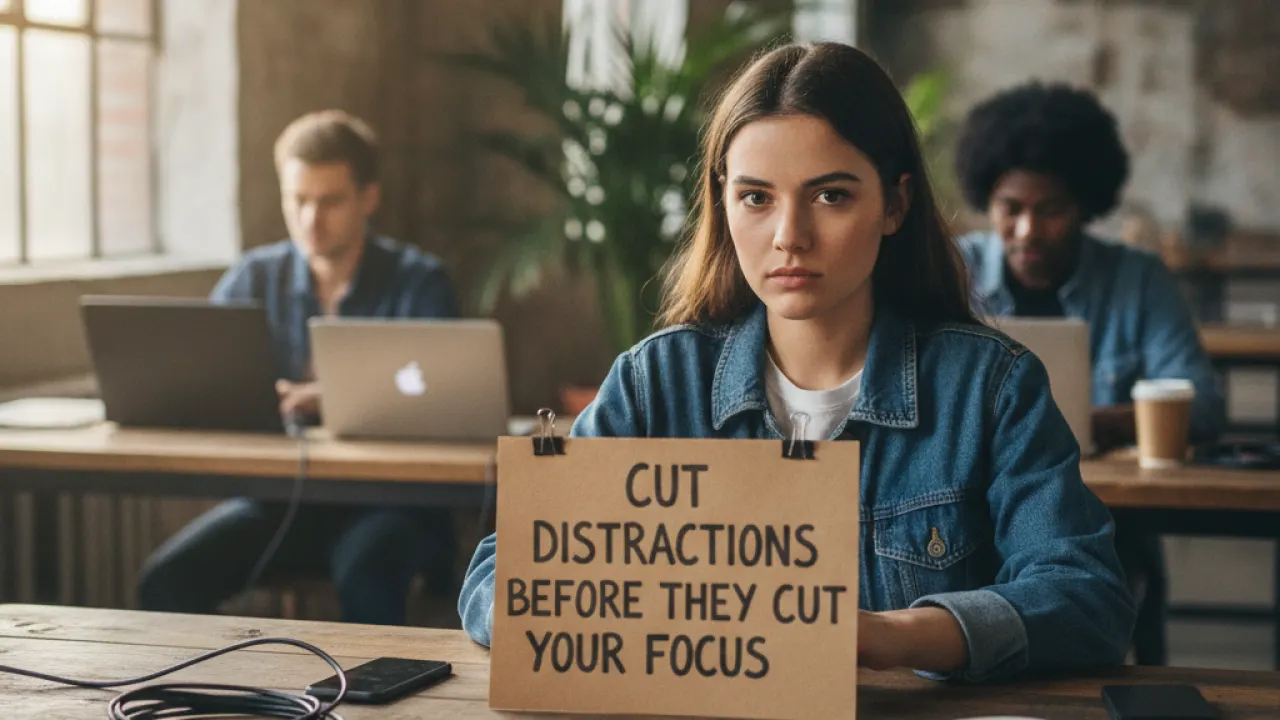
Cut Distractions Before They Cut Your Focus Distractions are the biggest enemy of productivity. A single interruption can cost you 20 minutes of lost focus. You think you got back on track, but your brain takes time to re-engage with deep work.
Here’s what to do:
- Phone notifications: Turn them all off during work blocks. All of them.
- Email: Check it twice a day. Once in the morning, once after lunch. Not constantly.
- Browser tabs: Close every tab that isn’t related to your current task.
- Noise: Use noise-cancelling headphones or play white noise if your environment is loud.
- People: Set clear signals. A closed door or headphones on means you’re in focus mode.
- Social media: Block it during work hours with a tool like Freedom or Cold Turkey.
- Your own mind: Keep a notepad nearby. When random thoughts pop up, write them down and get back to work.
The goal isn’t to eliminate all stimulation. It’s to control when and how you let things in.
The Two-Minute Rule

The Two-Minute Rule If something takes less than two minutes, do it now. Don’t add it to a list. Don’t postpone it. Just do it. This rule comes from David Allen’s Getting Things Done system, and it prevents the buildup of small tasks that pile up and create stress.
Time Blocking: Schedule Your Day Like a Pro

Time Blocking: Schedule Your Day Like a Pro Time blocking means you assign specific blocks of time to specific tasks in your calendar. Instead of a vague to-do list, you know exactly what you’re doing at 10 AM, 1 PM, and 3 PM.
Here’s a simple way to set it up:
- Deep work block: 2-3 hours for your most demanding tasks. Do this in the morning if possible.
- Admin block: 30-60 minutes for email, messages, and small tasks.
- Meeting block: Group all meetings together instead of scattering them through the day.
- Creative block: Set aside time for brainstorming, writing, or planning.
- Buffer block: Leave 30-60 minutes unscheduled for things that come up.
Time blocking works because it removes the constant decision of what to do next. The decision is already made. You just follow the plan.
You don’t need a special tool. Google Calendar or even a piece of paper works fine. The important thing is that you commit to the blocks and guard them. Similar principles apply when reviewing practical advice on how to plan your, where preparation and research make a noticeable difference. Similar principles apply when reviewing practical advice on how to plan your, where preparation and research make a noticeable difference.
Use the 80/20 Rule to Work Smarter
The 80/20 rule says that 80% of your results come from 20% of your efforts. In work terms, a small number of your tasks produce most of your output. The rest is mostly low-value busy work.
To use this as a productivity hack:
- Look at your task list and ask which items actually move things forward.
- Identify the 20% of tasks that create the most impact.
- Do those first and spend the most time on them.
- Delegate, delay, or drop the rest.
This isn’t about being lazy. It’s about being strategic. The people who get the most done aren’t doing more tasks. They’re doing the right tasks.
Take Breaks the Right Way
Skipping breaks feels productive. It isn’t. Your brain has a limited capacity for sustained focus. After 90-120 minutes of hard work, performance drops noticeably. Breaks restore your ability to concentrate.
Good break habits include:
- Short walks: Even five minutes outside resets your focus better than sitting at your desk.
- Hydration: Drink water, not just coffee. Dehydration quietly kills your concentration.
- Eye rest: Look at something 20 feet away for 20 seconds every 20 minutes. It reduces eye strain from screens.
- Light stretching: Loosen your neck, shoulders, and back. Sitting tightens everything.
- No phone during breaks: Scrolling doesn’t rest your brain. It just switches the type of stimulation.
Real breaks mean stepping away from screens and tasks. Five minutes of genuine rest is worth more than 15 minutes of scrolling.
The 90-Minute Ultradian Rhythm

The 90-Minute Ultradian Rhythm Your body naturally cycles through high-focus and low-energy states every 90 minutes. This is called an ultradian rhythm. Work with it by scheduling 90-minute deep work sessions followed by proper breaks. Fighting through low-energy peasks Together – productivity hacks” />
Batch Similar Tasks Together Task switching has a cost. Every time you shift from one type of task to another, your brain needs time to adjust. This is called switching cost, and it adds up fast across a full workday.
Batching means grouping similar tasks and e week in two or three long sessions.
- Do all your administrative work in one morning slot.
- Plan all your weekly meetings on Tuesday and Thursday only.
- Handle all invoicing and financial tasks on one specific day each week.
- Do grocery shopping, errands, and personal tasks in one trip.
- Review and respond to all messages at set times, not on demand.
- Create all social media posts for the week in a single batch session.
- Process all paperwork and filing at one weekly appointment with yourself.
Batching keeps you in the right mental mode for longer. The quality of your output goes up, and so does your speed.
Review Your Day and Improve Each Week
The most productive people aren’t just doing more. They’re getting better at working. A simple daily review takes five minutes and makes a real difference over time.
At the end of each day, ask yourself:
- What did I finish today?
- What didn’t I get to, and why?
- What one thing would have made today better?
Do a longer weekly review on Friday afternoons. Look at what you accomplished, what got pushed back, and what needs attention next week. Then plan your top three priorities for Monday.
This habit compounds over time. You start to see patterns. Maybe you’re most productive in the mornings. Maybe Tuesday afternoons are always slow. Maybe email is eating more time than you thought. Once you see the patterns, you can fix them.
Track Your Time for One Week
Most people are wrong about how they spend their time. They think they work eight focused hours but actually work four, with the rest scattered across distractions. Track your time for one week using a simple tool like Toggl or a paper log. The results are usually eye-opening and immediately actionable.
Build Systems, Not Just Habits

Habits are good. Systems are better. A system is a repeatable process that produces reliable results without relying on motivation. When you have a system, you don’t need to think about what to do next. You just follow the process.
Bu
Over time, systems save huge amounts of mental energy. That energy goes toward actual work instead of figuring out how to work. For broader insights, exploring practical advice on how to create a vision board that actually works will give you actionable takeaways you can apply right away. For broader insights, exploring practical advice on how to create a vision board that actually works will give you actionable takeaways you can apply right away.
Quick Wins: Small Hacks That Add Up

Not every productivity hack needs to be a major change. These small adjustments have an outsized impact when used consistently:
- Use keyboard shortcuts for everything you do repeatedly on a computer.
- Stand during phone calls</stof your workday to your brain.
- Keep your desk clear at the end of each day so you start fresh tomorrow.
- Eat a real lunch away from your desk. It recharges more than eating while working.
- Get moving in the morning. Even a 10-minute walk improves focus and mood for hours.
None of these alone will transform your productivity. But all of them together, used consistently, make a meaningful difference in how much you get done and how you feel at the end of the day.
Frequently Asked Questions
What is the
The productivity hacks is a structured approach designed to give clear, actionable steps that produce reliable results over time.
How do I start with the
Begin with the foundation steps, focus on consistency, and build intensity gradually as the plan progresses.
How long does the productivity hacks take to work?
Most people notice initial improvements within a few weeks, with more meaningful results appearing after 8 to 12 weeks of consistent effort.
Is the productivity hacks suitable for beginners?
Yes. The productivity hacks is designed to be accessible, with progressions and modifications that let anyone start at their current level.
What are the main mistakes to avoid with the
Common mistakes include skipping the foundation phase, expecting overnight results, and not tracking progress consistently.
What to Do Right Now
Don’t try to implement all of these productivity hacks at once. Pick one. Just one. Start with it today and give it a full week before adding anything else. The productivity hacks works when you follow it consistently.
The best candidates for quick results are planning your day the night before, doing your MITs first thing, and turning off notifications during work blocks. These three habits alone can transform how much you get done each day.
Productivity isn’t about doing everything. It’s about doing the right things well. When you get that right, more gets done with l
What’s the one productivity hack you’re going to try first this week? This guide shows you how the productivity hacks fits real life.
one productivity hack you’re going to try first this week?Understanding productivity hacks takes time and practice. The most effective approaches to productivity hacks focus on consistency rather than perfection. People who commit to productivity hack
What has your experience with productivity hacks been? Which tip worked best for you? Share in the comments below. Start with the basics of the productivity hacks and build from there.
What has your experience with productivity hacks been? Which tip worked best for you? Share in the comments below. Many readers who study this area also benefit from detailed breakdown of goal setting methods that actually work to ensure all key factors are covered. Many readers who study this area also benefit from detailed breakdown of goal setting methods that actually work to ensure all key factors are covered.
Common questions about the productivity hacks
People often ask whether the productivity hacks works for complete beginners. It does, because every step can be adjusted to match your current level. Start where you are, not where you think you should be.
Another common question is how much time the productivity hacks takes each day. Most people spend between twenty and forty minutes on the core steps. That is enough to make progress without taking over your schedule.
Consistency is the factor that separates people who get results from people who stay stuck. Missing one day is fine. Missing three days in a row is where momentum breaks. The productivity hacks removes common barriers that stop people from starting.
hat, optional.Consistency is the factor that separates people who get results from people who stay stuck. Missing one day is fine. Missing three days in a row is where momentum breaks.
Tracking progress is another habit that helps. Write down what you did, how it felt, and any small wins. Those notes become proof that the productivity hacks is working, especially on days when motivation is low.
Finally, remember that the productivity hacks